Tag Archive: witches

Secret Salem

By Katherine Howe

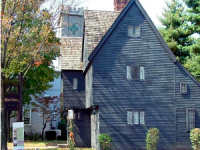
Every year thousands of visitors throng into Salem, Massachusetts, appetites whetted for witches. And witches there are, for in Salem we are experts in witchery: witch hats, witch t-shirts, witch plays, even some real witches thrown in for good measure. Sometimes visitors are puzzled, however, that there aren’t more places to see that are tied to the actual Salem witch trials of 1692. The Witch House, was the home of a real Salem witch judge, and is maintained as a historic house today. But other than that, we find few elements of historical witchery remaining in what is essentially a nineteenth century city. Where did it go?

Salem Town was first founded in the 1620s (its name comes from Salaam, or Shalom, meaning “peace”), and very quickly became one of the busiest and most important seaports in early colonial New England. So busy, in fact, that the rocky sea coast could not produce enough food to support the growing population. As a result, in 1636 an outlying farm region was established, to supply grain and goods for the port town. Initially the region was called Salem Farms, though quickly that name changed to Salem Village.

As we know, it was in Salem Village that the witch crisis first broke out. Salem Village held the meeting house where the most dramatic accusations took place. Salem Village was the home of Rebecca Nurse, Samuel Parris, and the people we remember from the The Crucible. Salem Village had a distinct personality that separated it from Salem Town, and some historians think that these clashing cultures contributed to the panic. Salem Village tried early on to pull away from Salem Town, but was not successful until 1757, when its name was changed to Danvers.

Today, in Danvers, a memorial stands on the ground that once held the Salem Village meeting house, and Rebecca Nurse’s house is maintained as a historic property open in the summertime. True hunters after historical witchery know to look in modern Salem, and also its shadowy neighbor, the secret Salem Village, Danvers.

Katherine Howe is the author of the New York Times bestseller The Physick Book of Deliverance Dane. She is completing a PhD in American and New England Studies at Boston University, and this August (2010), Signet Classics is publishing a new edition of Nathaniel Hawthorne’s The House of the Seven Gables with a new introduction written by Katherine. Read more about the book here.

IMAGE: The Witch House, home of Judge Jonathan Corwin, is the only structure still standing in Salem with direct ties to the Witchcraft Trials of 1692.

Congratulations to the following W & M winners of this book:

Kimberly and Melanie

Witches Go to the Dogs

By Elyssa East

In 1999, forlorn paintings by the American Early Modernist painter Marsden Hartley led me to seek out Dogtown, an isolated colonial ruin on the island tip of Cape Ann, Massachusetts that is believed to be haunted. For over three hundred years Dogtown was a barren expanse whose giant boulders drew comparisons to Stonehenge and Easter Island. Today it is a 3,000-acre woodland, but the mystical, primordial character for which the area has long been known is still palpable.

When I started exploring Dogtown’s wilds, a spectral aura was inescapable. The area’s mystery deepened.

Investigating, I learned that Dogtown’s history abounds in tales of witches, supernatural sightings, pirates, former slaves, drifters, and the many dogs Revolutionary War widows kept for protection and for which the place was named.

When people on Cape Anne began mentioning Dogtown’s “dark time” to me I assumed that they were referring to the Revolutionary War when a group of widows who were later presumed to be witches were visited by a corposant, or glowing ball of light, believed to be the spirits of their husbands who had been lost at sea. But these contemporary Cape Anners were alluding to 1984 when a mentally disturbed local outcast crushed the skull of a beloved schoolteacher as she walked in Dogtown’s woods. Eventually, the story of this murder and Dogtown’s uncanny past started to come together.

Ultimately, what I discovered in Dogtown is one of those rare, enigmatic places where it feels as if history is still alive and casting an undeniably alluring, dark spell.

Elyssa East, author of Dogtown: Death and Enchantment in a New England Ghost Town, received her B.A. in art history from Reed College and her M.F.A. in creative writing from Columbia University’s School of the Arts. Her writing has appeared in The New York Times, Dallas Morning News, and numerous New England regional magazines. She grew up in Georgia and lives in New York City. To read more about her latest book, click here.

IMAGE: An image of Dogtown’s witches from a 1919 Harper’s Monthly article called “The Broomstick Trail”.

Witches and Midwives

By Holly Tucker

Witches can be nasty creatures…and doubly so anywhere near newborns. Just think about the evil fairies in Sleeping Beauty or Snow White. Nothing to trifle with!

If witches and mean fairies seem to be circling baptisms and childbeds in fairy tales, it has a lot to do with the fact that–according to popular legends–they were in need of supplies for their devilish rituals.

According to early-modern writers like Jean Bodin, Cardano, and Della Porta, the fat of newborns was a vital ingredient in magical flying potions. Witches were also said to make candles from an infant’s umbilical cord.

Other byproducts of labor were also reported to have great mystical properties. The placenta was considered by some to be an aphrodisiac and, if eaten, could be used to treat infertility, a practice that the church condemned.

These and other concerns regarding what the midwife-witch might do with human flesh and body fluids motivated regulations in German (Wurzburg, 1555) that clearly specified how the midwife was to dispose of all biological bi-products during the delivery. Morever, frequent laws were passed in France that dictated that only woman of good Catholic faith could help a birthing mother.

Lifted from my Pregnant Fictions: Childbirth and the Fairy Tale in Early-Modern France (p. 67)

Holly Tucker is the Editor of Wonders and Marvels. Read more about Holly here.

IMAGE: London Witches flying on broomsticks from The History of Witches and Wizards, T. Norris, London 1720, Courtesy of the Wellcome Library

Midwives and Witches


by Bronwyn Backstrom (Vanderbilt University)

The ideas of witches and witchcraft have been around for centuries and were hot topics. Witches were typically identified as older single women of lower class. Throughout history, there has been a stereotype that only women, specifically midwives and other women-healers, were witches. Women were targets because of the tradition of misogyny; women’s participation in folk-healing; and changes in the awareness of female nature, their family and economic roles, and ideas of women’s social behavior.


Female witches were accused of three main things: female sexuality (this included every sexual crime against men), organization, and having magical powers (both good and bad) that affected one’s health. Witchcraft was considered to go against the Catholic Church. It was considered a threat to God’s holy order because it was not based on scripture or religion. In addition, all witchcraft was considered based off of carnal lust, or strong sexual desires, with evil spirits.

The Malleus Maleficarum, meaning “Hammer of Witches,” was written in 1484 by two reverends: Heinrich Kramer and James Sprenger. This book contains everything one needs to know about witches and witchcraft at the time, from what defines a witch and how they become one, to the sentences they would receive because of their participation in witchcraft. It also contains information on witch-midwives.

According to Malleus Maleficarum, witch-midwives were considered the most wicked and dangerous witches, who inflicted the greatest injuries. This is because they dealt with the health of others and had easy access to newborn children, who were used in offerings for the evil spirits. Witch-midwives were accused of causing miscarriages; however, if they allowed a child to be born, they would allegedly either feast on the child or offer it to the evil spirits, allowing the witches to infect the child and turn it into a witch.

The evil spirits called the witch-midwives to offer them newborn children for several reasons. One was for their pride. Another was to disguise the act of infidelity as a virtue. By associating children with the evil spirits, the witches drew in more innocent people, making it easier for them to turn into witches. Finally, they used the children to fill their ranks. When the evil spirits infected children at an early age, turning them to witches, they could set them aside to be used in the future as needed.

There was a decline in accusations against women as witches between the 17th and 18th centuries because of the increase in male midwives. Men began to replace women, resulting in fewer women in the field who could be accused of witchcraft.

Image: Heinrich Kramer and James Sprenger. Malleus Maleficarum, 1669. (Courtesy of Wellcome Library, London.)

References:
Brauner, Sigrid. Fearless Wives and Frightened Shrews: The Construction of the Witch in Early Modern Germany. Amherst: University of Massachusetts Press, 1995.

Ehrenreich, Barbara, and Deirdre English. Witches, Midwives, and Nurses: A History of Women Healers. Old Westbury: Feminist Press, 1973.

Kramer, Heinrich, and James Sprenger. Malleus Maleficarum. Trans. Reverend Montague Summers. Manchester: University of Manchester Press, 2007.