Tag Archive: witchcraft

Secret Salem

By Katherine Howe

Every year thousands of visitors throng into Salem, Massachusetts, appetites whetted for witches. And witches there are, for in Salem we are experts in witchery: witch hats, witch t-shirts, witch plays, even some real witches thrown in for good measure. Sometimes visitors are puzzled, however, that there aren’t more places to see that are tied to the actual Salem witch trials of 1692. The Witch House, was the home of a real Salem witch judge, and is maintained as a historic house today. But other than that, we find few elements of historical witchery remaining in what is essentially a nineteenth century city. Where did it go?

Salem Town was first founded in the 1620s (its name comes from Salaam, or Shalom, meaning “peace”), and very quickly became one of the busiest and most important seaports in early colonial New England. So busy, in fact, that the rocky sea coast could not produce enough food to support the growing population. As a result, in 1636 an outlying farm region was established, to supply grain and goods for the port town. Initially the region was called Salem Farms, though quickly that name changed to Salem Village.

As we know, it was in Salem Village that the witch crisis first broke out. Salem Village held the meeting house where the most dramatic accusations took place. Salem Village was the home of Rebecca Nurse, Samuel Parris, and the people we remember from the The Crucible. Salem Village had a distinct personality that separated it from Salem Town, and some historians think that these clashing cultures contributed to the panic. Salem Village tried early on to pull away from Salem Town, but was not successful until 1757, when its name was changed to Danvers.

Today, in Danvers, a memorial stands on the ground that once held the Salem Village meeting house, and Rebecca Nurse’s house is maintained as a historic property open in the summertime. True hunters after historical witchery know to look in modern Salem, and also its shadowy neighbor, the secret Salem Village, Danvers.

Katherine Howe is the author of the New York Times bestseller The Physick Book of Deliverance Dane. She is completing a PhD in American and New England Studies at Boston University, and this August (2010), Signet Classics is publishing a new edition of Nathaniel Hawthorne’s The House of the Seven Gables with a new introduction written by Katherine. Read more about the book here.

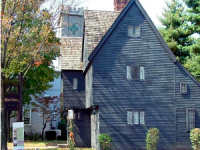
IMAGE: The Witch House, home of Judge Jonathan Corwin, is the only structure still standing in Salem with direct ties to the Witchcraft Trials of 1692.

Congratulations to the following W & M winners of this book:

Kimberly and Melanie

King James I: Demonologist

By Mary Sharratt

Even by the standards of his age,” King James VI of Scotland, later James I of England, stood out as a deeply superstitious man, obsessed with the occult.

Before his reign, witchcraft persecutions had been rare in Britain. But that all changed in 1590 when James personally oversaw the trials by torture for around seventy individuals implicated in the North Berwick Witch Trials, the biggest Scotland had known. Their alleged crime? Raising a storm which nearly sank James’ ship when he sailed home from Norway with his new bride, Anne of Denmark. The trial resulted in possibly dozens of people burned at the stake, although the precise number is unknown.

In 1597, James published Daemonologie, his rebuttal of Reginald Scot’s skeptical work, The Discoverie of Witchcraft, which questioned the very existence of witches. Daemonologie was an alarmist book, presenting the idea of a vast conspiracy of satanic witches threatening to undermine the nation.

In 1604, only one year after James ascended to the English throne, he passed his new Witchcraft Act, which made raising spirits a crime punishable by execution.

James’ ideas on witchcraft were later popularized by Shakespeare’s play Macbeth, performed for James’s court in 1606. For the first time in history, English drama depicted witches gathering in secret for their own malign scheming. According to Instruments of Darkness by James Sharpe, this terror of supposed witch covens was the driving factor mobilizing 17th century witch hunts.

In 1612, the King’s paranoid fantasy of satanic conspiracy, planted in the minds of local magistrates eager to win his favor, culminated in one of the key manifestations of the Jacobean witch-craze—the trials of the Lancashire Witches, accused of plotting to blow up Lancaster Castle with gunpowder. Eight women and two men were executed.

James’s legacy extends even into our age. The King James Bible, completed in 1611, saw the scriptures rewritten to further the King’s agenda. Exodus 22:18, originally translated as, “Thou must not suffer a poisoner to live,” became “Thou must not suffer a witch to live.”

Further reading:

The Lancashire Witches: Histories & Stories, Robert Poole, ed, Manchester University Press, 2002.

Instruments of Darkness: Witchcraft in England, 1550-1750, James Sharpe, University of Pennsylvania Press, 1997.

Mary Sharratt is the author of Daughters of the Witching Hill (Houghton Mifflin Harcourt, April, 2010), a novel based on the true and heartbreaking story of the Pendle Witches of 1612. She lives at the foot of Pendle Hill in Lancashire, England. To read more about her, click here.

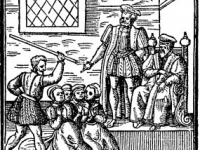
IMAGE: illustration from the original document, The News from Scotland, about the trial of the Witches of North Berwick

Congratulations to the following winners:

DaintyBallerina, Gian T., and Paul M.,

We’ll be in touch real soon!

Friday Marvels


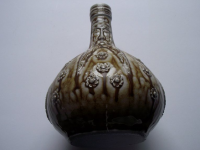
Two articles caught our attention this week. The first was this story about a “
17th-century Urine Filled Witch Bottle.

Apparently, according to the latest issue of British Archeology (and as reported by MSNBC), “this spell device, often meant to attract and trap negative energy, was particularly common from the 16th to the 17th centuries, so the discovery provides a unique insight into witchcraft beliefs of that period.” Looks like we’re not the only ones fascinated with witches!

And from the Wellcome Library for the History of Medicine London comes some thoughtful reflections on a painting by the 19th century Solomon Hart depicting an encounter between Galileo and Milton (Galileo and Jewish Emancipation).

If you haven’t subscribed to the Wellcome’s blog, be sure to do so. The Wellcome Library is a simply magnificent collection for anyone interested in the History of Medicine or early cultural history. For the cooks among us, they also have a great collection of 16th and 17th century cookbooks.

Heads up: there’s a new book out called Galileo Goes to Jail with top-notch articles by many of the most renowned historians of science today. Be sure to have a look.

Image: Courtesy of MSNBC