Tag Archive: susan higginbotham

The Fairest Maiden of Them All: Edward Stafford, Duke of Buckingham

By Susan Higginbotham

“Edward? Good Lord, you did dress him as a girl!”

“Aye . . . He bore his womanhood like a man, you might say.”

Edward Stafford, the third Duke of Buckingham (1478-1521), is mainly known today for finding out the hard way that offending Henry VIII could cost someone his head. Less well known is the episode when the five-year-old Edward—dressed as a girl—was hidden from Richard III’s agents.

Edward’s adventures in cross-dressing began in October 1483 when Edward’s father, Henry Stafford, the second Duke of Buckingham, joined the ill-fated uprising against Richard III known as Buckingham’s rebellion. The enterprise proved fatal to Henry, who died on the scaffold at Salisbury. Before he was captured and executed, however, he had entrusted Edward to Richard Delabeare, who had close ties to the Stafford family. Richard Delabeare later married his servant Elizabeth Mors, whose recollection of this episode was found in the Stafford family papers.

With Henry dead, Richard III began searching for Edward, who proved to be elusive, thanks to Elizabeth. She shaved the lad’s forehead and dressed him in a “maiden’s raiment.” At one point when a search party arrived, Elizabeth fled to a park with Edward, sitting with her no doubt squirming charge for four hours until the danger was past. After that, Elizabeth took Edward to Hereford. Edward made the journey as would a young lady of quality: “rydinge behynde Willm ap Symon asyde upon a Pillowe like a gentelwoman ridde in gentelwomans apperell.” Rather sweetly, Elizabeth concluded her story, “And I wisse he was the fearest gentelwoman and the best that ever she hadd in her Daies.”

Nothing more is heard of Edward’s whereabouts during Richard III’s reign, but in Henry VIII’s reign, Edward was noted for his sartorial splendor, such as in 1513, when he appeared in an outfit “full of Spangles, and little Belles of golde, marueylous costly and pleasant to behold.” One wonders if on such occasions, the duke ever thought back to his long-ago disguise in 1483.

Susan Higginbotham’s new novel, The Stolen Crown, set during the Wars of the Roses, tells the story of Edward’s parents, Henry, Duke of Buckingham, and Katherine Woodville. Susan is working on a novel about Margaret of Anjou.

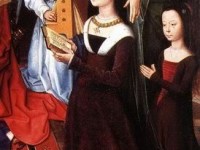
IMAGE:How Edward might have looked in disguise: a well dressed little girl (far right) in Hans Memling’s Donne triptych. (Image courtesy of Hans Memling’s website.)

Edward III’s Wooden Town

By Susan Higginbotham

“I gather the news is good. My lord is coming home?”
Bess shook her head. “No—he is staying in Calais. But the news is good. We—I and the queen and her daughters and many others—are going there!”

As this snippet shows, Bess, the heroine of my novel Hugh and Bess , is bound in November 1346 for Calais, then under siege by troops led by King Edward III. Thanks to Edward III’s careful planning, she would find many of the comforts of home there.

Having won a stunning victory over the French at Crécy in August 1346, Edward III’s army moved to Calais in September. As the town’s strong fortifications and marshy environs made taking it by battle unfeasible, Edward decided to starve its citizens into submission. Knowing that he was in the siege for the long haul, the king ordered the construction of what amounted to the equivalent of a modern military base, complete with barracks, officers’ quarters, and shopping. As the chronicler Jean Froissart reports:

On the king’s arrival before Calais, he laid siege to it, and built, between it and the river and bridge, houses of wood : they were laid out in streets, and thatched with straw or broom ; and in this town of the king’s, there was everything necessary for an army, besides a market-place, where there were markets, every Wednesday and Saturday, for butcher’s meat, and all other sorts of merchandise : cloth, bread, and everything else, which came from England, and Flanders, might be had there, as well as all comforts, for money. [p. 169]