Tag Archive: salem witch trials

Secret Salem

By Katherine Howe

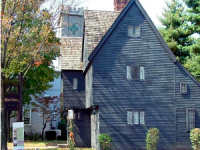
Every year thousands of visitors throng into Salem, Massachusetts, appetites whetted for witches. And witches there are, for in Salem we are experts in witchery: witch hats, witch t-shirts, witch plays, even some real witches thrown in for good measure. Sometimes visitors are puzzled, however, that there aren’t more places to see that are tied to the actual Salem witch trials of 1692. The Witch House, was the home of a real Salem witch judge, and is maintained as a historic house today. But other than that, we find few elements of historical witchery remaining in what is essentially a nineteenth century city. Where did it go?

Salem Town was first founded in the 1620s (its name comes from Salaam, or Shalom, meaning “peace”), and very quickly became one of the busiest and most important seaports in early colonial New England. So busy, in fact, that the rocky sea coast could not produce enough food to support the growing population. As a result, in 1636 an outlying farm region was established, to supply grain and goods for the port town. Initially the region was called Salem Farms, though quickly that name changed to Salem Village.

As we know, it was in Salem Village that the witch crisis first broke out. Salem Village held the meeting house where the most dramatic accusations took place. Salem Village was the home of Rebecca Nurse, Samuel Parris, and the people we remember from the The Crucible. Salem Village had a distinct personality that separated it from Salem Town, and some historians think that these clashing cultures contributed to the panic. Salem Village tried early on to pull away from Salem Town, but was not successful until 1757, when its name was changed to Danvers.

Today, in Danvers, a memorial stands on the ground that once held the Salem Village meeting house, and Rebecca Nurse’s house is maintained as a historic property open in the summertime. True hunters after historical witchery know to look in modern Salem, and also its shadowy neighbor, the secret Salem Village, Danvers.

Katherine Howe is the author of the New York Times bestseller The Physick Book of Deliverance Dane. She is completing a PhD in American and New England Studies at Boston University, and this August (2010), Signet Classics is publishing a new edition of Nathaniel Hawthorne’s The House of the Seven Gables with a new introduction written by Katherine. Read more about the book here.

IMAGE: The Witch House, home of Judge Jonathan Corwin, is the only structure still standing in Salem with direct ties to the Witchcraft Trials of 1692.

Congratulations to the following W & M winners of this book:

Kimberly and Melanie

Can Witch Trials Be Reasonable?

By Katherine Howe

No matter how many Salem books appear, the question of New England witchcraft never seems to be exhausted. It forces us to confront the fragility of some of Americans’ dearest assumptions about ourselves: that we are tolerant, that we value the socially marginalized, that we are rational and can be persuaded by reasoned argument. Salem means that we can’t take our toleration for granted. Instead, we hunt for justification. Usually we point to “hysteria,” as though living in the past, according to a past set of beliefs, automatically makes one crazy.

But it is not so. They weren’t crazy at all.

In 1690s New England, Salem was only the most extreme example of an otherwise common legal problem. We don’t bother to legislate against imaginary threats, after all. The Salem participants – accusers, accused, judges, jury, theologians, the lieutenant governor – all lived in a religious system which assumed witchcraft to be real. The Salem episode was unusual for its breadth and longevity, facts not lost on observers at that time. But for people who believed themselves to occupy still-new lands “that were once the Devil’s territories,” the presence of Satan working through earthly interlocutors was a credible, and terrifying, threat. Looked at from this perspective, the Salem trials resemble the most rational response available to a community struggling to free itself from the ravages of evil incarnate.

The idea of witch-hunting as rational, however, might be too chilling to contemplate. A mere decade after the panic ended, several participants began to regret their role in the trials; Samuel Sewall, a judge, and Ann Putnam, an afflicted girl, both made humble public apologies for their participation in what they now felt was a miscarriage of justice. The speed with which Salem was reconsidered, even in the colonial world, is itself reassuring – even they thought they were being crazy! Phew.

And yet, for the first many months of 1691/92, inquiry into the presence of witches in Essex County was anything but crazy. In fact, it was imperative, given the cultural and religious structures in place in that community at that time. One wonders what other assumptions, imperative in our own time, will be hysterical in another?

Spread the Wonder, email this to a friend

Katherine Howe is author of The Physick Book Deliverance Dane, just published by Voice (Hyperion).