Tag Archive: salem

By Katherine Howe
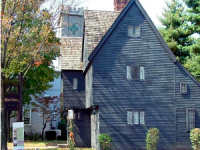
Every year thousands of visitors throng into Salem, Massachusetts, appetites whetted for witches. And witches there are, for in Salem we are experts in witchery: witch hats, witch t-shirts, witch plays, even some real witches thrown in for good measure. Sometimes visitors are puzzled, however, that there aren’t more places to see that are tied to the actual Salem witch trials of 1692. The Witch House, was the home of a real Salem witch judge, and is maintained as a historic house today. But other than that, we find few elements of historical witchery remaining in what is essentially a nineteenth century city. Where did it go?
Salem Town was first founded in the 1620s (its name comes from Salaam, or Shalom, meaning “peace”), and very quickly became one of the busiest and most important seaports in early colonial New England. So busy, in fact, that the rocky sea coast could not produce enough food to support the growing population. As a result, in 1636 an outlying farm region was established, to supply grain and goods for the port town. Initially the region was called Salem Farms, though quickly that name changed to Salem Village.
As we know, it was in Salem Village that the witch crisis first broke out. Salem Village held the meeting house where the most dramatic accusations took place. Salem Village was the home of Rebecca Nurse, Samuel Parris, and the people we remember from the The Crucible. Salem Village had a distinct personality that separated it from Salem Town, and some historians think that these clashing cultures contributed to the panic. Salem Village tried early on to pull away from Salem Town, but was not successful until 1757, when its name was changed to Danvers.
Today, in Danvers, a memorial stands on the ground that once held the Salem Village meeting house, and Rebecca Nurse’s house is maintained as a historic property open in the summertime. True hunters after historical witchery know to look in modern Salem, and also its shadowy neighbor, the secret Salem Village, Danvers.
Katherine Howe is the author of the New York Times bestseller The Physick Book of Deliverance Dane
. She is completing a PhD in American and New England Studies at Boston University, and this August (2010), Signet Classics is publishing a new edition of Nathaniel Hawthorne’s The House of the Seven Gables with a new introduction written by Katherine. Read more about the book here.
IMAGE: The Witch House, home of Judge Jonathan Corwin, is the only structure still standing in Salem with direct ties to the Witchcraft Trials of 1692.

Congratulations to the following W & M winners of this book:
Kimberly and Melanie

By Kathleen Kent
I was a child when I first heard from my maternal grandmother that I was the descendent of an accused Salem witch, Martha Carrier. When I asked if Martha had really been a witch, my grandmother laughed. There are no such thing as witches, I was told, merely ferocious women. Well she would have known as she was fairly ferocious herself; outspoken, prone to riding saddle-shy horses, and a dead shot with a rifle. I am happy to say we have our fair share of ferocious women in my family.
I grew up hearing stories of the witch trials at most family gatherings, but there were also stories of the Carriers’ day to day life in 17th century Massachusetts that made this challenging time in American history come alive for me. For example, the tale of the family cow that had been fed pumpkins and produced golden milk which, unfortunately, was probably one more bit of proof that the Carriers were playing with magic.
I spent several years doing research for The Heretic’s Daughter, drawing on numerous traditional sources about the witch trials. But some of the most revealing anecdotes, a few of which were woven into the novel, came from Massachusetts village sextants, local town historians, and even amateur genealogists. After the book was published, I was delighted to receive emails and letters from dozens of other Carrier descendants who had heard the same stories, passed down through nine and ten generations. Their family remembrances reinforced what I already knew; that Martha Carrier was both a courageous and ferocious woman, and someone I was proud to call my ancestor.
Kathleen Kent, author of The Heretic’s Daughter
and recipient of the David J. Langum, Sr. Prize in American Historical Fiction, is a tenth-generation descendant of Martha Carrier. To read more about the author and her book, click here.
IMAGE: The Trial of George Jacobs, Thomkins H. Matteson, 1692