Tag Archive: Pompeii

The New Realism: Pompeii’s Living Dead

By Eugene Dwyer

Plaster casts of the Pompeian victims, first made by Giuseppe Fiorelli in 1863, have become world famous through post cards, documentary films, and now traveling exhibitions.

Direct exposure to the casts, whether one experiences them in Pompeii or in a museum setting, can be very moving or it can be unaffecting, depending upon the circumstances and expectations brought to the experience by the visitor. To stumble upon a cast unexpectedly in a dimly lighted vault can be a memorable experience.

Fiorelli’s own initial discovery of victims, made by freeing his newly made plasters of the surrounding earth, came as such a shock that he claimed to have “stolen from death” the bodies that had been concealed for more than eighteen hundred years.

In fact, Fiorelli’s process made it possible to see the faces and the helpless gestures of the victims at the very moment they were overcome by the volcano. No one before Fiorelli had seen ancient Romans as “living persons.” Portrait sculpture and ideal or mythological sculpture and painting had been the basis of most people’s acquaintance with the ancients, leading to exalted notions of the beauty of the ancients.

The experience of human remains was limited to skeletons, gruesome but insufficient to contradict the supposed veracity of the works of art. Now it was apparent that the Pompeians had been heavily clothed, mostly well shod, and that they strikingly resembled contemporary inhabitants of the zone. Most noticeably, they appeared to contradict the images handed down in ancient art.

Postcards from Ancient Rome

By Michelle Moran

One of the most frequent questions I’m asked by readers is what life was like two thousand years ago when Julius Caesar walked the corridors of the Senate house and Cleopatra visited Rome. Surprisingly, life for the ancient Romans was not unbelievably different from today. The Romans had many of the little luxuries that we often associate exclusively with the modern world. For example, baths were to be found in every city, and public toilets were viewed as a necessity. The toilets depicted in HBO’s Rome Series are copies of those discovered in Pompeii, where those caught short could find a long stretch of latrines (much like a long bench with different sized holes) and relieve themselves next to their neighbor. Shops sold a variety of wigs, and women could buy irons to put curls their hair. For the rain, there were umbrellas, and for the sun, parasols. Houses for the wealthy were equipped with running water and were often decorated quite lavishly, with , with elaborate mosaics, painted ceilings, and plush carpets.

In the markets, the eager shopper could find a rich array of silks, along with linen and wool. You could also find slaves, and in this, Roman times certainly differ from our own. While some men spoke out against it, one in three people were enslaved. Most of these slaves came from Greece, or Gaul (an area roughly comprising modern France). Abuse was rampant, and the misery caused by this led desperate men like Spartacus to risk death for freedom.

For those few who were free and wealthy, however, life in Rome provided nearly endless entertainments. As a child, there were dolls and board games to be played with, and as an adult, there was every kind of amusement to be had, from the theater to the chariot races. Even the poor could afford “bread and circuses,” which, according to Juvenal, was all the Romans were really interested in.

Michelle Moran, author of Cleopatra’s Daughter: A Novel, was born in the San Fernando Valley, CA. She took an interest in writing from an early age, purchasing Writer’s Market and submitting her stories and novellas to publishers from the time she was twelve. When she was accepted into Pomona College she took as many classes as possible in British Literature, particularly Milton, Chaucer, and the Bard. Not surprisingly, she majored in English while she was there. Following a summer in Israel where she worked as a volunteer archaeologist, she earned an MA from the Claremont Graduate University.

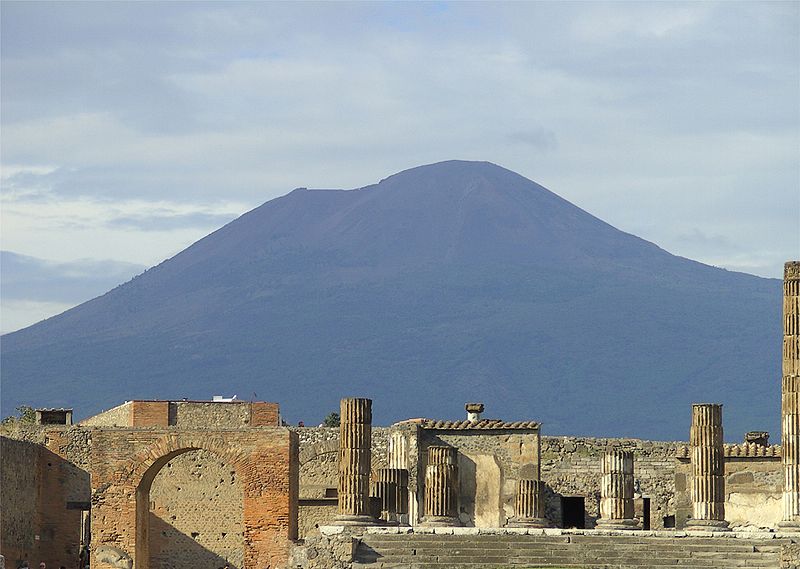
IMAGE: The ancient City of Pompeii