Tag Archive: paris

Impotence in the Archives: or, a Research Trip Failed

By Lisa Smith, W&M Contributor

A year ago I went to Paris on a week-long research trip. My goal was to look at eighteenth-century impotence trials, part of the Série Z at the Archives Nationales. I planned to compare them with English impotence trials that I had already examined.

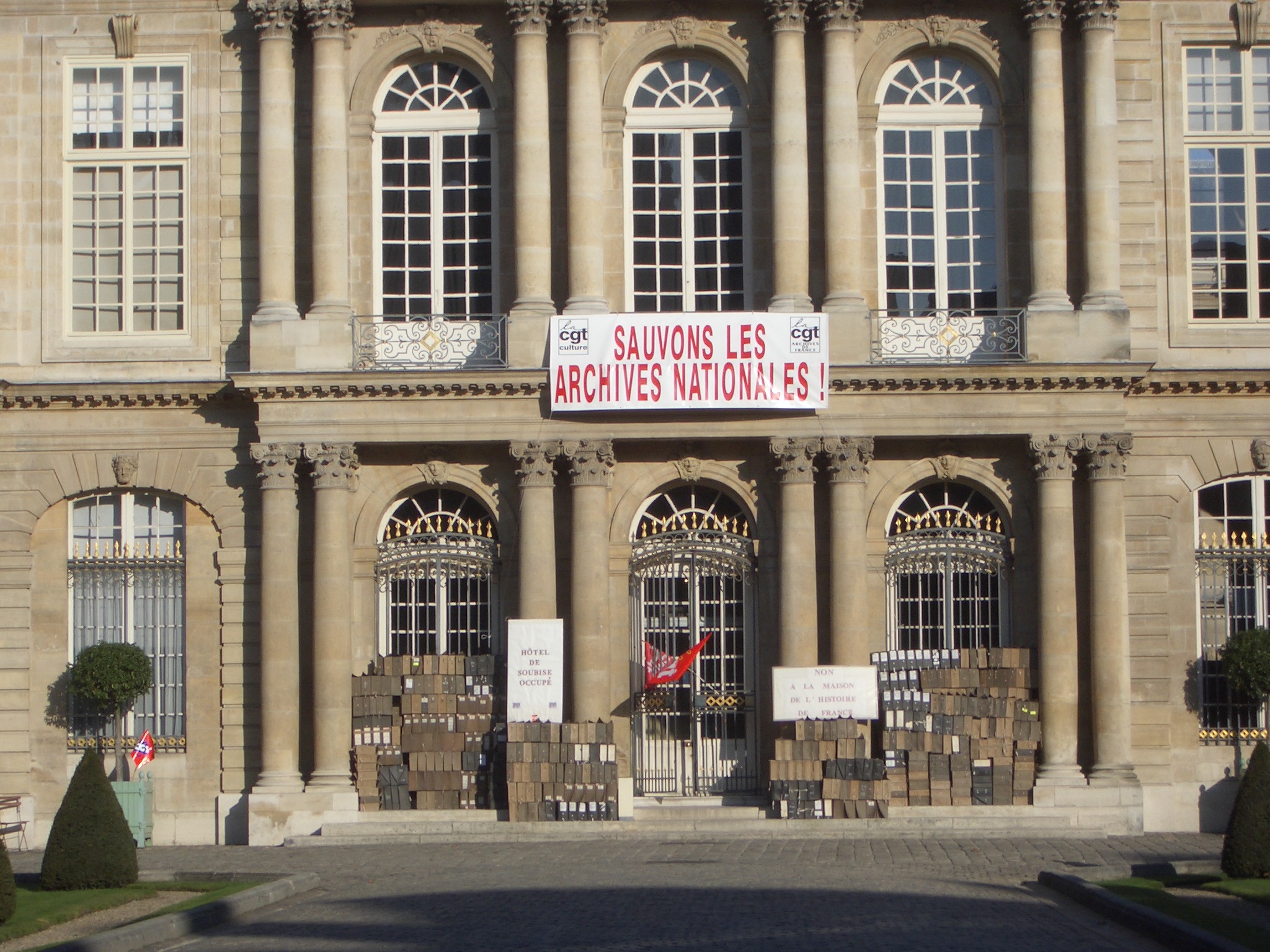
French historians and archive workers had been occupying part of the building to protest Sarkozy's proposed (rightwing) museum.

There were the standard research problems, of course. The handwriting was unusually terrible. The boxes were unsorted and contained few, if any, impotence trials, which were challenging to find. But the biggest difficulty was entirely unexpected. Série Z closed for maintenance every second day during that week.*  This mystified the counter-staff as much as me. Each time, they were unaware of the closure.

Previously, my research method had been to transcribe notes by hand, then review them afterwards. To the growing number of historians who prefer to take photographs of archival documents, this seems a bit quaint. On this rapidly passing trip with its two fruitless days, I certainly did not have the luxury of time. Instead, I photographed the trial records like mad, writing brief outlines of the cases. Each night I organised the photos and turned them into pdf files, hopeful about the possibilities for my new use of photography. I thought how nice it would be to have images of the documents to hand.

But a year on, I’ve realised a key problem in this system: much of my work in archives is tied to physical memory. Looking back at my notes over the years, I can remember the way in which documents looked or smelled at the time. More importantly, I can remember where to find specific points in my notes. I recall in detail the stories from the English trial records, but the French ones only fleetingly, even though I have since read through the files a couple times. It has become clear to me that I need another French research trip – this time simply to sit in my office transcribing the files stored on my computer – if my knowledge of the trial records is ever to become potent.

How do you internalise your material when doing research?


*Admittedly, this allowed me to have leisurely lunches and sightsee, so all was not in vain.


Lisa Smith is an Associate Professor of History at the University of Saskatchewan. She writes on gender, family, and health care in England and France (ca. 1600-1800).

Forensics in 1800 Paris

By Catherine Delors

The investigation into the Rue Nicaise bombing attack, which is the topic of FOR THE KING, is considered the first modern police investigation. As I researched it in great detail, I was struck by the modernity of the investigators’ thinking.

For instance, their first reflex was to look for the license plate of the cart where the bomb had been detonated, or for any witnesses who might remember the number. Yes, in 1800 Paris, all horse-drawn carts and carriages had license plates, just like modern cars. In this case, however, the license plate had been blown apart by the explosion, and no one had noticed the number.

The investigators made full use of the scientific techniques available to them. Letters from Georges Cadoudal, the famous royalist insurgent who had directed the conspiracy from afar, were identified by handwriting analysis. The gunpowder found in a barrel at the home of one suspect was analyzed and found to be of English manufacture.

But what fascinated me about the investigation was the first clue: the mare pulling the cart where the bomb, the infernal machine, had been brought to the scene. Little remained of the poor animal. But the head and one of the forelegs was intact. And, lo and behold, the hoof had been newly shod! Does it not remind you of a car with a brand-new tire?

It was the perfect clue, of course. All the police had to do was to round up all of the blacksmiths in Paris. Sure enough, one of them remembered three men bringing a little mare to get shod. The blacksmith identified the remains of the animal, and was able to provide a precise description of the three men who had taken her to his smithy. Soon it was posted all over the streets of Paris, with a reward of 2,000 gold louis, an enormous sum. It was only a matter of weeks before the assassins were caught…

Catherine Delors was born and raised in France. She graduated from the University of Paris-Sorbonne School of Law and became the youngest member of the Bar of Paris at the age of twenty-one. Her second novel, For the King, (Dutton Adult) was released July 8, 2010. Catherine is currently writing on a third novel, a prequel to Mistress of the Revolution. She is also researching a fourth one, which shall revolve about Jane Austen and her French connections. To read more about the book and the author, please click here.

IMAGE: Bombing attack at Rue Saint-Nicaise, Paris, 24th December 1800

Congratulations to the following W & M winners of this book:

Eric, Karen, and Carol

It’s rough, but someone has to do it….

Eglise Saint-Jean de Malte

By Holly Tucker

While Wonders & Marvels hums along as usual (with the help of my amazing editorial team), I’m actually spending the summer in France. Yes, France. To be more precise, the South of France. Aix-en-Provence. Yes, it’s a rough life.

I’m here teaching at my university’s study abroad program. We’ve had a program in Aix for almost 50 years. One of the greatest perks for faculty is that we get to teach in rotation here.

Several years ago, my family and I spent a full year in Aix. So being here is like coming home. In fact, just yesterday, we had our neighbors—whom we’ve known for years–over for an American breakfast. You can imagine how fun it is to serve grits and bacon here!

Aside from the grits, I can’t begin to tell you how delicious it is to be here. First, of course, because of all of the delicacies to be found. Fresh fruit and vegetable markets dot the city each day. Olives, tapenade [an olive spread], fresh goat cheese, and wine—de préférence, rosé, are a staple for our evening aperitif.

It’s delicious to me for an even more important reason, however. As a professor, I am nearly giddy with the opportunities my students and I get to share together. I’m teaching a course called “Textes et Contextes,” which covers history, art, and literature from the Middle Ages to the Eighteenth Century.

Last week, I talked to the students about medieval architecture—and particularly the shift from Roman to Gothic styles in church construction. A student had a question about a specific type of arch. I pulled up some Google images to give her a better idea. Then it occurred to me…duh, we were literally RIGHT NEXT DOOR to a 13th century church: Saint Jean de Malte.

The busy Posthumous life of Genevieve

By David Powell

In November 1793, the oldest victim of the Reign of Terror went quietly to her fate. She had already been dead for nearly thirteen centuries, but that did not mollify the revolutionaries who had exhumed Saint Genevieve of Nanterre from the crypt beneath the Parisian abbey that bore her name.

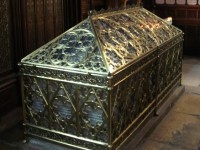
Her ornate, early medieval reliquary, gilded in gold and silver and encrusted with diamonds and other gems, was taken to the city mint over the protest of hundreds of the saint’s admirers. There, behind locked doors, assayers valued the ancient coffin at 23,800 livres. They then dismantled it.

Within, wrapped in white linen, they found “the bones of a cadaver and a head on which there were many deposits of gypsum or plaster.”

They also found a tiny piece of ancient parchment with an inscription: Hic jacet humatum corpus sanctae Genovefae. “Here lies buried the body of holy Genevieve.”

It was an undignified end for the patron saint of Paris. Genevieve was a shepherdess from nearby Nanterre who, as the governing apparatus of the Roman Empire receded from 5th century Gaul, gained widespread fame for her piety and charity. When Attila the Hun, the “Scourge of God,” threatened Paris in 451, a prayer vigil led by Genevieve was credited with saving the city from his wrath.

After her death, she was interred atop the hill that would later be home to the city’s Latin Quarter. Her shrine, just east of the town’s disused Roman forum, quickly became a pilgrimage site. Even in death, she remained active. In the centuries to come, as Paris bloomed around her, every grave threat to the city was met by a procession featuring her sarcophagus: war, plague, famine…even high water. The Marquise de Sevigny described a 1675 procession meant to end a series of flooding rainstorms:

“Monks of every order walk in it, and all the parish clergy and the canons of Notre-Dame, his Grace the Archbishop, in pontifical robes, on foot, and blessing the people right and left all the way to the cathedral. However he walks only on the left side. On the right walks the Abbot of Sainte-Genevieve, barefooted, preceded by 150 monks, also barefooted …The Parliament in red robes and all the higher guilds follow the shrine, which sparkles with precious stones, and is carried by twenty-two barefooted men clad in white. The head of the merchant guilds and five councillors are left as hostages at the Abbey of Sainte-Genevieve until the return of [the saint’s relics].”

By 1793, her fame had become a liability. Her bones were tried for treasonous collaboration with the Bourbon royal family, found guilty, and burned at the Place de Grève (now the Place de l’Hôtel-de-Ville). The few remaining fragments of her body were later reburied at the Church of St. Stephen, where they remain today. Nearby, the city’s Pantheon stands on the former site of her shrine and is the final resting place of Voltaire and other secular titans of France. The building’s intended purpose remains visible, however, in the murals that decorate its vaulted interior, which depict the life of a shepherd girl from Nanterre.

Further reading:

Bitel, Lisa. Landscape with Two Saints: How Genovefa of Paris and Brigit of Kildare Built Christianity in Barbarian Europe. Oxford University Press, 2008.

Sluhovsky, Moshe. Patroness of Paris: Rituals of Devotion in Early Modern France. Brill, 1998.

David P. Powell studies ancient and medieval Europe in the graduate history program at Villanova University. When the urge seizes him, he writes about the topic at his blog, Studenda Mira.

IMAGE: Tomb of Saint Genevieve in Saint Etienne du Mont

Coming up in YA

By Melissa L.

Here’s a look at what’s coming up in YA.

Beth Ain’s The Revolution of Sabine is set in 1776 Paris. The American Revolution is the talk of the town, and everyone is planning parties to honor the man behind it all: Benjamin Franklin. Sabine Durand’s mother, obsessed with making her party perfect in order to impress the other members of the French aristocracy, is no exception.

But Sabine herself has much less regard for the social conventions that seem to dictate her mother’s life. When she secretly renews her friendship with Michel, her governess’s son, and has her portrait painted by the famous Fragonard, her outlook begins to change. She visits her first salon, meets Mr. Franklin himself, and begins to read the works of Voltaire. Now Sabine longs for change in her own life…but can she defy her mother and the rest of the aristocracy?

Beth Ain is a former editor who is also the author of When Christmas Comes Again, a novel set during World War I. In her post for us, she plans to describe how she got the idea for The Revolution of Sabine.

Look for a post from Beth soon on Wonders & Marvels!

Melissa L. is the YA Editorial Assistant for Wonders and Marvels. You can read more about her here: Editorial Staff.

IMAGE: Cover art for The Revolution of Sabine

Do you smell that?

By David S. Barnes

In the late summer of 1880, a wave of offensive odors descended upon the city of Paris. For just over two months, between late July and early October of that year, Parisians complained of the putrid, insufferable stench. The tone of many reactions was apocalyptic: “[T]he odors are truly unbearable”; “We’ve never seen anything like this!” “This can’t go on!”

Complaints came from all sides. … The press protested violently against the government’s negligence. … People approached one another with but one greeting: “Do you smell that? What a stench!” It was a real public calamity. Parisians were panic-stricken; public officials were anguished; cabinet ministers were troubled.

Medical authorities, journalists, and fearful residents all agreed that the odors brought with them the threat of deadly diseases. The chorus of popular protest was seconded by scientific authority, as a special commission composed of the nation’s leading medical scientists (including Louis Pasteur, the father of bacteriology) concluded that foul-smelling emanations were capable of transmitting the germs of contagious disease, and that “these odors which have spread over Paris … can pose a threat to the public health.”

Fifteen years later, the capital’s residents again found themselves beset by stench. “Fetid emanations,” “nauseating” and “disgusting” odors, “Paris again turning putrid”—the noisy complaints that began in early June 1895 sound like a reprise of August and September 1880.

Disgusted and indignant reactions to the odors of Paris again emphasized their intolerability and the urgent imperative of remedial action. As in 1880, the search for the culprits focused on the sewers and on suburban waste treatment plants, and once again local government officials were harshly criticized for inaction and complacency. Only the certainty of impending epidemics and the search for germs in the foul miasmas were missing from the public reaction in 1895.

David Barnes, author of The Great Stink of Paris and the Nineteenth-Century Struggle against Filth and Germs, is a historian of medicine and public health who has taught at the University of Pennsylvania since 2002. He received his Ph.D. in History from the University of California, Berkeley.

IMAGE: City street-cleaning tanks dispense perfume instead of water. Caption: “A means of combating the odors of Paris.”

Coach: Status Symbol

By Karen Newman

London and Paris grow prodigiously in the early modern period. London may have quadrupled its population to some 400,000 by 1650; by 1645 Paris expands to some 500,000. Such rapid expansion required new forms of transport, first elite coaches and carriages, but rapidly hackneys, diligences and omnibuses.

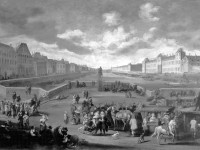
Medieval streets, often no more than two meters wide, could ill handle the growing number of vehicles. Coaches produced newly configured urban environments–broader streets, sidewalks, and bridges like the Pont Neuf designed for vehicular traffic rather than pedestrian commerce.

The first coach was brought to England for Elizabeth I in 1564, but coaches quickly spread through the aristocracy and gentry. By 1636, there were said to be some 6000 in London; Paris was over-run as well. Gentlemen of indifferent fortunes were said to “starve their families at home to make a great figure abroad” since coaches made “a publique difference between Nobilitie, and the Multitude.”

Coaches and carriages were a new technology that separated the privileged from unwanted encounters with the heterogeneous crowds and filth that filled city streets. By 1619, London traffic inspired petitions complaining of the “multitudes of Coaches . . . . [such that] inhabitantes there cannott come to their howses, nor bringe in their necessary provisions . . . nor the passenger goe . . . without danger of their lives and lymmes.”

The English word coach, which appears abruptly in nearly every European language in the period, itself comes to predicate: Londoners “coach to the Exchange” in Richard Brathwait’s words in The English Gentleman (1630); “All the Gentry coach it up to the City,” says another commentator: the urban elite rode in coaches to avoid the filth, stench and noise that plagued the city streets.

Karen Newman, author of Cultural Capitals: Early Modern London and Paris, is Professor of English at New York University.

IMAGE: Engraving of the Pont Neuf, Paris, France, William Miller from a drawing by J. M. W. Turner

Fifteen-year-old Françoise meets her first husband

By Veronica Buckley

From the humblest of births in a provincial prison cell, Françoise d’Aubigné made her perilous way out of desperate poverty to a brilliant salon life in Paris, and finally, as Madame de Maintenon, secret wife of the Sun King Louis XIV, to the centre of power at Versailles.

In the winter of 1651, wearing old-fashioned shoes and a dress much too short for her, the fifteen-year-old Françoise stepped into the salon of Paul Scarron, infamous poet of the burlesque. Though she had heard others talk of his dreadful disfigurement, the first sight of him in person proved too much for her.

Overcome by horror or pity, she broke down at once in tears. ‘My body, it’s true, is most irregular,’ Scarron himself admitted. The celebrated scandalmonger, toast of the Paris salons, was seated in the middle of the room, his twisted body propped up and strapped into a large wheelchair, with a wooden tablet affixed on which he rested one claw-like hand. ‘I used to be a well built man,’ he wrote, though it’s true I was never very tall. But now my legs are at an acute angle to my body, and my head is permanently bent down to my stomach – I’m a sort of human Z.

My legs and arms and fingers have all shrivelled up. In short, I’m a shrivility of human misery.’ Françoise, wiping the tears from her eyes, stepped forward to be introduced. ‘To look him in the face,’ recorded a witness of their meeting, ‘she had to lean over so far she was almost on her knees’.

Veronica Buckley, author of The Secret Wife of Louis XIV: FranCoise d’Aubigne, Madame de Maintenon, was born and educated in New Zealand, and later studied at the Universities of London and Oxford. Christina, Queen of Sweden, was the subject of her much-praised first biography. She lived in Paris while researching The Secret Wife of Louis XIV, and now lives in Vienna.

IMAGE: Portrait dit autrefois de Paul Scarron (1610-60). French school, seventeenth century. Le Mans, Musee de Tesse.

Spring in Paris


This will be one of the last travelogue posts, I promise. While I was digging around the archives in Paris, I had a constant companion: “Spring” the duck.

We picked the cute little rubber duckie up in Rome last fall. Spring found her way into my travel bag on this most recent trip to the French capitol. She visited the libraries, but she also tagged along with a friend who was traveling with me. Oh the places she went. And oh, the delight my daughter had in seeing the fun her duck had.

I snapped several pictures of Spring with other children. Being bilingual has its advantages. It was easy to ask parents to allow me to take their child’s picture with my daughter’s duck. But part of me is just wondering if they could sense that I was a parent missing her child. That can be expressed even without speaking.

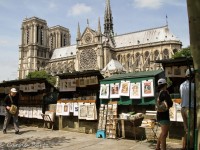
What a sight I must have been standing in front of Notre Dame with a camera trying to find Spring’s most photogenic angle! But my favorite by far is the one I snapped from the terrasse of the apartment my friend and I rented in the 5th arrondissement, on a quiet street right across from the Cluny museum. See photo above, as well as the photo-shopped picture below. Courtesy of my quirky friend, a graphic designer. That duck has friends in high places!