Tag Archive: French Revolution

By Harvey Sachs
A historical oddity was one of the reasons why I wanted to write a book on Beethoven’s Ninth Symphony and the year 1824 – the year in which this masterpiece was completed and premiered. This was the first symphony to include singing, and the words that the composer drew from, Friedrich von Schiller’s “Ode to Joy” are, among other things, a proclamation of universal brotherhood.
But Beethoven wrote the Ninth in Vienna, the same city in which Austria’s foreign minister, Prince Klemens von Metternich, was perfecting the first modern police state at the very same time. The Enlightenment, French Revolution, and Napoleonic wars had all come and gone; the old dynastic rulers – Romanovs, Hapsburgs, Bourbons, and others – had either held onto their shaky thrones or had been reseated on thrones they had lost, and they were determined to shore up and enforce, at any cost, the time-worn concept of Divine Right.
Beethoven’s negative views on absolute rulers were well known. He had even written to his patron and pupil Archduke Rudolph, brother of the Austrian emperor, that “benefactors of humanity have not been found… in the present world of monarchs.”
But he was considered too famous and too eccentric to be turned over to the regime for the sort of treatment – a long jail sentence or banishment – reserved for run-of-the-mill offenders. The Ninth Symphony was performed and acclaimed, and its message was ignored. Beethoven would be pleased to know that his creation is still performed and acclaimed today, and he would not be surprised to learn that its message is still ignored.
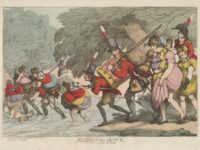
IMAGE: Facsimile from the author’s own collection
Harvey Sachs, author of The Ninth: Beethoven and the World in 1824
(released today, Random House), is also a music historian and the author or co-author of eight previous books, of which there have been more than fifty editions in fifteen languages. He has written for The New Yorker and many other publications, has been a Guggenheim Fellow and a Fellow of the New York Public Library’s Cullman Center for Scholars and Writers, and is currently on the faculty of the Curtis Institute of Music in Philadelphia. He lives in New York City.

By Patricia Elliott
My novel, The Pale Assassin
, is set during the French Revolution. As a writer, what fascinated me during my research was the discovery of how many contradictions this extraordinarily dramatic period contained.
The complex character of the king, Louis XVI: compassionate, but blind to the suffering of his people. His queen, Marie-Antoinette: vain and extravagant, yet one who endured her imprisonment with great fortitude. Then the aristocrats, privileged and wealthy, yes, but many of whom actively supported the introduction of a constitution that would bring equality and the end of the corrupt ancien regime.
Foremost among them was the Marquis de Condorcet, who drafted the first constitution, basing it on the Declaration of Independence – it is said with the help of George Washington. And Robespierre, the most powerful man in the new Republic, who lived a life of moral purity, yet was the cold-blooded architect of the Terror, when thousands were guillotined in order to preserve a “republic of virtue.” The Terror itself was sanctioned by a government paranoid about the enemy within, for, as Jefferson is believed to have said, “The price of liberty is eternal vigilance.” But the majority of the Terror’s victims were not the hated aristocracy but the ordinary, innocent people of France.
Lastly, the most tragic and ironic paradox of all was that in order to uphold the ideals of “liberty, equality and fraternity,” the revolutionaries resorted to a ruthless denial of human rights that was to have its echo down the ages.
Patricia Elliott’s novels for young adults have received critical acclaim. Her newest novel is The Pale Assassin
.
Visit her website at patriciaelliott.co.uk.