Tag Archive: ancient rome

The New Realism: Pompeii’s Living Dead

By Eugene Dwyer

Plaster casts of the Pompeian victims, first made by Giuseppe Fiorelli in 1863, have become world famous through post cards, documentary films, and now traveling exhibitions.

Direct exposure to the casts, whether one experiences them in Pompeii or in a museum setting, can be very moving or it can be unaffecting, depending upon the circumstances and expectations brought to the experience by the visitor. To stumble upon a cast unexpectedly in a dimly lighted vault can be a memorable experience.

Fiorelli’s own initial discovery of victims, made by freeing his newly made plasters of the surrounding earth, came as such a shock that he claimed to have “stolen from death” the bodies that had been concealed for more than eighteen hundred years.

In fact, Fiorelli’s process made it possible to see the faces and the helpless gestures of the victims at the very moment they were overcome by the volcano. No one before Fiorelli had seen ancient Romans as “living persons.” Portrait sculpture and ideal or mythological sculpture and painting had been the basis of most people’s acquaintance with the ancients, leading to exalted notions of the beauty of the ancients.

The experience of human remains was limited to skeletons, gruesome but insufficient to contradict the supposed veracity of the works of art. Now it was apparent that the Pompeians had been heavily clothed, mostly well shod, and that they strikingly resembled contemporary inhabitants of the zone. Most noticeably, they appeared to contradict the images handed down in ancient art.

Strange Tales and Surprising Facts about Ancient Rome

By James C. McKeown

The Romans have a reputation as being a very practical society, building impressive aqueducts with really good cement, while maintaining a ruthlessly efficient army that conquered and maintained a vast empire. They may sometimes seem rather dull and unimaginative, but this is not at all the case. They have left us lots of rather bizarre information about themselves, some of which is perhaps not entirely credible. For example:

1. In 173 BC, a large fleet of ships was seen in the sky near Rome.

2. Cobwebs were used to stop bleeding from fractured skulls and shaving cuts.

3. The Romans wondered whether plants enjoy travel in the same way as people do. There was a law against using magic to transfer growing crops from one place to another.

4. Faustina, the wife of the emperor Marcus Aurelius, had a collection of several hundred wigs.

5. The Latin word musculus means both “little mouse” and “muscle”, since muscles rippling under the skin were thought to be like little mice.

6. The emperor Commodus frequently fought as a gladiator, armed with iron weapons, whereas his opponents had lead ones.

7. A person found guilty of parricide was sewn up in a sack with a dog, a rooster, a viper, and a monkey, and thrown into the sea.

8. Kissing a she-mule on the nostrils cures hiccups and sneezing.

9. Even though the Romans had no stirrups, Julius Caesar could ride at a gallop with his hands behind his back.

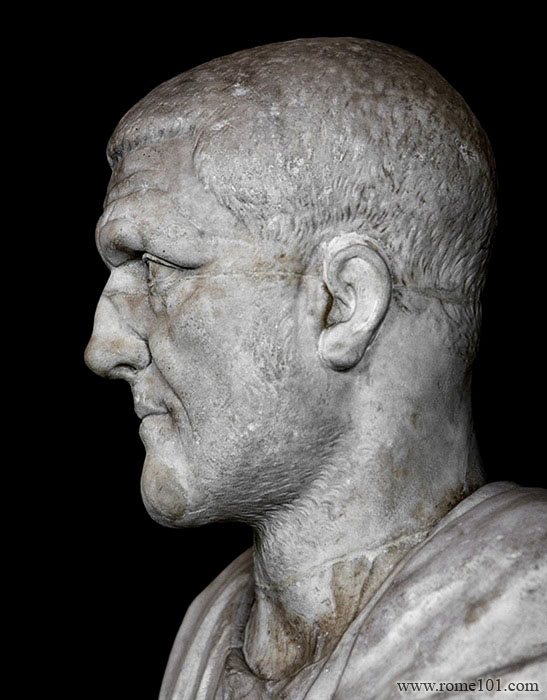
10. The emperor Maximinus was said to have drunk seven gallons of wine per day and to have been eight feet, six inches tall.

J. C. McKeown, author of A Cabinet of Roman Curiosities: Strange Tales and Surprising Facts from the World’s Greatest Empire, is Professor of Classics at the University of Wisconsin, Madison.

IMAGE: Communal toilets at Ostia, the port of Rome. Up to eighty people could sit together and socialize in Roman toilets. Photo by Jo Winston.

Congratulations to the following W & M winners of this book:

Gary, librarypat, and Lon!

Giveaway: The Poison King. Plus Announcing Previous Giveaway Winners

Another giveaway! But first things first — admin. We are revealing the names of the winners of previous contests. They are…

For Mrs. Rowe’s Little Book of Southern Pies, the winners are: Mary Prather, Susan M. and Frances Hunter. For The New York Review of Books 2010 Calendar, the lucky five are: Colleen, Vicky Alvear Shecter, Jen, Aurora Leigh Barrett and Claudette Raynor. Congratulations! We’d like to thank everyone who commented for their creative entries. Winners will be emailed for mailing address information shortly. And now, without further ado, we have another giveaway.

You know you’re bad when you can count Machiavelli as one of your fans. Well, Mithradates inherited a wealthy Black Sea kingdom at age fourteen after his mother poisoned his father. Apparently, Mother passed on this special skill to son since Mithradates’ own mastery of poison allowed him to foil assassination attempts and eliminate rivals. Read more about him in the aptly-titled The Poison King: The Life and Legend of Mithradates, Rome’s Deadliest Enemy by Adrienne Mayor. In fact, you may read a bit about Mithradates’ incredible trek over the Caucasus now right here at Wonders & Marvels.

For a chance to own a copy of this book, we are giving away two. Just comment to enter for a chance to win by midnight Eastern time on December 3, 2009 in response to this question: Who (real or fictitious) is your favorite storied character out of Ancient Rome and why? Winners will be announced soon after the draw. Sorry, but we can only ship to North America at this time. Good luck!

Pliny on Astronomy

By Philip Matyszak

Given that the Greeks and Romans had only intelligence and the naked
eye to make guesses about the cosmos, it is not surprising that they were sometimes wildly inaccurate, but sometimes they were often amazingly right

On the existence of other worlds

‘It is madness to harass the mind, as some have done, with attempts to measure the world, and to publish these attempts; or, like others, to argue from their conclusions that there are innumerable other worlds, and … if only one nature produced the whole, there will be so many suns and so many moons, and that each of them will have immense trains of other heavenly bodies.’ (Natural History 2.1)

The size of the sun

‘It is immeasurably huge. This you can tell from the following observation. Trees which are planted at the far limits of East and West, nevertheless cast shadows of the same proportions – though these trees are miles and miles apart, the sun appears in the same place, as though centred on either one’. (Natural History 2.45)

The moon and planets

Pliny was well aware that the world is round, and that it rotates on its axis every twenty four hours. However he believed that the planets rotated around the earth, from Saturn (the outermost) to Jupiter then Mars and finally – beneath the sun – the erratic and wandering Venus and tiny Mercury.

The moon, according Pliny, is 126,000 stades away. This is about 15,000 miles – an error of about 235,000 miles. Perhaps Pliny should have paid more attention to Posidonus, whose estimate of two (2) million stades he quotes in his work. Two million stades is a quarter of a million miles – and is pretty near spot on.

Professor Philip Matyszak, author of The Classical Compendium: A Miscellany of Scandalous Gossip, Bawdy Jokes, Peculiar Facts, and Bad Behavior from the Ancient Greeks and Romans, has a doctorate in Roman history from St John’s College, Oxford. Presently he is teaching and preparing courses for the eLearning program at Cambridge university’s Institute of Continuing Education at Madingley Hall. The author of many other books, learn more about Professor Matyszak, click here.

IMAGE: A 19th century portrait of Pliny the elder