Tag Archive: 17th century

Girl Warrior Fantasies, c. 1700

by Christine A. Jones

Wonders and Marvels is pleased to kick off The History of the Fairy Tale Week with this intriguing piece by Christine A. Jones. Look for more original guest posts on the topic of the fairy tale in the days ahead, as well as giveaways (a chance to win a new fairy tale book every day Monday through Friday of this week.)

Fairy tales are how we imagine the unimaginable. Beans can be magic and grow to the heavens. Frightening beasts turn out to be great princes in disguise. And girls are saved from annoying home lives by fairies and talking animals. Crazy things can happen.

Fairy-tale history contains some really juicy stuff, not all of which made it into the Mother Goose canon. For instance, how about a girl who shows up at court dressed as a knight and becomes the queen’s lover? Crazy indeed! Well, during the 1690s three French women authors thought up an ingenious plot for fairy tales where girls did their fighting for themselves. They showed up at court dressed as soldiers and did battle for the king. In each case, in fact, they became the kingdom’s best warriors. They were valiant, but also gentle and kind, and knew how to fold laundry. A rare combination, to be sure. And in the longest and most famous of these stories, by Marie Chatherine d’Aulnoy, the cross-dressed heroine has to fend off the queen’s advances with all her might.

Okay, the girl warrior and the queen never become lovers, but the love triangle among the queen (who loves the knight), the knight (who loves the king), and the king (who loves the knight but cannot figure out why) makes up the entire plot of the story. Historically, there had been woman warriors in France by the seventeenth century, but none of them had had quite this much fun at court. Read d’Aulnoy’s story, “Belle-Belle or the Chevalier Fortunate”, in Jack Zipes, Beauties, Beasts and Enchantments: Classic French Fairy Tales (New York: New American Library, 1989).

Christine A. Jones is co-editing a fairy tale anthology and writing a book on early porcelain experiments in France.  She is Associate Professor of French and Comparative Literary and Cultural Studies at the University of Utah.

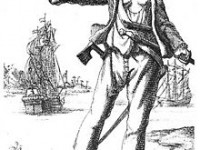
IMAGE: Chic girl pirate Anne Bonny.

The Invisible Hook

Now here’s a question that I had never given much thought about: What were the economic conditions for the pirating industry in the 17th century? But what a fascinating question it is!

Peter Leeson’s book is very intriguing–and wickedly clever. Who knew that pirates had elaborate systems of what we’d call “constitutional democracy” and “worker’s compensation” today? For Leeson, it’s all about measured responses to market forces.

To get a better sense of his argument, take a look at these articles or walk the plank mates!

The Pirates’ Code (The New Yorker)

Everyone in Favor say Yargh! (Boston Globe)

More to come in the next post. Be sure to sign up for a chance at a free copy. Just click the book cover to your left.

Ahoy!

[Image courtesy of author]