Category Archives: Sex and Childbirth

The Cow Dung Fertility Cure—and other odd adventures in baby-making

By Randi Hutter Epstein

Last year, I visited a sperm bank (was awash in a winter wonderland of frozen samples), watched a woman have her egg frozen, and sorted through websites of available egg donors. Would anyone really want an egg from a woman who put cheerleading under academic information in her donor-web entry? That was Donor 850991 in the Donor Egg Bank. This was all, of course, for book research. But even before I started my journey, I knew that for many couples, today, getting pregnant means marching through a whirlwind of conflicting advice and sorting through all sorts of low-tech and high-tech remedies.

What I didn’t know was that our great-great-great grandmothers, who may have been literally scared to death when pregnant, were bombarded with often contradictory words of wisdom. And they, too, had to pick and choose between an array of how-to-get-pregnant treatments.

Take Catherine de Medici, France’s sixteenth century Queen, for one. For years, the teenage queen (she married at 14) could not get pregnant. First, like so many women today, she tried folk remedies. But in her case, the Queen drank the urine of a mare and then soaked her “source of life” (vagina?) in a sack of cow manure mixed with ground stag’s antlers. The king was never attracted to his wife, preferring his mistress Diane de Poitiers. I can’t imagine the dung diaper helped get her back her man.

The teenage Queen then tried her own tactic. She had her servants drill a hole in the floor so she could watch her husband have sex with his mistress and learn a thing or two. Talk about an emotionally painful remedy. Finally, the two youngsters went to see a doctor who diagnosed the couple with physically deformed reproductive organs. We don’t know what he saw, what he did, or what he recommended, but shortly thereafter, they went on to have nine children.

Randi Hutter Epstein, MD is a medical writer, non-practicing physician, adjunct professor at The Graduate School of Journalism, Columbia University and author of Get Me Out: A History of Childbirth from the Garden of Eden to the Sperm Bank. A sampling of her articles are available at www.randihutterepstein.com

Little Men in Sperm

By Holly Tucker

Something major happened during the scientific “revolution” of the seventeenth- and eighteenth-centuries. Telescopes, barometers, blood circulation, air pumps, vacuums, early calculating devices, discovery of planetary systems…yes, yes, we know all about that.

The discovery of the egg and the sperm in 1672 and 1677 changed the way people understood babies–and how. Heated debates took place about whether possibly, just possibly, humans existed preformed in either the egg or the sperm. Animaculists argued that shrinky-dink-sized beings lay wait in the head of each sperm.

Ovists argued that tiny humans sat in each egg. At the end of the day, the ovists won out. One of the most difficult aspects of spermist theory to reconcile was the knowledge that there are millions of sperm in a single ejaculation. Surely God would not allow the genocide of all of those beings in a single embrace! And imagine what they had to say about going solo…

The best study out there on preformation is, without a doubt, Clara Pinto-Correia’s The Ovary of Eve: The Egg and the Sperm and Preformation.

IMAGE: Antonio Vallisnieri, Histoire della generazione dell’uomo e degli animali

Decades-Long Pregancies?

By Holly Tucker

Putting aside all modesty, let me scream and shout to you my excitement about a feature article that just came out in the New Scientist, one of my favorite magazines.

I uncovered this story several years ago as I was writing a book on early pregnancy and childbirth. I tried and tried to find a way to include Pierre Dionis’s detective story in my chapter on “Uterine Legends,” but could never find a way to fit it in.

The question of “fetus in fetu” and the links to testicular pregnancies were too much of  a detour from my main point, so I had to let it drop.  (Yes, there were claims that a man carried a fetus in his testicles!)

Tales about decades-long pregnancies are actually very common in 16th- and 17th-century medical treatises.  In my book, I tracked variants one specific legend from the late 16th century through to late 18th century.  In each, a woman went into labor and then the labor stalled–leaving her “pregnant” for decades.

What fascinated me was that the outcome changed ever so slightly in each variant. In 1582, there was absolutely no mention of the possibility of removing the post-term fetus.  In 1678, the woman begs doctors to operate to get rid of her “unpleasant load.”  But the doctors refuse.  By 1748, however, the doctors actually beg the woman to submit to a c-section.  She refuses and dies.  The doctors end up by admonishing the woman for her stubbornness and watch her die.  (Medical history is rarely pretty, folks.)

Interestingly, these accounts track–precisely–the dramatic shifts that were taking place in regard to attitudes toward caesarean sections.  In the 16th century, c-sections were frankly inimaginable.  By the 17th century, they had been proposed by certain renegade doctors by summarily dismissed by the majority of surgeons as “cruel and dangerous operation” (Phillipe Peu, 1694) or, worse, “a great excess of inhumanity, of cruelty, and of barbarity” (François Mauriceau, 1668).

By the second half of the eighteenth century, things began to change.   The procedure was considered more practical and less painful, after surgeons changed the location of the incision: horizontal, across the abdominal muscles to vertical, between the connective tissues of the muscles.  (Yet, it’s well worth pointing out that “less painful” is all in the eye of the beholder–given that we are still centuries away from effective anesthesia and antisepsis.)  While still rare and usually deadly, c-sections were now part of surgeons’  procedural toolboxes.  And, hence, in the last variant of the tale, they were newly ready to stress–and adamently so–that the parturient mother submit to the horrific procedure.

I couldn’t be more pleased with the home that it found in the New Scientist–and with the layout of the feature in the print edition.  I love the inclusion of Rosamond Purcell’s  extraordinary recreation of the engraving of Ole Worm’s Cabinet of Curiosity (Have fun comparing it with the image above.)  The print version of the piece also includes an image of an ectopic pregnancy by Dionis (the protagonist of the story).

Childbirth as a Spectator Sport


By Catherine Delors

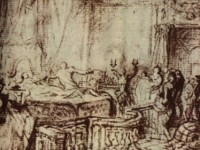
At Versailles, not only the Queen, but princesses of the royal blood were required to give birth in public. Why? To prevent any substitution of the infant in case he was destined to reign. I say “he” by design, because France’s unwritten constitution prevented women to step unto the throne in their own right, though they could, and often did govern the Kingdom as Regents.

In the case of Marie-Antoinette, her first laying-in was all the more eagerly awaited that she had been married for eight years without presenting her husband with an heir. For a Queen, this was a glaring failure. Her sister-in-law, the Comtesse d’Artois, married to the King’s youngest brother, had already been delivered of two healthy little boys. Marie-Antoinette had attended the deliveries, as required by the etiquette, and deeply felt the political and personal humiliation of her own childlessness.

Now at long last she herself was pregnant. The stakes could not be higher: if the child were stillborn, or a girl, the heir to the throne would remain the Comte de Provence, another brother of Louis XVI. The Comte de Provence was cunning, ambitious, and probably the most dangerous enemy of the royal couple. Every year that passed without Marie-Antoinette giving birth to a Dauphin brought him closer to the throne (to which he would eventually ascend, decades later, under the name of Louis XVIII.)

Let us listen to what Madame Campan, First Chambermaid to Marie-Antoinette, tells us in her irreplaceable Memoirs: “The Queen’s laying-in approached; Te Deums were sung and prayers offered up in all the cathedrals. On December 11, 1778, the royal family, the Princes of the royal blood, and the Great Officers of State spent the night in the rooms adjoining the Queen’s Bedchamber.” This, by the way, was days ahead of time because the child would not be born until the 19th of December.

Finally, before noon, it became certain that the birth was imminent. “The etiquette,” continues Madame Campan, “allowing all persons indiscriminately to enter at the moment of the delivery of a queen was observed with such exaggeration that when the obstetrician said aloud: “The Queen is going to give birth!” the persons who poured into the chamber were so numerous that the rush nearly killed the Queen. During the night the King had taken the precaution to have the enormous tapestry screens which surrounded Her Majesty’s bed secured with cords; but for this they certainly would have been thrown down upon her. It was impossible to move about the chamber, which was filled with so motley a crowd that one might have fancied himself in some place of public amusement. Two chimney-sweeps climbed upon the furniture for a better sight of the Queen.”

Marie-Antoinette fainted. Was it simply pain? The body heat created by the crowd packed in the bechamber? The feeling of being exposed to strange eyes in a circus scene? Or the pressure to give birth to a boy? Apparently Marie-Antoinette and her friend the Princesse de Lamballe, Head of the Queen’s Household and member of the royal family, had agreed on a sign the Princesse would make to inform Marie-Antoinette of the child’s gender as soon as it became apparent. Normally that announcement would have been made more formally minutes later, and Marie-Antoinette wanted to know right away. And the child turned out to be a girl! Maybe the disappointment was enough to make the Queen lose consciousness.

The obstetrician decided that the patient needed to be bled (indeed what patient wasn’t in need of a good bloodletting in the 18th century?). More sensibly by modern standards, he called for the windows to be opened wide.

The King sprung to action. The windows had been stopped up (Versailles has always been notoriously drafty) and he rushed to force them open. Let us not forget that Louis XVI was a man of unusual height and strength.

The Court’s head surgeon then seized his lancet and bled the Queen. Whether thanks to his ministrations or more likely the rush of fresh air in the stifling room, she opened her eyes. At this moment the Princesse de Lamballe, who was much given to what was then called “nervous spasms,” added to the general confusion by fainting herself. She had to be carried through the crowd “in a state of insensibility.” Only then was it deemed necessary to empty the room of all idle onlookers. “The valets,” writes Madame Campan, “dragged out by the collar such inconsiderate persons as would not leave the room.”

“This cruel custom,” continues Madame Campan, “was abolished afterwards. The Princes of the family, the Princes of the blood, the Chancellor, and the ministers are surely sufficient to attest the legitimacy of a prince.”

Certainly it was an improvement, but that still left a few dozen people to attend every royal birth…

Catherine Delors is author of Mistress of the Revolution. She also keeps a fascinating blog on all things royal during the eighteenth century.

Women’s Medical Secrets


by Renee Hanemann (Vanderbilt University)


Queen Elizabeth I, the queen of England and Ireland in the late 16th century, was a public participant in what was usually considered women’s secret, private household medical practice. She helped to create broader public recognition of women’s medical knowledge with the publication of “Closset of Secrets.” The “secrets” contained in the text were extensive, covering numerous aspects of women’s health and beauty. In a segment entitled “The Child Bearer’s Cabinet,” the text exposed monthly medical instructions for pregnant women, including nutritional information and advice for avoiding imaginary and psychological traumas which might affect the fetus. Additionally, the segment contained post-birth medical instructions, both for the newborn child and the new mother. The main purpose of this selection was to ensure that women of the royal court (among other readers) would make no mistakes in childbearing due to their own ignorance. Thus the queen used her position as queen to educate other women.

Another segment of Elizabeth’s “Closset” concerned the Black Plague and Smallpox. Epidemics in London created widespread fear and panic, calling for new medical knowledge. The selection “Treatise Concerning the Plague and the Pox” focused on presenting cures for both illnesses through the use of home remedies and recipes that could ward off contagions and keep the population healthy. In this way, Elizabeth I used her public position to draw connections between the queen’s duty to share knowledge and protect her people, and the housewife’s duty to use household wisdom to cure her family.

Arnold, Ken. Cabinets for the Curious: Looking Back at Early English Museums. Aldershot: Ashgate, 2006.

Evans, Robert John Weston. Curiosity and Wonder from the Renaissance to the Enlightenment. Aldershot: Ashgate, 2006.

A 19th Century Abortionist

By Beverly Swerling

It’s tempting to think the abortion wars started with Roe v. Wade, but it’s not true.

In the early eighteenth century abortionists advertised in New York City broadsheets offering “guaranteed cures” for “female problems,” code for an unwanted pregnancy. The cures took the form of a variety of purges and placebos, and the non-sterile, non-anaesthetized version of what we’d now call a dilation and curettage when performed by a doctor, or a back-alley coat hangar special at the hands of an unqualified abortionist.

Just as the title quack was not a pejorative in colonial times – quackery was defended as natural and ‘homely’ – abortion was considered perfectly acceptable if performed before the end of the fourth month, the usual time for the child to “quicken.” The popular notion was that until then the fetus was not human, not ensouled, as the clergy said. By 1828, however, doctors were beginning to develop the specialties of gynecology and obstetrics. To eliminate the competition they lobbied for a law that said a person performing an abortion after quickening could be charged with manslaughter, fined $100, and sentenced to a year in prison.

Their pleas were reinforced by a journalist, George W. Dixon, who saw himself as the keeper of public morality and apparently believed that if they could be sure of ending an illicit pregnancy, women would all become adulteresses and prostitutes. Under such circumstances no man could be sure of the virtue of his wife or his daughters.

None of this stopped the most famous abortionist of her day, a woman who called herself Madame Restell, from building a thriving business. On the one occasion when Madam Restell was imprisoned, the men who relied on her to look after their mistresses if needed, (philandering was fine, creating a scandal was not) paid her jailer to provide a featherbed and “delicate” food. While she was in prison the American Female Moral Reform Society visited and tried to persuade her to convert to Christianity. They were not successful. She made even more money after she was released. Enough so she built herself a Fifth Avenue mansion (on the corner of 52nd Street) and bought a splendid coach and four with a liveried driver who took her up and down Broadway every afternoon.

For more, see Edward G. Burrows and Mike Wallace, Gotham: A History of New York City to 1898. Oxford University Press.

Beverly Swerling is author of City of God:  A Novel of Passion and Wonder in Old New York.

Image: National Police Gazette, March 13, 1847

Witches and Midwives


Throughout the Middle Ages and into the early seventeenth century, witch hunts had reached their height, midwives were often depicted as witches who communed with the devil. While there may be questions regarding the exact nature of prosecution/persecution of midwives between 1500 and 1700, description of the demonic works of the midwife-witch nonetheless abound in lay and learned writings through the early-modern era. Kramer and Sprenger’s influential witchcraft book Malleus Maleficarum, first published in 1486 and reprinted no fewer than thirty times between 1487 and 1669, contains frequent reveries on witch-midwives and their horrific acts toward new mothers and their offspring. This book of witchcraft reports a woman’s allegations that she was punished after she refused to allow a midwife with a “bad reputation”to assist her in her pregnancy. Soon after she went into labor, the rejected midwife went into her room, paralyzed her so that she could not speak, and vowed to avenge herself. The midwife-witch then put thorns, bones, and bits of wood in her entrails so that, six months later, the new mother would be “tortured”with unbearable pain.

From Pregnant Fictions: Childbirth and the Fairy Tale in Early Modern France
(p. 64). Author? yours truly.

Men in the Birthroom

by Danielle Kruglak

Seventeenth-century France saw a rise of the prestige of the male midwife, or the chirurgien accoucheur. Two French male midwives who helped the male midwife secure a place in the traditionally female world of childbirth were Jacques Guillemeau and Francois Mauriceau. Their obstetrical treatises open the eye to midwifery practices, beliefs, and conflicts of the time (1).


Guillemeau, who lived from about 1550 to 1613, wrote De l’heureux accouchement des femmes, which was published in French in 1609. His text was broken up into three sections: illnesses and remedies during pregnancy, midwife conduct, and illnesses and remedies after childbirth. Throughout his text, Guillemeau provides references to the methods of the ancients, and he also heavily follows Galenic theory (2).

As a male midwife, Guillemeau was not fond of his female counterpart, and distanced himself from what he considered to be a lesser profession. According to him, female midwives were cunning, not knowledgeable, and would commit errors. They mainly had three jobs: 1) to see if a husband and wife were compatible, 2) to be present at delivery and birth, and 3) to tell if a woman was pregnant (2).

Mauriceau, who lived from 1637 to 1709, wrote two main obstetrical treatises: Des maladies des femmes grosses et accouchees (1668) and Observations sur la grossesse et l’accouchement des femmes (1694). Similar to Guillemeau, Mauriceau followed Galenic theory, including the one-sex model. Much can be attributed to this famous male midwife, such as his tire-tete forceps, which pulled dead children from the womb, and the semi-recumbent or “French” birthing position. Mauriceau also did not approve of female midwives, and he blamed them for causing problems during difficult deliveries (3).

As with many things in life, there were also conflicts within the field of midwifery. One of the largest fights broke out between Mauriceau and Philippe Peu, another well-known male midwife at the time. Through their manuals, treatises, and conflicts, Guillemeau and Mauriceau offer invaluble insight into early-modern French midwifery and culture (1).

Image: Fores, Samuel W. “A Male Midwife,” 1793. Wellcome Library.

(1) McTavish, Lianne. Childbirth and the Display of Authority in Early Modern France. Boston: Ashgate Company, 2005.

(2) Guillemeau, Jacques. Childbirth, or, The Happy Delivery of Women. London, 1612.

(3) Mauriceau, Francois. Des maladies des femmes grosses et accouchees. Paris: Jean Henault, 1668.

Men and Women in Midwifery


by Allison Nelson (Vanderbilt University)


In the early modern period, midwifery began to change from a female art into a male occupation. The shift was not a smooth one. Indeed, it began in 1522, when Dr. Wertt of Hamburg dressed up as a woman in order to observe midwives and learn about childbirth. When he was discovered as a man, Wertt was burned alive. Later in the mid-sixteenth century, however, the renowned surgeon Pare laid a more solid foundation for men’s work in the birthing room; he did this by aiding in delivery by pulling babies out of the womb by their feet during difficult births.

A contributing factor in this shift of gender roles was Louis XIV’s use of male midwives to deliver his illegitimate children. As men delivered his mistresses babies, male midwives gained popularity. A rapid population boom in Europe further encouraged these social changes; as the population grew and universities increased their study of reproduction and anatomy, childbirth became a medicalized and, thus, masculinized domain. Case studies, rather than oral tradition, became the preferred method for educating individuals about childbirth (1).

There existed three recognized distinctions between male and female midwives. First, the men held a monopoly over medical tools, which women were disallowed from owning. Second, the male midwives were more formally educated in universities; there they dissected bodies, read case-studies, and learned about classical theories. Women, on the other hand, were taught through experience; they apprenticed and learned through women’s household manuals. Third, male and female midwives viewed patients differently. While women’s manuals emphasize individual relationships and take a maternal tone, men’s manuals stressed quantitative practices and medical causality (2).

Even as male midwives gained popularity, their acceptance was not unanimous. Some people believed that men did not belong in the birthing room; since men could never experience childbirth, some believed it was beyond the realm of male expertise. Such critics often cited the Bible, claiming the absence of men at recorded births. Other critics viewed male midwives as interlopers into other men’s domestic territory. In a space where the husband or father was absent, the male midwife’s presence stood out as inappropriate; it raised questions about the male midwives’ potentially inappropriate behavior toward vulnerable female bodies. Thus issues of female modesty and male property emerged, and opponents called upon husbands to bar male midwives from their homes (3).

While gender issues caused debate, so too did suspicion about scientific instruments and their over-use in the birthing room. Frequently, male midwives used tools even in “normal” births that might not necessitate them — and the tools posed additional risks. Not only did the tools threaten additional infections, but their misuse could harm the baby or its mother. Renowned female midwife Sarah Stone, for example, claimed that in her career she had only seen four cases that could have been safer through the use of tools (4).

Image: Fores, Samuel William. “A Man-Mid-Wife.” From Man-Midwifery Dissected. London, 1793. (Wellcome Library, London)

(1) Schnorrenberg. “Is Childbirth Any Place for a Woman? The Decline of Midwifery in Eighteenth-Century England.” Studies in Eighteenth Century Culture (10) 1981: 393.

(2)Fife, Ernelle. “Gender and Professionalism in Eighteenth-Century Culture.” Women’s Writing (11:2) 2004: 185-200.

(3)Blunt, John. “Man-Midwifery Dissected: or, The Obstetric Family Instructor.” 1793.

(4) Stone, Sarah. “A Complete Practice of Midwifery.” 1737.

Syphilis in Early Modern Europe

by Jamie Whittenberg


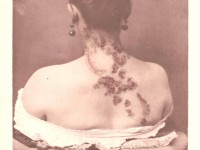
Syphilis, a highly infectious sexually transmitted disease, sparked fear among the early Europeans. And for good reason.

Syphilis has three stages, the last being deadly and untreatable if advanced enough. First recognized as an outbreak in 1494 in Naples among the French mercenary troops, it quickly spread to all parts of Europe. Faced with such a contagious and disfiguring disease, the early Europeans quickly blamed one another or attributed it to external forces such as interspecies sex, the planets, or witchcraft (1).

Often, the men were most often depicted as victims of syphilis. The course of the disease: a woman, the carrier of death. The case of Bellina Loredana exemplifies this attitude. She was accused of inflicting the disease on a prostitute through witchcraft, until she was (partly) exonerated due to the prostitute’s obviously promiscuous behavior. Still, the idea that women spread the disease by seducing men was prevalent (2).

As the disease spread, early modern Europeans began to turn to more naturalistic causes for syphilis. This evolved into two theories: Pre-Columbian and Post-Columbian. The former operated on the belief that syphilis was always present in Europe, possibly misdiagnosed as leprosy. Although the surge may have been noticed after contact with the New World, this theory states that it is just a coincidence. The Post-Columbian theory suggests that syphilis was a disease brought over from the Indians and that no European country was to blame, no matter how much they bickered among each other (1).

No consensus was reached on who was correct in this matter. Many seemed to offer contradictory views on the subject, such as John Smith. He at once called syphilis the “French pockes” as well as the “Indian disease” within one sentence. Both theories are present in his statement. Even looking retrospectively, bio-archaeologists have found it impossible to determine which theory is correct. They studied for syphilitic lesions on the bones in pre-contact Europe and America (1). Although they did find evidence of syphilis in early America, it does not have the characteristic dental pathology that is typical with syphilis. Therefore, it is still undetermined to this day whether syphilis came over from the New World, or if syphilis exploded into a potent form during the siege in Naples in 1494 (1).

Image: Gilman, Sander L. “AIDS and Syphilis: The Iconography of Disease.” October (1987): (43) 87-107.

(1) Qualitiere, Louis F. & William Slights. “Contagion and Blame in Early Modern England: The Case of the French Pox.” Literature and Medicine (2003): (22) 1, 1-24.

(2) McGough, Laura J. “Demons, Nature, or God? Witchcraft Accusations and the French Disease in Early Modern Venice.” Bulletin of the History of Medicine (2006): (80) 2, 219-246.