Category Archives: Queens and Kings

The Confession of Katherine Howard

By Suzannah Dunn

The Confession of Katherine HowardKatherine Howard is the wife of Henry V111′s about whom we know the least – in all but one respect. We know absurdly little of the girl who was, for a time, Queen of England – but ironically, and sadly for her, we know more of one part of her life than perhaps we could know of our closest friends’.

We don’t know what she looked like: there are no authenticated likenesse of her. We don’t know when she was born – even approximately – meaning that we don’t know her age when she became queen nor at her execution a year and a half later.

What we do know of her, though, is what she got up to in bed with her boyfriend, Francis Dereham, when growing up in the traditional Catholic household of her step-grandmother, the Dowager Duchess of Norfolk. Because that, she confessed to her interrogators with startling candour… although I doubt she had much choice in the matter.

I don’t mean that she was physically coerced, but to an uneducated teenage girl, those men – however cautiously they proceeded -must have been gravely intimidating. By sleeping with Dereham, she’d in fact done nothing wrong: what she did before she married was her own business. The big problem was that – incredibly – this behaviour hadn’t stopped when she’d become queen. Although she always denied a sexual relationship with Thomas Culpeper, she didn’t deny their romance. It was her friends’ heartbreakingly credible testimonies, similarly under interrogation, which sealed her fate.

About the author: Suzannah Dunn is the author of ten previous novels, all of which have been critically acclaimed. She has written three historical novels: The Queen of Subtleties, The Sixth Wife and The Queen’s Sorrow.

The Confession of Katherine Howard

Giveaway is closed.

Would you like an email notification of other drawings? Sign up for our weekly digest in the sidebar –>.

Helen of Where?

By Laurel Corona

The Treasure Heinrich Schliemann Uncovered at Troy (Perhaps Helen Wore Some of the Jewelry)Some of the most important scenes in the Odyssey take place in Sparta, where Telemachus, Odysseus’ son goes to search out news of him. The Sparta of the Odyssey, however, was a very different place from the later, more famous city-state that rose to rival Athens during the period of the Greco-Persian and Peloponnesian Wars. King Leonidas, probably the most famous Spartan ruler, would not live until four centuries after Homer, who himself lived more than three centuries after the events of the Iliad and Odyssey.

Sparta and the region immediately around it were known as Lacedaemon (lass-ah-DEE-mun). At the time of the Odyssey, Lacedaemon lacked the prestige, wealth, and military might of its neighbors Mycenae, Tiryns, and Argos. What it did have was a legendary queen, Helen. Her husband, Menelaus, was the younger brother of Agamemnon, the powerful king of Mycenae. Menelaus married Helen, the heir to the relatively insignificant kingdom of Lacedaemon, because he would never rule Mycenae and wanted to be the ruler of something. When Helen runs away, he turns to his brother to raise an army to get her back, because without Helen he has no grounds to be king.

Taking away the trappings, the story is about a minor queen married to a relatively powerless man, but as they say, the rest is history. Regardless of whether you think these characters are real or fictional, Helen should properly be called Helen of Sparta, not Helen of Troy.

About the author: Laurel Corona is a professor of humanities at San Diego City College and a longtime resident of Southern California. She is the author of The Four Seasons: A Novel of Vivaldi’s Venice, along with numerous works of nonfiction. For more information about Laurel and her work, visit www.laurelcorona.com.

Penelope's DaughterGiveaway is closed.

Would you like an email notification of other drawings? Sign up for our giveaway email list by clicking here.

Image Credit: Wikipedia Commons

The Great Fire of Rome

By Stephen Dando-Collins

The Great Fire of RomeRome had experienced devastating fires before, but nothing like the conflagration that started beneath the Circus Maximus on the summer’s night of July 19, AD 64. Fanned by strong winds, the blaze first consumed the stadium, largest wooden construction in history, then spread to nearby suburbs. Seven days later, only four of the city’s fourteen administrative regions remained untouched.

Twenty-six-year-old Nero, emperor of Rome, was on Italy’s west coast at the time, competing in a singing contest. Far from fiddling while Rome burned, he hurried back to organize food and shelter for the hundreds of thousands of refugees.

Nero set up a disaster fund and swiftly commenced clearing and reconstruction, introducing Rome’s first building regulations and providing incentives for private landowners to rebuild. After Rome’s water-delivery system failed to provide water to her 7,000 firemen on the first night of the blaze, Nero updated the water supply. For all this, Nero was widely praised.

Yet, within weeks, Nero’s enemies were accusing him of setting the fire. Within a year, a plot to assassinate him was exposed. Within four years, Nero would meet a bloody end. That end had its beginnings in the Great Fire.

Jewish resistance fighter Josephus railed against those historians who told ‘impudent lies’ about Nero. First century writer Dio Chrysostum was convinced the truth about Nero’s end never came out. That truth, about the two great fires of Rome – one that destroyed the city, the other that destroyed an emperor – is more bizarre, and bloodier, than fiction.

About the author: Stephen Dando Collins is the author of The Great Fire of Rome (Da Capo Press, September 2010).

The Great Fire of Rome

Top 5 Things People Might Not Know About Mary Tudor

Top 5 Things People Might Not Know About Mary TudorBy Anna Whitelock

1. Mary was engaged to be married, aged 2 and a half years old, to the French dauphin. In spite of her young age, Mary did, it seems, know something as to what was happening at the betrothal ceremony that took place at Greenwich palace in London. ‘Are you the Dauphin of France?’ She was reported to have said to the French ambassador: ‘If you are, I wish to kiss you.’

2. With her mother, Catherine of Aragon’s guidance, Mary was highly educated and widely praised for her accomplishments. She was able to read a Latin letter by the age of nine and at twelve translated the prayer of St Thomas Aquinas from Latin into English.

3. Throughout her life, Mary loved to gamble. Her privy purse accounts reveal numerous amounts of money lost in this way.

4. She was the first ever woman to be crowned queen of England. Many people think it was Matilda, daughter of Henry I in the twelfth century, but she was never crowned and was given only the title ‘Lady of the English’. Up until Mary’s reign, English law was masculine referring only to kings. By a special Act of parliament in April 1554, Mary declared that women had all the power of men and queens could rule with all the force of law as their male counterparts.

5. Mary is buried beneath Elizabeth I in Westminster Abbey. Elizabeth was dug up from elsewhere in the abbey three years after her death and moved into her sister’s grave by king James I. Elizabeth’s presence in the grave is celebrated by a magnificent monument, the fact that Mary also lies there is acknowledged only by the Latin inscription ‘Partners both in throne and grave. Here rest we two sisters Mary and Elizabeth in the hope of one resurrection.’

About the author: Anna Whitelock received her PhD in History from Corpus Christi College, Cambridge, in 2004 with a thesis on the court of Mary 1. Her articles and book reviews on various aspects of Tudor history have appeared in publications including The Guardian, The Times Literary Supplement, and BBC History. She has taught at Cambridge University and is now a lecturer in Early Modern History at Royal Holloway College, University of London. In 2010, Whitelock, who was nominated by Antonia Fraser, received the Arts Club Emerging Writer Award.

Mary Tudor: Princess, Bastard, QueenGiveaway is closed.

Would you like an email notification of other drawings? Sign up for our giveaway email list by clicking here.

Image Credit: Bridgeman Art Library in London

History’s Black Widow: The Legend of Catherine de Medici

By C. W. Gortner

Catherine de Medici is known as the evil queen who masterminded a massacre. Or so the legend says. In truth, Catherine has been the target of a smear campaign that began in her lifetime and culminated with Alexander Dumas’s famous depiction of her in his novel La Reine Margot. Dumas exalted the queen we love to hate and enshrined her as history’s black widow.

Of Italian birth, Catherine came to France as a teenager to wed Henri II. To this day, she is not considered French; her background as a Medici made her a parvenu and prejudice against her because of her nationality haunted her throughout her life. Italians were despised as experts in the black arts; Catherine’s natural inclination toward her fellow countrymen was thus often used against her.

One of the greatest misconceptions is that Catherine nurtured a “passion for power”—another Italian trait. Though not raised to rule, she became regent for her sons in a kingdom torn apart by war. Her alleged ambition was in fact an effort to defend her adopted realm. While she made serious errors, she was usually motivated by the urgency to salvage a crisis than any cold-blooded urge to destroy her foes.

In the end, she is best revealed by her own words: “It is great suffering to be always fearful.”

C.W. Gortner, author of The Confessions of Catherine de Medici: A Novel, holds an MFA in Writing, with an emphasis in Renaissance Studies. Half Spanish by birth, he was raised in southern Spain and has traveled extensively to research his books. He is currently at work on The Princess Isabella, a novel about the early reign of Isabella of Castile, as well as The Tudor Secret, Book One in The Elizabeth I Spymaster Chronicles. C.W. is available to chat with book groups via speaker phone or Skype. To book a chat and learn more about his work, please click here.

IMAGE: Portrait of Catherine De Medici and her children

Congratulations to the following W & M winners of this book:

Jennifer, Kitty, and Dana

The Heretic and the Murderer

By S. J. Parris

England, 1583. Twenty-five years into the protestant Queen Elizabeth’s reign, the kingdom remains dangerously divided between those still loyal to the old Catholic faith and those who accept the official religion. Rumors of invasion plans by the European Catholic powers fuel whispers of conspiracies to assassinate the queen in the name of Rome.

Into this web of tensions arrives one of the most enigmatic and compelling figures of the Renaissance: the Italian philosopher Giordano Bruno. An ex-Dominican friar, on the run from the Inquisition for his heretical beliefs about an infinite universe, Bruno comes to England under the patronage of the French king and is invited to the University of Oxford to take part in a public debate about the new cosmology.

All this is historical record. But some believe that Bruno was working as a spy for Sir Francis Walsingham, Elizabeth’s spymaster, while he was in England, and this theory has been the basis for my novel, Heresy. Oxford was a source of great anxiety to Elizabeth’s government; a hotbed of underground Catholic resistance, where the very young men who would go on to become pillars of the English establishment – politicians, lawyers, churchmen – were being converted to Rome right under the noses of the authorities.

My fictional Bruno uses his time in Oxford as a cover for investigating secret loyalties. But when the university Fellows start to be murdered around him, with apparently religious motives, Bruno realizes that there are those who are willing to kill for their faith as well as die for it.

S.J. Parris is the pseudonym of Stephanie Merritt, a contributing journalist for various newspapers and magazines, including the Observer and the Guardian. She is also the author of Heresy. She lives in England.

IMAGE: Portrait of the real Giordano Bruno

Congratulations to the following giveaway winners:

Rachel, Kitty, Audra, librarypat, and John

A copy of Heresy is on it’s way!

Some little known-things about Cleopatra

By Duane W. Roller

Cleopatra VII (69-30 BC), the last queen of Egypt, is probably the most famous woman from classical antiquity, if not all history. Yet her modern reputation is based largely on the presentation of her in art and cinema, rather than the actual historical reality of this most fascinating of women. Here are several things about her that are not generally known:

1. She was by no means a great seductress. She had only two known relationships in 18 years, hardly a sign of promiscuity. Both of these were with carefully selected partners (the most powerful Romans of the era), and were designed to produce heirs (the only way her kingdom could survive).

2. She was a highly educated person. She knew at least a dozen languages. She was also a published author, writing at least two treatises on medical subjects, the predominant discipline of her era.

3. She was a naval commander. As a royal personage, she was skilled in the arts of warfare, and twice led her fleet in battle.

4. She was connected with contemporary Messianic thought. Many were suggested to be the Messiah in her day; an oracle tells of a woman who will restrain the Romans and push them out of the eastern Mediterranean. There is no other candidate for this woman than Cleopatra.

5. She did not die by the bite of an asp. The Egyptian asp (cobra) is several feet long and generally not fatal. She probably died by poison, as the sources consistently say, but may have left a suicide note fabricating the story of death.

Duane W. Roller is Professor Emeritus of Greek and Latin at the Ohio State University and author of Cleopatra: A Biography (Oxford 2010).

IMAGE: Wall painting in Room 71 of the House of M. Fabius Rufus, Pompeii, showing the statue of Cleopatra VII in the Forum Julium. Courtesy of Pietro Giovanni Guzzo, Domenico Esposito, and the Soprintendenza Archeologica di Pompei.

Congratulations to the following winners:

Anne, Marie, Zoe, and Patty

We’ll be in touch real soon!

King James I: Demonologist

By Mary Sharratt

Even by the standards of his age,” King James VI of Scotland, later James I of England, stood out as a deeply superstitious man, obsessed with the occult.

Before his reign, witchcraft persecutions had been rare in Britain. But that all changed in 1590 when James personally oversaw the trials by torture for around seventy individuals implicated in the North Berwick Witch Trials, the biggest Scotland had known. Their alleged crime? Raising a storm which nearly sank James’ ship when he sailed home from Norway with his new bride, Anne of Denmark. The trial resulted in possibly dozens of people burned at the stake, although the precise number is unknown.

In 1597, James published Daemonologie, his rebuttal of Reginald Scot’s skeptical work, The Discoverie of Witchcraft, which questioned the very existence of witches. Daemonologie was an alarmist book, presenting the idea of a vast conspiracy of satanic witches threatening to undermine the nation.

In 1604, only one year after James ascended to the English throne, he passed his new Witchcraft Act, which made raising spirits a crime punishable by execution.

James’ ideas on witchcraft were later popularized by Shakespeare’s play Macbeth, performed for James’s court in 1606. For the first time in history, English drama depicted witches gathering in secret for their own malign scheming. According to Instruments of Darkness by James Sharpe, this terror of supposed witch covens was the driving factor mobilizing 17th century witch hunts.

In 1612, the King’s paranoid fantasy of satanic conspiracy, planted in the minds of local magistrates eager to win his favor, culminated in one of the key manifestations of the Jacobean witch-craze—the trials of the Lancashire Witches, accused of plotting to blow up Lancaster Castle with gunpowder. Eight women and two men were executed.

James’s legacy extends even into our age. The King James Bible, completed in 1611, saw the scriptures rewritten to further the King’s agenda. Exodus 22:18, originally translated as, “Thou must not suffer a poisoner to live,” became “Thou must not suffer a witch to live.”

Further reading:

The Lancashire Witches: Histories & Stories, Robert Poole, ed, Manchester University Press, 2002.

Instruments of Darkness: Witchcraft in England, 1550-1750, James Sharpe, University of Pennsylvania Press, 1997.

Mary Sharratt is the author of Daughters of the Witching Hill (Houghton Mifflin Harcourt, April, 2010), a novel based on the true and heartbreaking story of the Pendle Witches of 1612. She lives at the foot of Pendle Hill in Lancashire, England. To read more about her, click here.

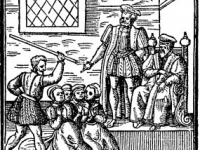
IMAGE: illustration from the original document, The News from Scotland, about the trial of the Witches of North Berwick

Congratulations to the following winners:

DaintyBallerina, Gian T., and Paul M.,

We’ll be in touch real soon!

The Fairest Maiden of Them All: Edward Stafford, Duke of Buckingham
By Susan Higginbotham

“Edward? Good Lord, you did dress him as a girl!”

“Aye . . . He bore his womanhood like a man, you might say.”

Edward Stafford, the third Duke of Buckingham (1478-1521), is mainly known today for finding out the hard way that offending Henry VIII could cost someone his head. Less well known is the episode when the five-year-old Edward—dressed as a girl—was hidden from Richard III’s agents.

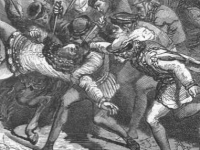
Edward’s adventures in cross-dressing began in October 1483 when Edward’s father, Henry Stafford, the second Duke of Buckingham, joined the ill-fated uprising against Richard III known as Buckingham’s rebellion. The enterprise proved fatal to Henry, who died on the scaffold at Salisbury. Before he was captured and executed, however, he had entrusted Edward to Richard Delabeare, who had close ties to the Stafford family. Richard Delabeare later married his servant Elizabeth Mors, whose recollection of this episode was found in the Stafford family papers.

With Henry dead, Richard III began searching for Edward, who proved to be elusive, thanks to Elizabeth. She shaved the lad’s forehead and dressed him in a “maiden’s raiment.” At one point when a search party arrived, Elizabeth fled to a park with Edward, sitting with her no doubt squirming charge for four hours until the danger was past. After that, Elizabeth took Edward to Hereford. Edward made the journey as would a young lady of quality: “rydinge behynde Willm ap Symon asyde upon a Pillowe like a gentelwoman ridde in gentelwomans apperell.” Rather sweetly, Elizabeth concluded her story, “And I wisse he was the fearest gentelwoman and the best that ever she hadd in her Daies.”

Nothing more is heard of Edward’s whereabouts during Richard III’s reign, but in Henry VIII’s reign, Edward was noted for his sartorial splendor, such as in 1513, when he appeared in an outfit “full of Spangles, and little Belles of golde, marueylous costly and pleasant to behold.” One wonders if on such occasions, the duke ever thought back to his long-ago disguise in 1483.

Susan Higginbotham’s new novel, The Stolen Crown, set during the Wars of the Roses, tells the story of Edward’s parents, Henry, Duke of Buckingham, and Katherine Woodville. Susan is working on a novel about Margaret of Anjou.

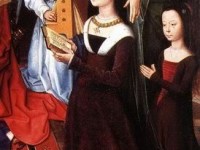
IMAGE:How Edward might have looked in disguise: a well dressed little girl (far right) in Hans Memling’s Donne triptych. (Image courtesy of Hans Memling’s website.)

The Boleyn Ring

By Karen Harper

When I was in London in 2003 for the 400th anniversary of the death of Queen Elizabeth I, I visited a display of her possessions. What caught my eye was a ring with a hidden lock which sprang open to reveal two tiny portraits, that of the queen herself and of her mother, Anne Boleyn. After Anne’s downfall and beheading in 1536 when Elizabeth was only three, she was forbidden by her father, Henry VIII, to speak of her mother. Yet here was proof Elizabeth had cherished the shamed and dispossessed woman. It was said that, whatever other opulent rings she wore, the Virgin Queen never removed this ring and it was only taken from her finger upon her death.

There is, of course, other proof that Elizabeth did not believe her mother had committed adultery or even, in the wildest of accusations which helped Henry rid himself of her, witchcraft. Elizabeth took for her own crest her mother’s white falcon and elevated many of her mother’s kin when she finally became queen in 1558.

That little ring gave me a great plot device for my latest historical novel, The Queen’s Governess. In the book, Anne summons Elizabeth’s governess, Katherine Ashley to the Tower, where she is under arrest for treason and gives her the ring to keep for Elizabeth until she is of age. King Henry’s discovering the ring years later on the Princess Elizabeth’s person causes him to banish her from court—an actual happening. From such small wonders and marvels as a little ring are epic stories made.

A New York Times and USA Today bestselling author, Karen Harper is a former college English instructor (The Ohio State University) and high school literature and writing teacher. To learn more about her book, The Queen’s Governess, click here.

IMAGE: The Ring