Category Archives: Queens and Kings

Ruff-ing It and the Politics of Fashion

By Elizabeth A. Lehfeldt (W&M Regular Contributor)

Writing in 1637, the Marquis of Careaga deplored the “delicate and womanly” fashions that enraptured Spanish men.  He warned that these indulgences “overthrew their spirits, unnerved their determination, weakened their energy, and diminished their manly vigor.”

We might wonder what sort of fashions could inspire such vitriol.  A particular item stood at the heart of his comments and those of other moralists: a ruff.  Specifically, a Spanish variation on the ruff known as the cuello.  The cuello, represented here in a portrait by El Greco, had become an object of excess.  This collar was several inches high, tinted with powders, and often decorated with fancy threads.  And it had to be washed and starched daily to maintain its appearance.  By the early seventeenth century, some tried to elevate their cuellos even further, using an undergirding support known as an alçacuello.  Thus, the cuello came to embody a host of moralizing complaints that ranged from foreign policy to the economy to fears of compromised masculinity.  To begin with, the dyes used to tint them were imported from Spain’s enemy, the Dutch.  Many argued that the nobility’s ducados would benefit Spain more if they were spent locally.  Finally, the cuello violated the prevailing code of virtuous virility that prized moderation, control, and a sense of effortlessness in matters of style.  If anything, the cuello screamed excess and effort.  Everyone knew how labor-intensive their care and presentation was.  Men who indulged in this fashion were often characterized as effeminate.  Their inability to dress with moderation compromised their masculinity.  At a time when Spain was engaged in military conflict across the globe, the “manly vigor” of its male citizens had serious political consequences.

The crown, in fact, vigorously legislated against them.  As early as 1594 it forbid the adornment of cuellos, specified a particular width for them, and that any decorative elements be white.  Again, in 1600 it issued orders regarding the width of cuellos.  Yet the fashion endured.  Ultimately, rather than modify their appearance, the crown abolished them completely in 1623.  It presented as an alternative the low, flat collar of the valona.  Even the king himself was not above this new rule as we can see here in Velázquez’ portrait of Philip IV (1621-1665).  Not unlike today, seventeenth-century fashion was intensely political.

Elizabeth A. Lehfeldt is Chair and Professor of History at Cleveland State University.  She writes on the history of gender in premodern Europe.


Juana of Castile’s Baggage

By Elizabeth A. Lehfeldt (W&M Regular Contributor)

Imagine being known to history as Juana “la Loca” or Juana “the crazy one.” That is heavy baggage to carry forward from the sixteenth century into the postmodern era.  Before she was Juana la Loca, she was Juana of Castile (1479-1555), the eldest surviving heir of the famous monarchs Isabel of Castile (r. 1474-1504) and Fernando of Aragon (r. 1474-1516).  When her mother died in 1504, earlier marriage capitulations made it impossible for her father to inherit the throne, making Juana the rightful sovereign of Castile.  Yet her ambitious father and her husband, Philip the Fair (1478-1506), sought to break this neat line of succession and push her off the political stage.  In part, they used rumors of her instability to discredit her authority.  When Philip died unexpectedly in the city of Burgos in 1506, Juana’s behavior unfortunately fueled the flames of her detractors.  She insisted upon accompanying her husband’s funeral cortege across the Iberian peninsula from Burgos to his final resting place in Granada.  Fernando presented this act of wifely devotion and other emotional outbursts as evidence of mental illness and advanced his own claims to the throne.  He eventually forced her seclusion in a convent in the small town of Tordesillas.

Fernando died in 1516, leaving behind Juana and her son, Charles I (1500-1558), as his heirs.  Despite her confinement, Charles continued to consult with her and maintained the pretense of joint rule with his mother.  A group of urban leaders who were dissatisfied with Charles’ long absences from Castile and reliance on foreign advisers even appealed to Juana during a revolt they staged in 1520-21.  Some clearly believed she could still exercise independent sovereign power.

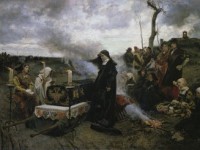
But in the end, later generations would immortalize her for her presumed, but never proven, insanity.  Juana’s plight captured the attention of nineteenth century Romanticists, for example, who sentimentalized her devotion to Philip in paintings like this one above by Francisco de Pradilla, produced in 1877.  This haunting portrait speaks volumes about history’s distorted image of a misunderstood queen.  In 2001 a Spanish movie, “Juana la Loca,” (translated for English-speaking audiences as “Mad Love”) perpetuated this interpretation of Juana’s instability.

Recent scholarship has sought to investigate the true character of Juana’s personality and exercise of political authority (see, for example, Bethany Aram, Juana the Mad: Sovereignty and Dynasty in Renaissance Europe, 2005).  It reveals that she often rejected the power that she was entitled to, but she was not insane.  At some moments she worked vigorously to assert her sovereignty and her control over her royal household.  Only time will tell if interpretations like this are enough to rid Juana of the weighty baggage of being portrayed as a mentally unstable queen.

Elizabeth A. Lehfeldt is Chair and Professor of History at Cleveland State University.  She writes on the history of gender in premodern Europe.


A Versailles Christmas

Marie Antoinette at Versailles, ornament available at zazzle.com

A few years ago I had the pleasure of visiting the Bibliotheca Bodmeriana in Geneva (a must-do for historical bibliophiles), where the eyes feast on marvels such as a full codex of the gospel of John and a Gutenberg Bible. Among the rare court documents that Martin Bodmer collected over his lifetime sits Elizabeth I’s Christmas gift list for her courtiers; names and gifts descend in order of rank. Looking at it, you have a glimpse into Elizabethan holiday ritual. It occurred to me as a French seventeenth-centuryist that I knew little about Noël at Versailles. I turned to the fountainhead of anecdote about the Sun King’s reign: the Duc de Saint-Simon.

Louis XIV’s outspoken courtier talks about the holiday several times in his 15-volume memoires of the court. Two mentions are incidental and occur because another important event he is describing happens to take place around Christmas. A third that briefly details holiday ritual (Chapter LXXI) is tucked into a description of the religious skepticism of Louis XIV’s brother, Monsieur, Le Duc d’Orléans. Saint-Simon sets his story of the prince’s ungodliness at midnight mass in Versailles’ chapel—three midnight masses to be exact—to which Monsieur accompanied the king. The memoires describe the beauty of the atmosphere as charmed, even for Versailles: music that surpassed the opera, magnificent decoration, and extraordinary lighting. Palace celebration, trimming and all, revolved around the mass.

In the midst of this “brilliant scene,” Monsieur sat reading what looked like a prayer book. A lady-in-waiting was moved by the vision of the Duc immersing himself in the spirit of the night and remarked on it. As Saint-Simon recollects it, the Duc responded, “You are very silly, Madame Imbert. Do you know what I was reading? It was ‘Rabelais,’ that I brought with me for fear of being bored.” So much for holy music and fabulous decoration. On Saint-Simon’s read, no manner of divine celebration could stop Monsieur from “playing the impious, and the wag,” not even Christmas at Versailles.


Christine A. Jones teaches French 17th/18th-century literature and culture at the University of Utah. She writes on fairy tales, porcelain, dance and wine.

Even Royal Molars Decay

By Lauren Renaud (Vanderbilt University)

A gleaming white smile represents youth and beauty. Today, pearly whites are achievable for many through regular visits to the dentist. However, in eighteenth century France, the dental field was just seceding from quackery. A new professional, the dentiste, was replacing local blacksmiths who remedied toothaches through extraction with bulky metal tools. Without dental hygienists and the knowledge that sugar leads to cavities, even French royalty couldn’t escape the blight of tooth decay.

The most visible of royal dental disasters afflicted French King Louis XIV. Ironically, the Sun King, known for visual extravagance, was toothless by age forty. Throughout the 1680’s Louis XIV experienced tooth decay probably catalyzed by his taste for candied fruits and sweetmeats. Although the decay necessitated numerous extractions, the royal surgeon refused to remove the king’s rotten molars because dentistry was considered a “mechanical” field. Instead, he summoned arracheurs de dents (itinerant tooth pullers) to perform the tasks.

The procedures progressed regularly until 1685, when one extraction merited mention in the Journal de santé [The Health Journal]. In this case, the extractor accidentally removed a large portion of the king’s jaw and palate in addition to the rotten tooth. The Sun King was left with a large hole in his mouth. After this incident, whenever the King took a drink, the beverage spouted out his nose in a fountain-like manner. A surgeon later cauterized the hole ending the embarrassment and the festering infection.

After experiencing the woes of tooth decay, Louis XIV appointed a specialist dental surgeon in 1712. Years later, Louis XV also grew concerned about tooth loss. He assigned an even greater importance to the dentistry by granting his personal dentiste, Jean-Francois Capperon, letters of ennoblement. This meant that, by royal decree, the dentiste was now a member of the nobility.

Tooth decay not only afflicted French commoners but also members of high society. For French royalty, who assigned utmost importance to their appearances, the services of the dentiste became necessary for preserving their smiles and the marriage potential of their children.

A Marvelous Dinner Party


Footed plate for Louis XV’s “service bleu céleste.” Vincennes Manufactory. 1754-5. Boughton House.

Madame de Pompadour, mistress of Louis XV, had a serious passion for porcelain. She took a leading role in patronage and artistic influence at the French manufactory at Vincennes, which produced the finest objects in the realm in the 1750s. The king provided the economic support to ensure that Pompadour and his court could overindulge in these luxuries. He purchased the manufactory, restricted the movement of workers, and entrusted direction to the head chemist at the Académie des Sciences, Jean Hellot. In return, the manufactory lavished the monarch and mistress with exquisite wares designed in their honor.

One innovation that charmed the court hailed from Europe’s leading porcelain manufactory at Meissen in Saxony. Meissen’s chemists had perfected a new form in porcelain—the plate—and hatched the novel idea of an entire service of cups, plates, and servers painted with the same pattern. Louis XV asked Vincennes to copy the new form and produce the first French dinner service. For the occasion, Hellot, who was a specialist in paint, experimented with a color never before seen on porcelain wares. He wanted an underglaze rich enough to cover a whole area of the vessel—color had formerly been too thin to coat a large area well and was reserved for small designs or trim. “Celestial blue” (bleu céleste) formed a bright heavenly orb in the center of the plate and proved worthy of special presentation.

Anecdote has it that one evening in February, 1755 the service sat waiting in boxes around the royal dining room. The king planned to unveil it ceremoniously by involving guests in the ritual. He gathered the nobility before the group of crates. Everyone in attendance was asked to open one and unwrap a celestial “masterpiece.” This spectacle of the marvelous dinner plate nicely captures the excitement around the art of the table when the full porcelain service first became the must of the fashionable dinner party.


Christine A. Jones teaches French 17th/18th-century literature and culture at the University of Utah. She writes on fairy tales, porcelain, dance, and, most recently, wine.

The Royal Miracle

By Gillian Bagwell

The defeat of Charles II by Cromwell’s forces at the Battle of Worcester on September 3, 1651 set off one of the most astonishing episodes in British history – Charles’s desperate six-week odyssey to reach safety in France, which came to be known as the Royal Miracle because he narrowly escaped discovery and capture so many times.

Charles and his ragged and outnumbered army knew that all their hopes rested on the outcome of the day.  Their bloody rout ended the Royalist cause.  Once Charles had been convinced that the best he could do was survive, he fled as his supporters made a last ferocious stand, and legendarily dashed out the back door of his lodgings as the enemy entered at the front, slipping out the last unguarded city gate.

From that disastrous night until he finally sailed from Shoreham near Brighton on October 15, he was on the run, sheltered and helped by dozens of people – mostly simple country folk and very minor gentry – who could have earned the enormous reward of £1000 offered for his capture, but instead put their lives in jeopardy to help him.

For most of the time Charles was traveling, he was riding with a woman, and disguised as a servant.  It was an improbable scheme.  He was a noticeable man, six feet two and very dark, yet time after time he rode right under the noses of Cromwell’s soldiers without being recognized.

He was in grave danger of capture and death throughout his 600-mile journey (which can be recreated by following the Monarch’s Way footpath), but the experience was strongly formative.  After his restoration to the throne he told the story frequently for the rest of his life, and the hardships he endured gave him an understanding of the common people such as no other king had had.  If he hadn’t escaped, England’s history would likely have come out quite differently.

Gillian Bagwell’s novel The September Queen, the first fictional account of Jane Lane, an ordinary Staffordshire girl who risked her life to help the young Charles II escape after the Battle of Worcester, will be released on November 1.  Please visit her website, to read more about her books and read her blog Jane Lane and the Royal Miracle, which recounts her research adventures and the daily episodes in Charles’s flight to freedom.

A Queen’s Anger

By Elizabeth A. Lehfeldt

In the summer of 1474 (only a few months after the acclamation ceremony I described in my earlier post), King Fernando met with miserable failure on the battlefield.  Upon returning to the court, according to the chronicler Juan de Flores, his wife, Queen Isabel, delivered a scathing harangue: “Using the courageous words of a man rather than those of a fearful woman,” she upbraided Fernando.  She said that as news reached her of the outcome she “had sat in the palace, with an angry heart, gritted teeth and clenched fists.”  She berated his temerity and weakness.*

Despite the fact that there are at least five contemporary chronicles of the monarchs’ reign, this account of the queen’s anger only appears in the one by Juan de Flores.  Only one other comments on Isabel’s emotional state, saying simply that she was saddened by the loss.

We should ask ourselves, then, what image of the queen does Flores’ account create?  At first blush we might think that he is criticizing her.  What right did she have to speak to her husband like that?  Conduct manuals of the day cautioned wives—even powerful ones—to be silent, circumspect, and obedient.  Curiously, Flores may thwart this dilemma by endowing her with manly attributes.  And he doesn’t limit himself to descriptions of Isabel.  In fact, this assertive Isabel is consistent with his portrait of another forthright personality of Isabel’s day, Beatriz de Bobadilla.  Beatriz, due to her husband’s illness, had periodically administered the city of Segovia.  According to Flores, she performed the necessary tasks “like a very discrete man and woman” and with a “shrewdness more intense than women customarily possess.”   Like Isabel, Beatriz conducts herself in a masculine fashion.

Flores’ contemporaries would have seen in his portrayals of Isabel and Beatriz familiar images of what they called a mujer varonil or manly woman.  It was also how a fifteenth-century Spanish biography described the cross-dressing warrior Joan of Arc.  This gender-bending category praised women not for feminine virtue, but for the transcendence of their womanly nature (perceived as weak) and the assumption of male qualities.  Thus, Isabel’s anger is not a liability, but rather an indication of her strength.

* All translations are my own taken from Flores’ Crónica incompleta de los Reyes Católicos.

Elizabeth A. Lehfeldt is Professor of History at Cleveland State University.  She writes on the history of gender in Europe between 1400 and 1700 with an emphasis on Spain, queens, and convents.

Louis XIV and his Marvelous Legs

Raoul-Auger Feuillet, Chorégraphie, 1700

By Christine A. Jones (Wonders & Marvels contributor)
The young Dauphin loved the stage. He famously danced the role of the Sun to the delight of the court at the age of 13. Later, when he began his personal reign at the age of 21, he adopted this allegory as his legendary alter-ego. Louis XIV understood that through dance, as through legislation, he could command the aristocracy to move to the beat of his singular drum. He asked dancing masters to create movement for his body and involved his courtiers in spectacles performed at court in which he played the central role—a most creative way to remind them of their place in his universe.

If you pay attention to portraits of Louis XIV and compare them to those of his descendants you’ll notice a striking feature of his poses: his legs in tights are often visible. And this is no accident. Gifted with a capacity to learn complicated movements that set him apart from most in the 1680s, Louis used the ability to be steady, strong, and graceful on his feet to his advantage. Dance helped him craft the identity that he sought to project to his people as their absolute monarch.

Hyacinth Rigaud, Louis XIV, 1701

Most importantly, as with everything else he did, the Sun King documented his dancing. Not only did his official dance master, Pierre Beauchamps, codify the kinds of steps he designed for the king on stage, he also named the five basic positions—“first position,” “second position,” etc.—and charted their succession in primitive notations on paper. In 1700, a student of Beauchamp’s named Raoul-Auger Feuillet made history by publishing a book that contained the steps to some of the court’s most famous ballroom dances. He called this conceptualization “chorégraphie”: Choreography, or the art of describing dance steps in characters, figures, and symbols. Modern dance notation, and with it the ballet, was born.

Conisbrough Castle, Yorkshire

By Charles Stephenson

Conisbrough Castle - The Keep

By the second half of the 12th century, great towers were becoming ever more architecturally exuberant. One famous example is the whimsical keep built in the 1160s by King Henry II (1154-89) on the Suffolk coast at Orford. Another is the tower built a decade or so later at Conisbrough by the king’s illegitimate brother, Hamelin. Conisbrough had been established soon after the Norman Conquest by William de Warenne. It had come to Hamelin, probably in 1164, by virtue of his marriage to Warenne’s great-granddaughter, Isabel, along with the rest of the Warenne inheritance and the title of Earl of Surrey.

Henry’s tower at Orford is polygonal, with round rooms on the inside, and is supported on the outside by three great buttressing towers. Hamelin’s keep at Conisbrough has similar round rooms and six exterior buttresses, while its exterior is completely cylindrical.

Historians were once inclined to interpret these features as experiments in military science, intended either to deflect missiles or to provide more angles from which to launch them. More recently, Orford has been shown as something altogether different: a playful exercise in geometry. Conisbrough would seem to be a building in much the same mold. Such towers, because of the thickness of their walls, had an inherent resilience, and therefore were of military value. But they were also homes for the super-rich, designed by masons who prized inventiveness for its own sake.

Excerpt from Castles - pages 74-75

Castles

About the author: Consulting editor CHARLES STEPHENSON is a historian and writer, whose recent military titles include: Servant to the King for His Fortifications; Paul Ive and the Practise of Fortification; The Admiral’s Secret Weapon; Fortifications of the Channel islands, 1941-45: Hitler’s Impregnably Fortress; and The Fortifications of Malta, 1530–1945. He is currently working on a history of the Italo-Ottoman War of 1911–12.

An Unusual Political Marriage

By Elizabeth A. Lehfeldt, Professor and Chair, History Department, Cleveland State University

She was twenty-three years old when surprising news reached her in the city of Segovia in 1474.  Her half-brother, Enrique IV, the King of Castile, had died.  She was the lawful heir to his throne—the new sovereign ruler.  She was also married.  In 1469 she had wed the presumed successor to the kingdom of Aragon, Fernando.  She was, however, alone in the city of Segovia when she received the news of Enrique’s death; Fernando was traveling in Aragon.  In Castile Isabel faced a restless nobility and a competitor for the throne, Enrique’s daughter, Juana.  Despite her legal rights to the realm (Castile had nothing like the Salic Law of France that excluded women from succession to the throne), she had to contend with a culture that viewed the political power of women warily or even with outright hostility.  Many probably expected her to turn the reins of power over to her husband.

But she didn’t.  Instead, recognizing the power of swift, decisive action, she quickly staged an acclamation ceremony and did not wait for him to arrive and participate.  She dressed herself regally and processed through the streets of Segovia.  According to at least two chroniclers, she had a member of the nobility walk ahead of her, carrying an unsheathed sword, long-identified as the symbol of justice.  One of these chroniclers found this highly unusual, condemning her ostentatious presumption when such an action was more appropriately her husband’s prerogative.  The other defended her, saying it was her right.  Even if Fernando had been present, he argued, it was still appropriate that the sword accompany her, since she was sovereign ruler of Castile.

Her husband, Fernando, was less sanguine.  Upon hearing the news of the ceremony and her use of the sword, he reportedly remarked to one his courtiers how strange it was for her to employ such a “manly attribute.”  When the two were eventually reunited in Segovia, Fernando’s displeasure prompted a re-negotiation of their marriage contract.  Curiously, despite the fact that his anger had been the catalyst, Isabel retained significant rights and privileges in the kingdom she had just inherited.  The two would share some powers, but her precedence in Castile was clear.

In these battles for power, the reign of Isabel and Fernando reveals a curious mix of gender and politics that would continue to characterize their joint reign until her death in 1504.


I have lots of stories about the unusual political marriage of Isabel and Fernando—let me know in the comments if you’d like to hear more in future posts.