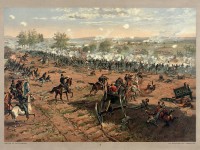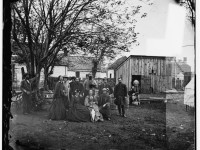
It was mid-summer 1863 and both the North and South felt that as far as the Civil War was concerned, things were coming to a climax. The Yankee army was moving north to meet the invasion of the Confederates under General Robert E. Lee. In Vicksburg, Mississippi, people had been living in caves for six weeks, since the Yankees had the town under siege. In the North there were draft riots. Something had to happen.
Dog trainer from the Red Star Kennel in Russia with a Black Russian terrier, c. 1955.
In the former Soviet Union twenty million people were killed during WWII. Hitler’s order in dealing with the Russians was, “Scruples of any sort are a crime against the German people.” Both the human and animal populations suffered starvation, and death. Is it any wonder the Soviets had such hatred for the invading Germans and all things German? Could a German shepherd expect mercy when it was the favored dog of the Nazis throughout the war, when even Hitler himself had chosen one as a pet? Not likely.
Visitors to Paris are often enthralled by the majestic – if, to my mind, artificial looking – landscape of the Bois de Boulogne. This 2,000-acre park in the city’s southwest corner is dense, not just with vegetation but with history, too. One spot that few tourists stumble upon combines both. Set among the trees, a concrete monument marks the spot where, during the Nazi Occupation of Paris, thirty-five young Resistance fighters, betrayed by a Gestapo agent, were killed by German soldiers in an ambush on August 16, 1944. The horror of this event was compounded by its timing: Just over a week later, Paris was liberated and the Nazis expelled.

Sitting on the steps of the Lincoln Memorial in Washington, D.C., and looking toward the Capitol, we can see America’s vision of how war is meant to be.