Category Archives: Religion

Congratulations, Hildegard!

By Elizabeth A. Lehfeldt (W&M Regular Contributor)

Congratulations to Hildegard of Bingen (1098-1179)!  Pope Benedict XVI has announced that he will recognize her as a Doctor of the Church in October of this year.  She will join the ranks of only thirty-three other individuals and she will be only the fourth woman to receive this prestigious recognition.  What does this title mean and what is its significance for Hildegard of Bingen?

According to the Catholic Encyclopedia, “certain ecclesiastical writers have received this title on account of the great advantage the whole Church has derived from their doctrine.”  So it wouldn’t surprise us to find the likes of St. Augustine, St. Jerome, and St. Bede the Venerable among their ranks.  Considering the vast array of ecclesiastical writers and theologians that populate Catholic history, however, the list is surprisingly short and exclusive.  And the previous female additions to this canon have come only in the last forty-five years: St. Teresa of Avila (1970), St. Catherine of Siena (1970), and St. Thérèse of Lisieux (1997).

Hildegard of Bingen was a visionary nun of the twelfth century.  In addition to recording her visionary experiences, she wrote on a vast array of other topics, including the natural sciences and theology.  In her lifetime she corresponded with popes and was sought out by other ecclesiastics for her advice.  She also wrote music that has been widely performed and recorded in the modern era.  Click here for a sample of from one of these recordings.

The nomination to be a Doctor of the Church must come from the papacy or an ecumenical council (although no council has ever exercised this prerogative).  Thus, the decision to nominate may tell us as much about the nominee as it does about the historical context during which that recognition is achieved (an approach that has been effectively applied to the study of canonization proceedings as well).

Benedict XVI appears to have a particular affinity for Hildegard.  He has spoken about her in several general audiences dating back to at least 2010.  In September of that year he said She brought a woman’s insight to the mysteries of the faith. In her many works she contemplated the mystic marriage between God and humanity accomplished in the Incarnation, as well as the spousal union of Christ and the Church. She also explored the vital relationship between God and creation, and our human calling to give glory to God by a life of holiness and virtue.”  He has continued to include her in his remarks, indicating most recently his decision to elevate her to the status of Doctor.

Curiously, he will have to canonize her as a saint first, since that is required for the status of Doctor and Hildegard had only previously reached the ranks of the beatified.

Elizabeth A. Lehfeldt is Chair and Professor of History at Cleveland State University.  She writes on the history of gender in premodern Europe.

A Versailles Christmas

Marie Antoinette at Versailles, ornament available at zazzle.com

A few years ago I had the pleasure of visiting the Bibliotheca Bodmeriana in Geneva (a must-do for historical bibliophiles), where the eyes feast on marvels such as a full codex of the gospel of John and a Gutenberg Bible. Among the rare court documents that Martin Bodmer collected over his lifetime sits Elizabeth I’s Christmas gift list for her courtiers; names and gifts descend in order of rank. Looking at it, you have a glimpse into Elizabethan holiday ritual. It occurred to me as a French seventeenth-centuryist that I knew little about Noël at Versailles. I turned to the fountainhead of anecdote about the Sun King’s reign: the Duc de Saint-Simon.

Louis XIV’s outspoken courtier talks about the holiday several times in his 15-volume memoires of the court. Two mentions are incidental and occur because another important event he is describing happens to take place around Christmas. A third that briefly details holiday ritual (Chapter LXXI) is tucked into a description of the religious skepticism of Louis XIV’s brother, Monsieur, Le Duc d’Orléans. Saint-Simon sets his story of the prince’s ungodliness at midnight mass in Versailles’ chapel—three midnight masses to be exact—to which Monsieur accompanied the king. The memoires describe the beauty of the atmosphere as charmed, even for Versailles: music that surpassed the opera, magnificent decoration, and extraordinary lighting. Palace celebration, trimming and all, revolved around the mass.

In the midst of this “brilliant scene,” Monsieur sat reading what looked like a prayer book. A lady-in-waiting was moved by the vision of the Duc immersing himself in the spirit of the night and remarked on it. As Saint-Simon recollects it, the Duc responded, “You are very silly, Madame Imbert. Do you know what I was reading? It was ‘Rabelais,’ that I brought with me for fear of being bored.” So much for holy music and fabulous decoration. On Saint-Simon’s read, no manner of divine celebration could stop Monsieur from “playing the impious, and the wag,” not even Christmas at Versailles.


Christine A. Jones teaches French 17th/18th-century literature and culture at the University of Utah. She writes on fairy tales, porcelain, dance and wine.

A Tree of Knowledge Branches Out

Tree1956
By Brook Wilensky-Lanford (Wonders & Marvels Contributor)
Back in 2006, someone told me about a new book called Mapping Paradise, an illustrated history of the cartography of Eden by Alessandro Scafi. Too broke to purchase it, I took notes discreetly in a Manhattan Barnes and Noble. The notes looked like an extended haiku by T.S. Eliot; but one item from the book took me on a long journey. A 1946 photograph from the Times of London of a small dead tree in southern Iraq, which was purported to be the Bible’s Tree of the Knowledge of Good and Evil. The caption suggested creating an international peace park on the spot. That’s weird, I thought, how could the Tree still be alive?

But the story got weirder. In 2007, an MFA student at Columbia, I accessed the Times online archive. It turned out that picture sparked a mini-drama in the Letters page. Several British military personnel sent in competing descriptions of a decades-earlier incident: On New Year’s Eve, 1919, soldiers stationed in Qurna, Iraq, had climbed—and broken—this very Tree of Knowledge, enraging Iraqis and forcing the Brits to repair it with concrete. Soon afterward, rebellion broke out across Iraq. I had to know more. What were the soldiers thinking? Who was enraged and why? And what did the Garden of Eden have to do with the revolution?

One of the letter-writers claimed he’d gathered a file of outraged telegrams at the time. But I could find nothing in the British Library or Archives online. My professor, visiting London, offered to search the actual Library for me—still nothing. So I tried to accumulate enough background about the place, people, and timeline to able to tell at least a provisional story. In the late nineteenth and early twentieth centuries, many travelers had passed through Qurna, at the junction of the Tigris and Euphrates, and taken note the Tree. I stitched together numerous tiny references into something that resembled a whole. My proudest discovery was actually the answer to the Times photograph.

During Iraq’s one period of stable government between two bloody revolutions in the 1950s, the British-backed king went on a publicity tour of major European capitals, touting the country’s resources, achievements, and potential in an (ironically British-printed) glossy propaganda pamphlet. And one of those points of pride was Qurna’s Tree of Knowledge. This image shows a healthy Tree flourishing after being broken, bombed, and belittled. Before I returned the pamphlet—too soon, since the library somehow classified it as a periodical—I made sure to scan the photo.

But to actually understand what had gone on in 1919, I had to search closer to the present. Bruce Feiler’s Walking the Bible described the post-Saddam park built in Qurna to protect the Tree of Knowledge. One of the few travel companies that still took tourists to Iraq in the 1990s had photographs of the Tree on its website. (Or rather, Trees. By now there were several.) Reuters stories after the 2003 invasion talked of busloads of Iraqis coming to the Tree to pray.

But why? It couldn’t really be the tree from the Bible, could it? And weren’t Iraqis Muslim anyway? An online search for “trees” “Iraq” “shrine” and “sacred” eventually led me to an academic scholar of Middle Eastern folklore who, as it turned out, lived in my then-neighborhood, Astoria, Queens.  We met for coffee. Oh sure, he said, this sounds like traditional Middle Eastern tree-worship. It predates the Bible, and monotheism in general, which is remarkable in a region filled with monotheistic fundamentalists.

I needed firsthand description. My brother, a journalist, put me in touch with a Kurdish Iraqi colleague; we met in the lobby of Columbia’s journalism school. Sadly, he didn’t remember Qurna’s Tree. But when I asked him about sacred trees in general, he lit up. In his hometown, hundreds of miles from Qurna, people visited sacred trees all the time, to request favors. The trees had to be treated with respect. You could not touch them, take a branch, or peel their bark, without risking the wrath of the holy man associated with them—or your mother. Finally, I understood why there were enough outraged telegrams to fill a file folder in 1919. And every time one sacred tree dies, another is planted in the same spot, which explained why there was now a small grove in Qurna. Three years later, I could finally tell the whole story.

A small illustrated version of it (in the literary journal Triple Canopy) became a twenty-page essay, and then informed three chapters of my book, Paradise Lust: Searching for the Garden of Eden. This week, six years after I first discovered it, the Middle Eastern scholar told me he’d been teaching my story about the Tree in his folklore class.  I guess it really is the Tree of Knowledge!

Brook Wilensky-Lanford is the author of Paradise Lust: Searching for the Garden of Eden, which was a New York Times Editors’ Choice in August. Her reviews and essays have appeared in Salon, Lapham’s QuarterlyThe San Francisco Chronicle and The Boston Globe. A graduate of Columbia University’s nonfiction writing MFA program, she lives in New Jersey.

The Scientist Pope

By Nancy Marie Brown

The Scientist PopeSylvester II, pope from 999 to 1003, was a wizard. He had sold his soul to the devil.

So, at any rate, said the official Lives of the Popes written in the late 1200s by Martin the Pole, a Dominican friar, and referenced for hundreds of years.

Friar Martin wasn’t making this up. He had good sources.

Pope Sylvester was “the best necromancer in France, whom the demons of the air readily obeyed in all that he required of them by day and night,” wrote Michael the Scot earlier that century.

In the 1120s, William of Malmesbury claimed Pope Sylvester spent his time in Rome practicing “the black arts.” He owned a “forbidden” book stolen from a Saracen philosopher. After “close inspection of the heavenly bodies,” he made himself a talking statue that would answer any yes-or-no question.

Then in 1602, the papal librarian Cardinal Baronius came across a collection of Pope Sylvester’s letters and concluded he “was nothing but a learned man who was ahead of his time. Those who want to efface his name from the catalogue of popes are ignorant fools.”

What did the cardinal read in those letters? About Pope Sylvester II’s abacus, or counting board.

Pope Sylvester II was the first Christian known to teach math using the nine Arabic numerals and zero, as a 10th-century manuscript found in 2001 reveals. His abacus introduced the place-value system of arithmetic and mimics the algorithms we use today for adding, subtracting, multiplying, and dividing. It has been called the first counting device in Europe to function digitally – even the first computer. In a chronology of computer history, Gerbert’s abacus is one of only four innovations mentioned between 3000 B.C. and the invention of the slide rule in 1622.

Pope Sylvester II wasn’t a wizard. He was a geek.

About the author: Nancy Marie Brown writes about science, history, and sagas. She is the author, most recently, of THE ABACUS AND THE CROSS: The Story of the Pope Who Brought the Light of Science to the Dark Ages (Basic Books; December 2010). Her previous books include The Far Traveler: Voyages of a Viking Woman and Mendel in the Kitchen: A Scientist Looks at Genetically Modified Food, which was named one of the Best Sci-Tech Books for General Readers for 2004 by Library Journal. She lives in East Burke, Vermont.

The Abacus and the Cross

Giveaway is closed.

Would you like an email notification of other drawings? Sign up for our giveaway email list by clicking here.

History’s Black Widow: The Legend of Catherine de Medici

By C. W. Gortner

Catherine de Medici is known as the evil queen who masterminded a massacre. Or so the legend says. In truth, Catherine has been the target of a smear campaign that began in her lifetime and culminated with Alexander Dumas’s famous depiction of her in his novel La Reine Margot. Dumas exalted the queen we love to hate and enshrined her as history’s black widow.

Of Italian birth, Catherine came to France as a teenager to wed Henri II. To this day, she is not considered French; her background as a Medici made her a parvenu and prejudice against her because of her nationality haunted her throughout her life. Italians were despised as experts in the black arts; Catherine’s natural inclination toward her fellow countrymen was thus often used against her.

One of the greatest misconceptions is that Catherine nurtured a “passion for power”—another Italian trait. Though not raised to rule, she became regent for her sons in a kingdom torn apart by war. Her alleged ambition was in fact an effort to defend her adopted realm. While she made serious errors, she was usually motivated by the urgency to salvage a crisis than any cold-blooded urge to destroy her foes.

In the end, she is best revealed by her own words: “It is great suffering to be always fearful.”

C.W. Gortner, author of The Confessions of Catherine de Medici: A Novel, holds an MFA in Writing, with an emphasis in Renaissance Studies. Half Spanish by birth, he was raised in southern Spain and has traveled extensively to research his books. He is currently at work on The Princess Isabella, a novel about the early reign of Isabella of Castile, as well as The Tudor Secret, Book One in The Elizabeth I Spymaster Chronicles. C.W. is available to chat with book groups via speaker phone or Skype. To book a chat and learn more about his work, please click here.

IMAGE: Portrait of Catherine De Medici and her children

Congratulations to the following W & M winners of this book:

Jennifer, Kitty, and Dana

Silence: The Persecution of Christians in Early Modern Japan

By Cole G

With the inception of global trade and the beginnings of European Imperialism in the 17th century, the Catholic Church also seized the opportunity to spread its faith across the world. Missionaries first arrived in Japan on Spanish and Portuguese ships, and it was the Portuguese who established and maintained a strong trading and Christian base in the Japanese archipelago.

Christianity spread rapidly through Japan in the 17th century and at one point Japan had the largest population of Christians outside of European rule. Although Christianity did reach the ruling class of Daimyo*, Japanese Christians consisted mostly of peasant farmers during that time. The shogunate was suspicious of the European missionaries, considering them precursors of military conquest, and persecuted the Japanese Christians, questioning their loyalty to their daimyos.

In 1637, more than 30,000 Japanese Catholic peasants and samurai retaliated against the persecution of the feudal government in what is known as the Shimabara rebellion. The Christians destroyed many Buddhist relics and ransacked temples during the rebellion, faced an army of 10,000 samurai dispatched from the capital of Edo (present day Tokyo), and was eventually crushed, but not without huge losses on the side of the shogunate. Immediately following the rebellion, the Edo Shogunate outlawed Christianity in Japan, and progressively tightened restrictions on foreigners in Japan into what eventually became Japan’s closed border’s policy (鎖国 Sakoku).

With Christianity having been made illegal in Japan, the Japanese Church was forced underground and came to be called Kakure Kirishitan (隠れ切支丹, Hidden Christians). Missionaries in Japan were forced to leave or to apostasize. Many Japanese Christians and foreign priests were tortured in an attempt to make them denounce their faith. As proof of their apostasy, Christians were forced to tread upon a fumie (踏み絵、lit. “stepping picture”). The fumie was an image of Christ or the Virgin Mary which Japanese Christians were made to spit and stamp upon in order to prove their abandonment of the Christian faith.

The book Silence by Shusaku Endo deals with the psychological and spiritual struggle of a missionary priest during this time period. The book was controversial when it was published in 1966, and has since been hailed in Japan’s literary circles as an essential part of the Japanese literary canon. Silence is an astonishing literary work that explores cultural differences between Europe and Asia and serves as a vivid portrait of what happens when meetings between the East and the West go awry. The title of the book comes from the faith struggle that the priest goes through as he tries to justify God’s silence during his persecution.

The Christians were almost completely purged from Japan, with only a few Kakure Kirishitans continuing to practice their faith in utmost secrecy, reciting prayers in tongues they could not understand (Latin and Portuguese) and performing their own version of communion, substituting rice balls for the bread of the Eucharist. However, these practitioners are few, and there are fewer Christians in Japan than in any other Eastern Asian nation (less than 1%). Christianity continued to be outlawed in Japan until the overthrow of the Shogunate and reassertion of the Emperor’s power with the Meiji Restoration in 1868.

*Daimyo (大名)—powerful land owning lords in Feudal Japan.

Cole G. is the Wonders and Marvels Editorial Assistant for East Asian History/Nonfiction and Historical Fiction. You can read more about him here.

Where is Sister Janina?

By Mardi Link

A Felician nun has gone missing for the second time, more than a century after her violent death.

On a warm afternoon in August of 1907, Sister Mary Janina disappeared from her remote convent in Northern Michigan. The only clues were these: a rosary swinging on the convent’s doorknob and a prayerbook left on a windowsill, its pages fluttering in the breeze. She had been a teaching nun, responsible for educating the children of Holy Rosary Catholic Church, assigned to the flyspeck town of Isadore by her superiors at the Felician Motherhouse in Detroit.

For the next decade, parishioners, the law, her priest, Pinkerton detectives, and a local dog handler with a bloodhound for hire searched for her, to no avail. Ambition and progress did finally find her that first time, though; a new priest decided to tear down the old wooden church and replace it with a Gothic-styled brick one, her bones were found buried in the dirt-floored basement, surrounded by the rotting fabric of her nun’s habit. Stella, the convent’s housekeeper, was arrested for the crime and the case caused a sensation in the Catholic Church and in the courts.

“Charged with the slaying at Isadore, the housekeeper was alleged to have made a confession, giving jealousy as the motive for the crime,” The New York Times reported on October 26, 1919. Though Stella protested her innocence in court, the prosecution set up a table in front of the jury and laid the nun’s bones, one by one, upon it. With each knock of bone on wood, Stella’s guilt echoed louder in the minds of the jury.

And it was there that Sister Janina disappeared for the second time. There is no record of where her remains were taken after the trial. She had no funeral, there is no marked grave, the current parishioners of Holy Rosary call it simply “the tragedy” and today shoo away outsiders, and even the Felician Motherhouse has lost track of one of their own. Rumors from elders say she is buried in Holy Rosary’s cemetery, pictured above, but a map of the grounds does not list her as an eternal resident. A Centennial History published by the church does not even list her.

Still, someone must know where Sister Janina is buried. Do you?

Mardi Link is a freelance journalist and the author of Isadore’s Secret: Sin, Murder, and Confession in a Northern Michigan, a 2010 Michigan Notable Book and GLIBA “Great Lakes, Great Read.” Her work has appeared in The Detroit Free Press, Michigan History Magazine, The Bookseller (UK), and Publishers Weekly. She lives on a small farm in Northern Michigan. For more on the book, please view this video

IMAGE: Holy Rosary Catholic Church Cemetery in Cedar, Mich.

Congratulations to the following winners of this book:

Arwen, librarypat and Tom

We’ll be in touch soon!

The Heretic and the Murderer

By S. J. Parris

England, 1583. Twenty-five years into the protestant Queen Elizabeth’s reign, the kingdom remains dangerously divided between those still loyal to the old Catholic faith and those who accept the official religion. Rumors of invasion plans by the European Catholic powers fuel whispers of conspiracies to assassinate the queen in the name of Rome.

Into this web of tensions arrives one of the most enigmatic and compelling figures of the Renaissance: the Italian philosopher Giordano Bruno. An ex-Dominican friar, on the run from the Inquisition for his heretical beliefs about an infinite universe, Bruno comes to England under the patronage of the French king and is invited to the University of Oxford to take part in a public debate about the new cosmology.

All this is historical record. But some believe that Bruno was working as a spy for Sir Francis Walsingham, Elizabeth’s spymaster, while he was in England, and this theory has been the basis for my novel, Heresy. Oxford was a source of great anxiety to Elizabeth’s government; a hotbed of underground Catholic resistance, where the very young men who would go on to become pillars of the English establishment – politicians, lawyers, churchmen – were being converted to Rome right under the noses of the authorities.

My fictional Bruno uses his time in Oxford as a cover for investigating secret loyalties. But when the university Fellows start to be murdered around him, with apparently religious motives, Bruno realizes that there are those who are willing to kill for their faith as well as die for it.

S.J. Parris is the pseudonym of Stephanie Merritt, a contributing journalist for various newspapers and magazines, including the Observer and the Guardian. She is also the author of Heresy. She lives in England.

IMAGE: Portrait of the real Giordano Bruno

Congratulations to the following giveaway winners:

Rachel, Kitty, Audra, librarypat, and John

A copy of Heresy is on it’s way!

The busy Posthumous life of Genevieve

By David Powell

In November 1793, the oldest victim of the Reign of Terror went quietly to her fate. She had already been dead for nearly thirteen centuries, but that did not mollify the revolutionaries who had exhumed Saint Genevieve of Nanterre from the crypt beneath the Parisian abbey that bore her name.

Her ornate, early medieval reliquary, gilded in gold and silver and encrusted with diamonds and other gems, was taken to the city mint over the protest of hundreds of the saint’s admirers. There, behind locked doors, assayers valued the ancient coffin at 23,800 livres. They then dismantled it.

Within, wrapped in white linen, they found “the bones of a cadaver and a head on which there were many deposits of gypsum or plaster.”

They also found a tiny piece of ancient parchment with an inscription: Hic jacet humatum corpus sanctae Genovefae. “Here lies buried the body of holy Genevieve.”

It was an undignified end for the patron saint of Paris. Genevieve was a shepherdess from nearby Nanterre who, as the governing apparatus of the Roman Empire receded from 5th century Gaul, gained widespread fame for her piety and charity. When Attila the Hun, the “Scourge of God,” threatened Paris in 451, a prayer vigil led by Genevieve was credited with saving the city from his wrath.

After her death, she was interred atop the hill that would later be home to the city’s Latin Quarter. Her shrine, just east of the town’s disused Roman forum, quickly became a pilgrimage site. Even in death, she remained active. In the centuries to come, as Paris bloomed around her, every grave threat to the city was met by a procession featuring her sarcophagus: war, plague, famine…even high water. The Marquise de Sevigny described a 1675 procession meant to end a series of flooding rainstorms:

“Monks of every order walk in it, and all the parish clergy and the canons of Notre-Dame, his Grace the Archbishop, in pontifical robes, on foot, and blessing the people right and left all the way to the cathedral. However he walks only on the left side. On the right walks the Abbot of Sainte-Genevieve, barefooted, preceded by 150 monks, also barefooted …The Parliament in red robes and all the higher guilds follow the shrine, which sparkles with precious stones, and is carried by twenty-two barefooted men clad in white. The head of the merchant guilds and five councillors are left as hostages at the Abbey of Sainte-Genevieve until the return of [the saint’s relics].”

By 1793, her fame had become a liability. Her bones were tried for treasonous collaboration with the Bourbon royal family, found guilty, and burned at the Place de Grève (now the Place de l’Hôtel-de-Ville). The few remaining fragments of her body were later reburied at the Church of St. Stephen, where they remain today. Nearby, the city’s Pantheon stands on the former site of her shrine and is the final resting place of Voltaire and other secular titans of France. The building’s intended purpose remains visible, however, in the murals that decorate its vaulted interior, which depict the life of a shepherd girl from Nanterre.

Further reading:

Bitel, Lisa. Landscape with Two Saints: How Genovefa of Paris and Brigit of Kildare Built Christianity in Barbarian Europe. Oxford University Press, 2008.

Sluhovsky, Moshe. Patroness of Paris: Rituals of Devotion in Early Modern France. Brill, 1998.

David P. Powell studies ancient and medieval Europe in the graduate history program at Villanova University. When the urge seizes him, he writes about the topic at his blog, Studenda Mira.

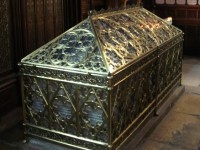
IMAGE: Tomb of Saint Genevieve in Saint Etienne du Mont

Who were the Guise?

By Stuart Carroll

Who were the Guise? Why write a book about them? The answer to the first question is simple. Everyone who has heard of Mary Queen of Scots knows them. Mary’s star certainly burned brightly for a brief while: she was queen of France for eighteen months, and claimed the thrones of England and Ireland, before setting sail for Scotland in 1561. But her star was not the sun around which her kinsfolk orbited. In the annals of the Guise family her existence values a few brief pages.

Today, Mary’s uncles and cousins are remembered, if at all, as bit players in the dramatic events of her life. I wanted to set the record straight and bring their remarkable story to wider public attention. But there was another reason for writing the book. In their day the Guise were held in awe throughout Europe. Admiring or appalled, none could ignore them. The story of their enmity with the great dynasties of Tudor, Habsburg, Valois and Bourbon is the story sixteenth-century Europe. The Guise shaped the course of European history: rising to prominence around mid century as one of Europe’s most powerful families before plunging France into bloody chaos, they refashioned the Catholic Church at the Council of Trent; plotted to invade England and remove Elizabeth I; and made and unmade the kings of France before ending the century as martyrs for the Catholic cause.

There was a further reason for writing the book. To understand the Guise is to understand the profound transformations that shook sixteenth-century Europe. Today’s religious fundamentalism and the conflict it entails make it imperative that we revisit the roots of Europe’s own religious violence. The word ‘massacre’ was first used in its modern context in sixteenth-century France and, as readers will discover, Europe’s Wars of Religion continue to reverberate across the centuries.

Stuart Carroll, author of Martyrs and Murderers: The Guise Family and the Making of Europe, has taught at the Universities of London and York, where he is currently Professor of History. He is twice-winner of the Nancy Roelker prize for the best essay written on early modern French History.

IMAGE: The Saint Bartholomew’s Day Massacre, which the Guise Family is widely believed to be partly responsible for, by Francios Dubois, c 1572-84