Midwives as murderers in 17th century London

in Helen King, History, Love and Marriage, Religion, Sex and Childbirth, Women and Society

By Helen King

In my last post for Wonders & Marvels, I introduced you to my favourite historical character, the ‘Popish midwife’ Elizabeth Cellier. When I was researching her for the first time some years back, I came across another midwife who was in London at precisely the same time: Mary Awbry, or Hobry. Like Elizabeth, Mary was accused of a crime, and appeared before the Old Bailey. Unlike Elizabeth, Mary came to a sticky end; her story is recounted in a pamphlet entitled ‘A Hellish Murder Committed by a French Midwife, on the Body of Her Husband, Jan. 27, 1687/8 for which she was Arraigned at the Old-Baily, Feb. 22, 1687/8, and Pleaded Guilty, and the Day Following Received Sentence to be Burnt’.
‘Burnt’? Yes, Mary died for her crime. It wasn’t ‘just’ murder: it was the murder of her husband Denis. And it wasn’t just that, either; she dismembered him and hid pieces in various locations around London. And it wasn’t just dismemberment; she used her young son to help conceal the bits. The image of a midwife as murderer was a potent one. This was, indeed, a ‘hellish’ crime.

It is clear from Mary’s evidence to the court that she had been the victim of domestic violence from her impecunious husband one time too many. On the night of the crime Denis returned home drunk, and raped her. But she could not claim this was a crime of passion because she waited until he was asleep before strangling him. It also didn’t help her case that, before the fateful night, she had been heard by witnesses to say ‘I must kill him’.

As she was French – apparently one of many Huguenot immigrants to London at this time – what she said was in fact ‘Il faut que je le tue’. Mary had married Denis Awbry, a Catholic, only four years before she killed him, and her previous name comes up in passing in the account of her trial: Desermeau. This means that her son John, her accomplice, must have been from an earlier relationship.

We know of a midwife called Mary Des Ormeaux from another source, the 1680 licensing records of the Anglican church, in which she provided testimonials from five witnesses and was licensed to serve the French community in London. At this point her husband was a jeweller called Daniel. After I first read about Mary Awbry, I came across Mary Des Ormeaux in the 1991 PhD thesis of Doreen Evenden. There, Mary featured as a model midwife, so I contacted Doreen to let her know my suspicions. Doreen and I spent an afternoon in the British Library reading the account of Mary’s trial together. Doreen was so horrified at what had happened to ‘her’ Mary that she cried out, and a librarian had to come over to threaten us with expulsion! Doreen was persuaded, but neither of us could find any more evidence to tell us how the Huguenot Mary Des Ormeaux ended up with the Catholic Denis Awbry who treated her so badly that she killed him.

Motto 1: maybe two characters you’ve come across in history are the same person: women change their names, and we need to be alert and look out for the connections.

Motto 2: it can all end in tears – and flames.


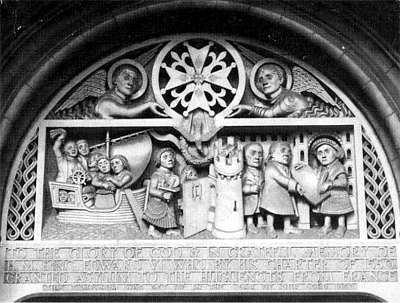
- the image shows a modern representation of the Huguenots’ flight to England, from the French Protestant church in Soho Square, London -


Further reading:

Doreen Evenden, The Midwives of Seventeenth-Century London (Cambridge University Press, 2000)

Frances Dolan, Marriage and Violence: The Early Modern Legacy (Pennsylania University Press, 2008)


  • http://twitter.com/FizzieLou Fizzie Lou

    Fascinating!

    • Helen King

      Glad you liked it, Fizzie Lou! for me it’s somehow a very ‘now’ story – one of those occasions when I feel I can connect across the centuries…

  • Vallevy47

    How interesting!

  • http://twitter.com/jakking49 Jak King

    Good work.  Thanks!

    • http://www.holly-tucker.com Holly Tucker

      Helen, your posts are always so interesting! It was great to see you at the Oxford conference and having a chance to admire the Wonders & Marvels inspired Traveling Vulva Pin. http://www.wondersandmarvels.com/2012/05/the-vulva-goes-on-pilgrimage.html
      Holly Tucker (Editor)

      • H King

        It was great to have an appropriate venue at which to wear my travelling vulva pin, Holly! Glad you enjoyed the conference!

  • Michelle Moon

    When I saw the title I was wondering if this was going to be about infanticide. It makes me wonder what’s on record about midwives being charged in the deaths of newborns, especially in an age of ineffective contraceptives and abortifacients.

    • H King

      Interesting question, Michelle! There were certainly many fears surrounding the role of the midwife here, and these fears start to shade into witchcraft beliefs – the idea that midwives have access to magically potent materials like the caul, or that they will use the fat of newborn babies in rituals… In the last 20 years or so, scholars have been separating out the real midwives, who were trained by apprenticeship and knew what they were doing, from the popular imagination in which midwives were superstitious and ignorant. But actual trials in which a midwife was accused of doing away with an unwanted baby are something else again, and I don’t know of any – maybe someone else in the W&M community does?

      • http://twitter.com/historybeagle Lisa Smith

        I’d recommend checking out 

      • http://twitter.com/historybeagle Lisa Smith

        I’d recommend checking out 
        http://www.oldbaileyonline.org/. Search the keywords by “midwife AND infanticide’. A quick scan suggests that midwives were more likely to appear in court as expert witnesses than accused of infanticide. Abortion (by tools or drugs) also doesn’t show up until the C19th and then often done by men. That said, there was a cracking ghost story from 1670s London about a midwife’s ghost coming back to reveal the location of the bones from a baby she’d murdered. But her motivation appears to have been evilness, much along the lines that Helen describes above.

        • http://www.holly-tucker.com Holly Tucker

          This is great, Lisa. I didn’t realize that the Old Bailey records were so accessible. And again, fantastic to meet you in real life last week at the Wellcome Library. Your work is so interesting!

      • http://www.holly-tucker.com Holly Tucker

        Holly here. I can’t think of actual court cases in which a midwife was charged with infanticide in the early-modern period. But then again, I don’t work deeply in legal history. My sense is that the bulk of these stories circulate like hearsay…and as part of efforts to discredit midwifery more generally. They certainly get more intense in the mid-seventeenth century, when we know that midwives were under much more intense scrutiny.

  • sally

    its amazing whats historys all about dont u think can u help me out i have got to do a homework on a scribe about londson in the 17 century if u have any intresting facts or somthing to do with the 17 century plz reply back thxs

  • DavidHarley

    Doreen Evenden systematically ignores the darker side of midwifery and overestimates the affluence of her sample groups.

    Midwives running or cooperating with houses where women could give birth to bastard children find no place in her work, yet there is evidence of such operations at all levels of society. Although we have some horrific cases, we also have examples of newborn children being sold to childless women, to perpetrate a suppositious birth, with or without the knowledge of their husbands.

    On the other hand, she fails to notice more publicly dynamic midwives in London, engaged in such activities as successfully sueing to retain control over their own earnings instead of handing them over to their husbands. Midwives used the civil and ecclesiastical courts to pursue slander accusations.

    Most spectacularly, she failed to notice the midwives involved in examining witches brought from Lancaster. The group of surgeons and midwives was directed by the anatomist and royal physician, William Harvey. One of the midwives was married to one of the surgeons, and they founded a notable medical dynasty. She was so prominent that she was awarded a coat of arms before one was awarded to her famous father, John Florio. She does not appear in Evenden’s lists.

Previous post:

Next post: