The Twisted History of Blood Transfusion

By Holly Tucker

The Twisted History of Blood Transfusion

For nearly three years, Wonders & Marvels has been featuring some great historical tidbits by authors of new books in history (nonfiction) and historical fiction.

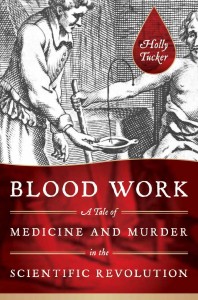
As editor of the site, I tend to work behind the scenes to bring these fascinating stories to you several times a week…but I’m hoping you guys won’t mind if I emerge to do a few posts myself!  Especially since my new book, Blood Work:  A Tale of Medicine and Murder in the Scientific Revolution, is now available online and in bookstores.

I’m thinking that every Wednesday, I’ll let you in on some of the cool history that I uncovered while writing the book.  Sound good?

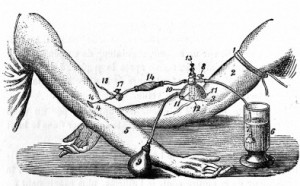
Blood WorkBlood Work is a nonfiction murder mystery set in the Scientific Revolution.  It centers around the very first blood transfusions, which took place in the late 1660s, a full 150 years before the discovery of anesthesia and antisepsis and nearly 250 years before the discovery of blood types.  To make things even more interesting:  these first transfusions used animals as donors.

The question I’ve been getting a lot is how I stumbled on the topic.  Actually, like any self-respecting college professor, I came across the very odd story of these first blood transfusions–and the related murder trial–while I was preparing a class lecture on William Harvey’s discovery of blood circulation in 1628.

For millennia, it was believed that blood was produced through the digestive system.  Food was “concocted” and “cooked” in the stomach and then “distilled” in the liver where it was made into blood.  From there, the blood moved to the heart.  The heart was viewed as something of a furnace, where blood was burned to produce body heat and energy.  The understanding that the lungs helped oxygenate the blood did not arrive until the 1670s.  Instead, doctors and natural philosophers (as scientists were called) believed that breathing served as a type of bellows to stoke the heart’s fires and as a way to blow off the “smoke” that was produced.

Harvey’s discovery of blood circulation was a radical–and controversial–departure from traditional thought.  I’ll talk more about that in later posts. But it set off a flurry of experiments, including and especially the first blood transfusion experiments.

I’m really eager to hear about what questions you have about early transfusion and early medicine more generally.

And of course, I’d LOVE it if you could help me get the word out on the book.  Please do tweet this post or put it on your Facebook page.  Stop by your local bookstore and ask for “help” finding the book on the shelf, even if you already see it somewhere.  My editor tells me first few weeks of a book release are critical to the success of a book.

And, by the way, if you pick up a copy (please do!)…Email Me your mailing address.  I’d love to pop a signed bookplate in the mail to you as a way of saying THANKS!

Shop Indie
Amazon
Barnes & Noble

Related Posts:

  • http://historywithatwist.blogspot.com Vicky Alvear Shecter

    I am really looking forward to reading this! Are you traveling at all to promote the book? Would love to get the copy personally signed!

  • Holly

    hi Vicky! Traveling…and how! Here’s the schedule:
    http://www.holly-tucker.com/news-events/

    Would love to connect!

  • Koko

    Sounds fascinating! I’ve been interested in the medical theory behind bloodletting. Looking forward to reading it.

  • librarypat

    How fascinating. I would have expected human rather than animal blood to be used for transfusions earlier on, but I am sure availability probably had much to do with it. Seeing the way medicine was practiced and how very far from what was helpful it often was is an intriquing study. I’ll have to see if I can get the libraries in our area to add this to their collections. The medical school at ETSU, Johnson City, TN, certainly should have it.

    Good luck with the release.

  • http://thetruebookaddict.blogspot.com/ Michelle @ The True Book Addict

    Congrats! I shared on Facebook and Twitter. I’ll pick up a copy as soon as I have some extra money in my pocket.

  • Carol Wong

    I would love to read this one so much. The history of medicine is so fascinating.

    Carol Wong

  • http://teddyrose.blogspot.com/ Teddy

    Congrats on your book release!

  • Anna Rempe

    Holly,
    I watched you on C-Span last night talking about “Blood Work”. Absolutely fascinating!
    This is the type of book I just love, since real life is often much more interesting than any fiction!
    I was delighted to find your blog, and looking forward to find many more great books!
    Good luck on your tour.
    I see you’ll be in Atlanta in September, I’ll be sure to come and listen. Emory seems to be the ideal place for you to, since they have such a big presence on the medical scene.
    All the best, Anna