Montaigne and Tasso

By Sarah Bakewell

Montaigne and Tasso

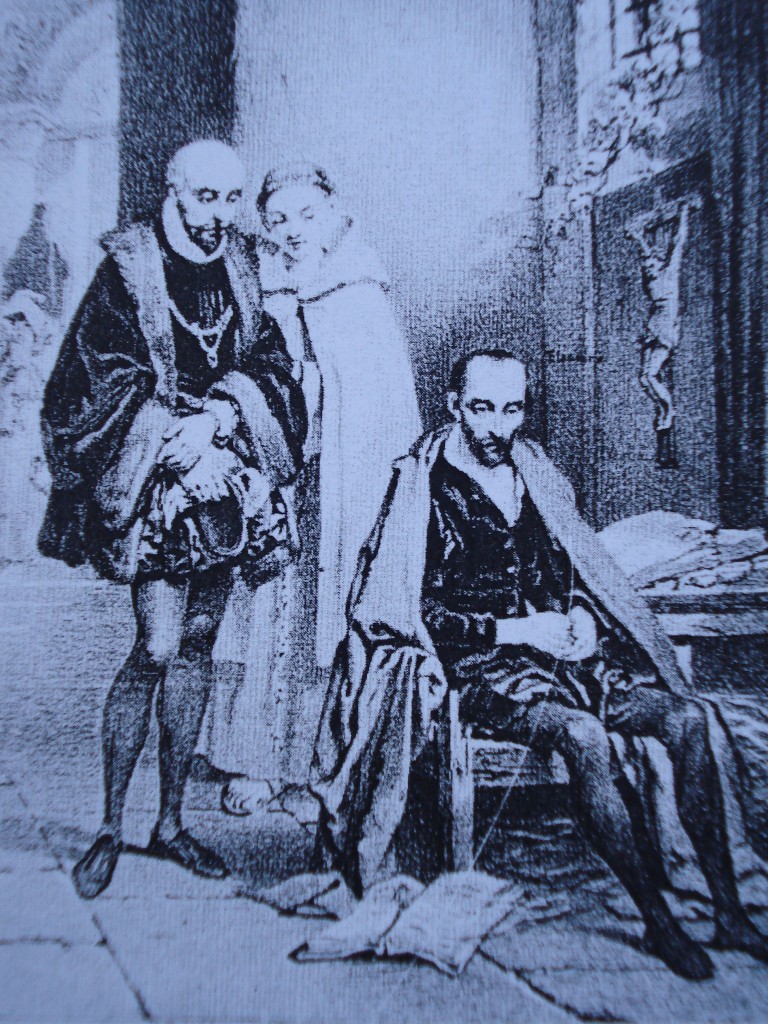
Montaigne’s visit to Tasso in Ferrara, 1580. Lithograph by P. J. Challamel after Louis Gallait’s painting Le Tasse visité dans sa prison par Montaigne (183), in Revue des peintres (1837), no. 208.
In 1580, two great writers met in Ferrara, in Italy. It should have been a wonderful moment: Italy’s greatest contemporary poet, Torquato Tasso, author of the epic La Gerusalemma liberata, or Jerusalem Delivered, came face to face with France’s first and greatest literary essayist, Michel de Montaigne. What a conversation they could have had! But the meeting left Montaigne, at least, filled with sorrow for the waste of an opportunity – and of a life. For Tasso, barely recognizable as the great man he had been, was confined in a lunatic asylum. He seems to have been in a semi-catatonic state, and showed no understanding of who his visitor was, or why Montaigne peered at him with so grave a frown.

Looking back on the encounter some years later, Montaigne speculated that Tasso had damaged himself with his own brilliance – he had been “blinded by the light”. Having pursued his genius into a furor, or poetic ecstasy, he could no longer find his way back. For Montaigne, no poetic achievement could be worth this. For him, the realm of the merely human was more than enough. People want to escape from themselves, he wrote; but instead they lose what is rightfully theirs.  ”Instead of changing into angels, they change into beasts.”

We do not know what Tasso might have made of Montaigne, since he could not say. We only know that some of his devotees in later years took a dim view of Montaigne’s attitude, thinking he showed a lack of poetic sensitivity. They had a point. But on the whole I am with Montaigne on this one. Not that he is likely to have been right about the reasons for Tasso’s madness (assuming that Tasso was mad at all – there have always been conspiracy theories about his confinement), but he was right about the dangers of neglecting the merely human. Overreaching ourselves in great creative or spiritual flights can achieve great things, but it can bring about some stupid and damaging things as well. In the end, I’d rather be an unimaginative traveller than a genius who has lost the ability even to feel curious about the person standing in front of him.

About the author: Sarah Bakewell’s latest book is How to Live: Or A Life of Montaigne in One Question and Twenty Attempts at an Answer (Other Press, 2010; Vintage, 2011). She lives in London, where she teaches creative writing and catalogues historic books for the National Trust.

How to Live: Or A Life of Montaigne in One Question and Twenty Attempts at an Answer

Giveaway is closed.

Would you like an email notification of other drawings? Sign up for our giveaway email list by clicking here.

Related Posts:

  • http://weamon@nmsu.edu William Eamon

    What a wonderful concept for a book! Montaigne was the quintessential man of the late Renaissance. I look forward to reading this book.

  • http://deborahharkness.com Deborah Harkness

    Thanks for the review, Holly. Makes me want to read Tasso and Bruno together!

  • http://historywithatwist.blogspot.com Vicky Alvear Shecter

    Very interesting post and book!

  • Laura C

    Oh Montaigne. I’d never heard that story before, but somehow I’m not surprised, considering his writings. I’d be interested to read!

  • librarypat

    How sad. Considering the conditions and treatment in lunatic asylums of the period, it is frightening to think of anyone being subjected to them. Considering the catatonic state he was found in, there is a chance he was being drugged. I am sure that is part of the conspiracy theories circulating.
    This book sounds like an interesting exploration of Montaigne.

  • Carol Wong

    I remember that Montaigne was one of my favorites when I took a class on French Literature. It is such a same that he could not met Tasso when he was younger.

    CarolNWong(at)a0l(dot)com

  • http://pasadenadailyphoto.blogspot.com/ Petrea Burchard

    I admit to knowing little about either Tasso or Montaigne, but this post makes me want to find out. Plus I’d like to have Ms. Bakewell’s job.

  • Cathie

    This sounds like another great book.

  • Michele

    A librarian friend just read this and adored it. She wrote this on Goodreads: “Bakewell is in complete control, a feat considering the source material, backstory, and history, and she has a flare for similes. An absolute pleasure!”

  • Lee Dembart

    I have long been a fan of Montaigne’s essays, and I go back to them repeatedly. Any book about him is a book I am eager to read.

  • Michelle

    Sounds like a great book – enter me in the drawing, please!

  • Jeannie

    I adore the observation that the realm of the merely human is enough. It brings up interesting modern comparisons with those that write on the dissolution of social structures and cohesiveness because of the very tools like social networking that do make lives intersect that otherwise might never have touched.

    Is it escapism, these flights of poetry and movies and video games, or would a better word be avoidance? Perhaps it is depression indeed, and given that escapism contains it’s own intrinsic stimulation to aid the creator and participant alike. But if a life consists of pure escapism, it loses the common grip of reality. For one with chemical imbalance issues to begin with, these would only be exacerbated.

    Somehow I’m also reminded of the famous meeting between Houdini and Doyle, where the former was truly disappointed in the acumen of the latter.

  • Lavonda Robinette

    Yes! This one sounds great too!

  • elizabeth houston

    So glad to find a site with all of these great suggestions. I’m finding the “History” section in my local Barnes & Nobel to be less and less full these days.

  • http://twitter.com/cflinnds Cheryl

    I’ve been wanting to read Montaigne. What a wonderful opportunity this book would afford me. Thanks for the opportunity!

  • http://www.nadinepinede.com Nadine

    Montaigne is the father of the essay, a word whose French root means “to try.” For him, the process of exploration was more important than a brilliant final result. This book appears to be a welcome addition to the growing field of practical philosophy, much like the work of Alain de Botton.

  • Shelli

    Completely new subject matter for me, but obviously something I need to learn about since I’m a Renaissance buff!

  • Shay

    This sounds quite interesting as well as a great read! Please enter me!!

  • Mona Everett

    What an intriguing subject! Bring it on!

  • Jennifer Hunsicker

    Montaigne is not familiar to me, but from reading reviews and other summaries of this book, I would like his writing. I would also like to learn more about him. Thanks for introducing me to this subject!

  • Raymond

    I am not familiar with Montaigne either would love to learn more about him. Please enter me.

  • Gayle J

    I would live to be entered to win this book, sounds very interesting. Thank you.

  • http://writingren.blogspot.com Julianne Douglas

    Please enter me in the drawing for this book! I’m so glad to see the growing interest in Montaigne in the popular press.

  • Ed Brown

    As someone who knew nothing of Montaigne except that he was ‘great’ I found Sarah Bakewell’s book a wonderful introduction to Montaigne as well as an inducement to read him. As a psychiatrist who has treated people with serious mental illness for years I was particularly struck by the story of Montaigne’s meeting with Tasso. Montaigne writes, “J’eus plus de despit encore que de compassion, de le voir à Ferrare.” I have seen despit [dépit in modern French] translated as anger or irritation. What strikes me about this response is that Montaigne includes both his actual response [dépit] and the socially expected response [compassion] in the same statement. His willingness to record his actual, unattractive response is just as Bakewell describes him. I have great admiration for his ability, in this instance, to hold onto both his actual response as well as the ideal response. And  I can say from my own experience that this is no easy thing to do.