By Barbara J. King
 Prey and predator: during our long evolution on the African savannah, we humans have played both roles. For millennia, big cats and sharp-eyed raptors made off with us as their lunch; then, wielding newly-invented tools, we turned the tables (at least to a degree) via scavenging, and later, hunting.
Our ancient sensory and cognitive skills sharpened as we paid attention to other animals – or paid with our lives. Then, as Homo sapiens, thinking symbolically with and relating emotionally to animals kicked in, as we see in a trio of prehistoric sites:
Chauvet Cave, France: Gorgeous animal images, painted 32,000 years ago, dot the walls and ceilings. Lions, horses, and rhinos are here – as is a hybrid woman-bison figure. Absent are trees, rivers, or other natural features. It’s the animals that matter.
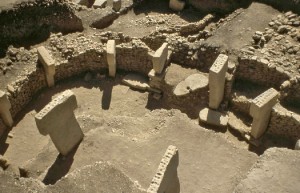
Gobekli Tepe, Turkey: Atop a hill stands a monumental structure dated to 11,000 years ago, called by archaeologists “the world’s first temple.” On huge pillars are carved lions, boars, foxes, scorpions, and snakes. From miles around people traveled to worship at this place thick with animal symbols.
Çatalhöyük, Turkey: In this village 8,000 years ago, a man and a lamb were buried together beneath a house floor, the traditional interment place for the ancestors. Research uncovers a surprising number of animal-human burials in the ancient world, hinting at a strong emotional connection between the species.
Being with animals made us who we are – and our prehistory helps to explain why humans in every society today crave (though in markedly different ways) connection with animals.
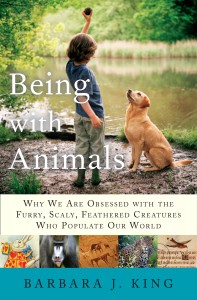
About the author: Barbara J. King is Chancellor Professor of Anthropology at the College of William and Mary. Her latest book is Being With Animals (Doubleday 2010). Information on her other books, media interviews, and Friday Animal Blog can be found at http://www.barbarajking.com.