Horses in 1820s Paris: A Daily Ordeal

By Thad Carhart

Horses in 1820s Paris: A Daily OrdealIt has become common to think of the time before automobiles as a kind of Eden for Western cities: no pollution, no congestion, no costly parking or maintenance, no noise. But anyone who has written about cites in the pre-industrial era knows differently. Before cars, trains, and tramways, all goods and people were transported by horse-drawn vehicles, and their sheer numbers caused problems that we can scarcely imagine.

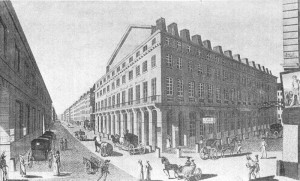
In researching a novel based partly in Paris of the early nineteenth century, I was astounded by the continual mention of horses in the primary sources. Paris in 1820 had approximately 725,000 human residents. Every day, as many as 35,000 horses would be in the city, doing the work now performed by trucks, buses, cars, subways, streetcars, and trains. Sturdy draft horses, high-spirited thoroughbreds, ancient nags, docile saddle mounts, intrepid mules and donkeys – all pulled carts, drays, carriages, wagons, stagecoaches, gigs, and every kind of vehicle to which they could be hitched.

The presence of so many animals required an elaborate infrastructure to house, feed, and – not least – clean up their leavings. Stables were as ubiquitous as the corner garage in our day, and at least as expensive. Prodigious amounts of fodder and hay were required and, in the course of nature, the oats, corn, and barley were left – in another form – on all the city’s streets.

A horse produces between 15 and 35 pounds of manure a day. Taking 20 pounds as a conservative average, 35,000 animals meant 700,000 pounds of manure each day that had to be cleared. Paris had an efficient municipal service for clearing much of this immense volume, which was loaded on to wagons (more horses!), then used as fertilizer in surrounding areas. Inevitably, however, not every part of the city was swept with equal efficiency, and piles of fresh manure accumulated. Even Mozart complained in a letter to his father as early as 1778: “…for really the mud in Paris is beyond all description.” Here, “mud” can be understood as a polite reference to small mountains of horse manure. Rain only worsened matters.

Swarms of flies were drawn to the manure, and they were regarded as a daily curse in the poorer parts of the city. Everyone complained of the ever-present stink. And when the manure was left to dry, it created a fine dust that was blown everywhere.

The curse of horse manure grew in all the great cities throughout the nineteenth century – New York, London, and Paris all vastly increased their use of horses as they became great industrial centers. The problem seemed insuperable – there were over 80,000 horses in Paris in 1880 – and then, virtually overnight, it vanished with the advent of the automobile. One form of pollution replaced another, but that didn’t become clear for many more generations.

About the author: Thad Carhart is the author of the historical novel, ACROSS THE ENDLESS RIVER (available in paperback October 2010 from Anchor Books) which tells the story of Sacagawea’s son, Jean-Baptiste Charbonneau. Visit http://acrosstheendlessriver.tumblr.com for photos of the real inspiration behind Baptiste’s fictional journey.

Across the Endless River

Giveaway is closed.

Would you like an email notification of other drawings? Sign up for our giveaway email list by clicking here.

Related Posts:

  • http://unabridged-expression.blogspot.com/ Audra

    Great post! I definitely am (or was) of the mindset “…the time before automobiles as a kind of Eden for Western cities…” — this was fascinating!

    Thanks for the giveaway!

  • Rachel W.

    This looks great! Thanks for the giveaway!

  • http://thetruebookaddict.blogspot.com/ Michelle @ The True Book Addict

    That is so interesting. It’s funny because I don’t know how many times I’ve had car problems and I’ve said that we should go back to horses as transportation. I guess I never really thought of the implications.

    I would love to win the book. Thanks for the chance!

  • http://www.jeanbaptistecharboneau.com Michael Ritter

    Hi,
    very informative article by Mr. Carhart regarding urban transportation, horses in particular. It may be noted that other livestock helped muddy the waters in the cities.
    On another note, regarding photos on this site, there is no documentation verifying that Charbonneau ever saw Paris. He may have been there off the record; where he might have stood, gazing at a bridge or other structure built by Napoleon, is conjecture. And of course this is a novelist’s domain, of which Mr. Carhart is a fine one.

  • http://historywithatwist.blogspot.com Vicky Alvear Shecter

    Shuddering at some of these details (imaging the smell, the fine powder of manure blowing through the streets…). Fascinating. This book sounds marvelous too!

  • Jacque Stengel

    What an interesting concept….I’m a farm girl and had to clean that stuff up…never thought of it when horses were in charge..lol…
    Sounds like a good book!

  • http://brokenteepee.com Patty

    My husband would love this book.
    thank you

  • Carol Wong

    I would love to read this book. When I was a child I grew up in a house that was already a hundred years old. Behind the backyard was stable! Of course, it had the upside down horseshoe for good luck but it also had a very wide door that swung out into the ally. I lived there in the 1950s. I remember that the garbage man drove down the alley with a pair of Clydesdales. So when I heard the clop,clop,clop of the wagen, I used to run to the gargage and slid out the door with excitement. I loved those horses. They were much prettier than today’s modern garbage trucks! Of course at that age I never thought of the manure!!!

    CarolNWong(at)aol(dot)com

  • librarypat

    I had heard that Jean-Baptiste was taken in by Clark, of Lewis and Clark, after the expedition, and that Clark made sure Jean-Baptiste got an education. After that, I know little of what his life was like after that.
    I visited the tumbler site listed above., wonderful pictures and blurbs. This should be an interesting book.
    We have to realize that any type of life leaves waste. The more compact the population, the more of a problem it will be. I can’t imagine the logistics of feeding, housing and cleaning up after all those horses. Add in human refuse and that from other domestic animals, and it would not have been a very pleasant place.

  • Sue

    Hmmm. I admit to have wondered about waste disposal on city streets in horse-drawn days, but only in passing. Cities were often pretty foul places, especially in non-affluent areas. Great place to live if you were into cholera, I understand.

    I woudl love to read about Mr. Charbonneau. Please enter my name in the draw.

  • K. Baluta

    I know what a hassle it is when wet, but it never occurred to me what a nuisance it could be dry and powdered…blowing on the clean laundry. EVERYTHING must have smelled of horse.

    I’m fascinated by Jean-Baptiste, the book sounds excellent!

  • Theresa N

    Well that’s something to think about, that’s a lot of horses and still we can’t get away from the subject of pollution.

  • http://www.tarotbyarwen.com Arwen

    Wow. Who knew! And think of the diseases that could be spread.

  • Nadine

    A biography of Sacagawea was one of my favorite books when I was in elementary school. I’d welcome the opportunity to read a book about her son (even if it is “historical fiction”).

  • Michelle

    This one looks so interesting!

  • Raymond

    Having been raised with horses and shoveled far more then the amount of manure that I ever wanted, I neglected to think of the problems that would result from horses being the sole means of transportation! Guess I stepped in it yet again! Please include me for this book!

  • Cathie

    I’d like to be entered. Thank you.

  • Terry

    Would like to read this one. Please enter me.

  • Amy

    This sounds really interesting. Thank you so much.

  • Jennifer Hunsicker

    It’s so easy to forget what our cities used to be like before modern transportation and modern conveniences. I enjoy reading about history as well as learning something new when I read. I will also, hopefully, be going to Paris in a couple of years and this would make for wonderful historical background. Please enter me in the drawing. Thanks you!