Chicago’s Millinery Scene

By Mary Beth Klatt

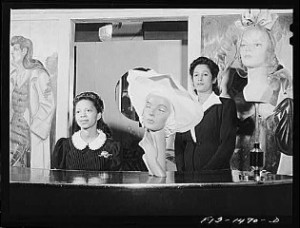
Miss Minnie Coleman (left), clerk, and Miss Selma Barbour (right), manager of the Cecilian Specialty Hat Shop, 454 East 47th Street, Chicago, IllinoisThe height of Chicago’s millinery scene was in the 1940s. African-Americans such as Miss Minnie Coleman (left), clerk, and Miss Selma Barbour (right), managed the Cecilian Specialty Hat Shop, 454 East 47th Street, Chicago, Illinois. Many women at the time trained to be milliners, which considered a respectable career until hats lost popularity in the 1960s. On the north side, there was Bes-Ben Hats, which had a boutique at the Drake Hotel.

Hats by both the Cecilian and Bes-Ben were often worn at Easter church services. Women could keep their hats on while men were expected to remove inside the premises as a sign of respect. Pews often had discrete little clips to hold the hat. Those clips can still be found on old pews today. The Easter tradition particularly thrived in 1940s when war-time restrictions limited the amount of fabric that could be used in attire, but not hats.

Chapeaux continued to be popular during the 1950s and 1960s with Chicago as an important training ground for milliners. Raymond Hudd’s reputation as a celebrity milliner rose during the 1960s – he made Phyllis Diller’s hats. Halston got his start as a Chicago hat designer before he segued into designing couture clothing in New York City.

Hats became less popular for various beginning in the 1960s. Now Chicago is the only place in the U.S. where milliners can take classes for college credit (the Art Institute of Chicago).

Image: “Miss Minnie Coleman (left), clerk, and Miss Selma Barbour (right), manager of the Cecilian Specialty Hat Shop, 454 East 47th Street, Chicago, Illinois,” this 1940s photo show two African-American women in the South Side shop where they worked. Many women at the time trained to be milliners, which considered a respectable career until hats lost popularity in the 1960s. (Courtesy of the Library of Congress, fsa 8e04945)

About the author: Mary Beth Klatt, a Chicago native, has been interested in fashion since she was a child and liked sketching models with a box of crayons. She has taught sewing at Vogue Fabrics, the Midwest’s premiere fabric source and Columbia College, the city’s premiere arts college. She’s currently writing an iPhone app for yarn, a companion to another fashion-related app: ✄ Fabric U ✄.
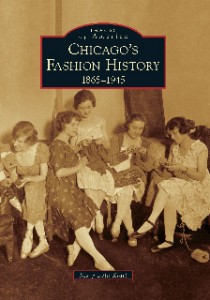
Chicago's Fashion History: 1865-1945

Giveaway is closed.

Would you like an email notification of other drawings? Sign up for our giveaway email list by clicking here.

Related Posts:

  • http://pasadenadailyphoto.blogspot.com/ Petrea Burchard

    I really like this Images of America series, and the idea of telling the story with images. Having lived in Chicago (more recently, but still…) I find this one particularly interesting.

  • http://unabridged-expression.blogspot.com/ Audra

    I find millinery so interesting! It’s interesting how hats have gone out of fashion — although I know small scenes in the US are embracing hats (browsing on Etsy is great for eye-candy).

  • Carol Wong

    My great grandmother was a milliner and had her own shop so I am very interested in its history. Please enter me in this contest.

    CarolNWong(at)aol(dot)com

  • http://ttthomas.wordpress.com T. T. Thomas

    (Thanks for indulging me, but this Wonders and Marvels piece made me write the following—and getting the book would be a bonus!).

    Frankie’s Hats

    Frankie Bristol drank a bit of Port each evening, but she sure knew her hats. The year was 1952; the place was Peoria, Illinois. I was ten years old, and Frankie, along with her elderly mother, was the neighbor two doors down. Every day she wore a different hat. In fact, she’d leave with one hat on in the morning, and get off the bus each evening with a different hat. I was too young to realize the milliner shop where Frankie worked as a shop girl provided her with a steady stream of hat-for-a-day loaners.

    When I’d visit Frankie, I always thought her house smelled odd. It was somewhere between minty and moldy. My friend Jerry Stuart said maybe it was the feathers from all the hats she had. I didn’t think feathers smelled, And Jerry knew more than me about everything, but even I knew he didn’t know about hats. Still, during my visits, as I followed Frankie from room to room, I feigned nonchalance as I surreptiously looked around for all the hats. I expected to see them in the closet when she opened that door. I expected to see them in the linen closet when she opened that door. I expected to see them on the bed, on the dresser, or in a chair, but I never saw more than one or two hats, and not a single feather. Well, what did I expect? Jerry Stuart’s the same kid who told me we’d reach China if we dug down far enough.

    A few years later, things changed, for Frankie and for hats. First, her old mother died. Afterwards, I’d visit Frankie during the long summer evenings, but I always had to stand at her front door. She never invited me in after her mom died. But she’d stand on the other side of the screen, glass of Port in hand, chatting. My mother “checked in” on Frankie every week or so. Somehow, she was invited in. Afterwards, she’d come home shaking her head. “I think Frankie is losing her mind.” There was never any explanation for that comment.

    For the next couple of years, Frankie continued to work, leaving every morning with a feather in her cap, coming home every evening with a pillbox on her head. One day, I came home form school, and my mother was sitting at the dining room table looking at a beautiful assortment of crystal. Dessert dishes, cordial glasses, wine glasses, and water glasses. Most were clear crystal, but some were a pale green, a few were the lightest shade of pink. Sixteen in all, service for four. A gift from Frankie. My mom said, “Frankie said, ‘You always admired these, Margaret, and I want you to have them.’” Mom sounded more sad than happy, and she shook her head a few times.

    I don’t know when I first noticed, but sometime after Easter, Frankie stopped going to work. My mother waved away my questions and said, “Business is down at the hat shop.” That was about 1958. As spring turned to summer, I’d walk past Frankie’s house of an evening, but it was all shut up. I thought that was strange because everyone knows how hot and humid it can get in Peoria. One evening, I decided to “check on Frankie.” After I knocked for a long time, the heavy front door opened a few inches. There was a single lamp on in the background with a dull light bulb revealing stacks of papers, miscellaneous Port glasses on the coffee table, and a strange old woman at the door. It wasn’t until she opened her mouth and I saw the dulled front tooth I recognized as hers that I realized it was Frankie. “Yes?” she said.

    For a moment, I was shocked into speechlessness. Finally, “Hi Frankie. How are you?”

    “Not so good, but I have to get ready for work now,“ she said, and closed the door on me.

    I wandered around Mr. DeJarnette’s back yard for a while. They weren’t home, and I considered stealing a white radish from the garden. I’d been asked not to steal the radishes, to merely ask for one, but oh, how I loved those hot, long, white vegetables. And the stolen ones tasted so good. Besides, how you supposed to ask when there’s no one home? But I didn’t steal one. Suddenly, I didn’t feel like having a radish. I walked home, slowly, practicing what I was going to say to my mother.

    “Frankie’s off her rocker,” I blurted out. My voice was trembling, my heart was pounding, and the fear in my voice got my mother’s full attention. She looked at my father. “Let’s walk down and check on Frankie,” she said. He nodded. I wanted to go with them, but my mother said no. Stay with your sisters. I sat on the front porch and waited for their return. They were gone nearly a half-hour. Next thing I knew, my mother was walking back alone. By the time she reached our house, an ambulance had pulled up in front of Frankie’s.

    My mom went straight to the kitchen, shaking her head. She turned on the kettle for a cup of tea, and sat down at the kitchen table. “Frankie’s sick,” she said. “Your father is with her, and they’re going to take her to the hospital. He has to give a statement.”

    I was alarmed because I thought my dad was going to the hospital with Frankie. My mom explained. No, he just has to give a statement. She has no living relatives. She’s senile and can’t take care of herself. It’s very bad inside her house. It’ll have to be gone through and thoroughly cleaned. She probably has bugs, maybe even mice.

    I sat on the front porch thinking about that and waiting for my dad. About a half hour later, he walked back up the street.

    “Is Frankie going to be OK,” I asked.

    “Well,” he said, “She’s going to move to where she can get some help. She can’t take care of herself anymore.” He went inside to sit with my mother, and I followed him indoors in time to see my mom wiping the tears from her eyes. Nobody said anything else about Frankie that night. I was sad but I didn’t really know why. Maybe it was about Frankie, maybe it was about my mom crying.

    The next day, I brought my mom a cup of tea and sat down across from her in the living room. That was our symbolic ritual for “let’s talk.”

    I wanted to talk about Frankie, but in my house, one first had to talk “around” things. You could get to the point, eventually, but it wasn’t considered good form to go there immediately, so, with that in mind, I hovered around Frankie by talking hats.

    “What’s going to happen to all Frankie’s hats?” I asked.

    My mom looked at me, startled. “Frankie doesn’t have any hats,” she said. “Those all belonged to the shop.” When my mother saw my face crumble, saw me realizing it had all been a kind of lie, Frankie and her hats, she amended her comment. “Frankie made a good living from hats,” she said, “because the owners paid her a salary, and then they paid her extra to wear the hats, like advertising.”

    I did feel better after hearing that. My first job was selling Christmas cards door-to-door when I was nine years old. Frankie was my first customer, so I felt better hearing she had had a good job. In the leap of logic that was my youthful brain, I figured those hats launched my career, too. Frankie always said I was a “born salesman,” so since she sold hats and I sold cards, I felt we had a lot in common. If I had liked hats, I felt I could have sold them, too, but I didn’t much care for them personally, although I loved to see what new outrage Frankie wore to and from work each day. Thirty years later, I’d be selling fiction, but just until my car sales career took off.

    After hearing the truth about Frankie’s hats, I went to my tree house, which happened to be located in a field right behind Frankie’s property line. I stared at the closed up house. It was a new feeling, knowing you were never going to see someone again. Never. Frankie died a year or so later in a Nursing Home. Mom said Frankie didn’t feel any pain because she didn’t even know where she was. I always wondered about that, though. If I didn’t know who I was, pain would still hurt, wouldn’t it?

    To this day, fifty-five years later, I still remember the minty musty smell. My mother later said Frankie ate mints to cover up the smell of alcohol. And for many years, the only person who wore hats as memorably as Frankie, it seemed to me, was Jackie Kennedy.

    copyright 2010 T.T.Thomas

  • Cathie

    Please enter me. Thank you.

  • librarypat

    I well remember those clips on the backs of pews. I never liked wearing hats all that much, but loved seeing the variety that women wore. It is always fun to watch the Kentucky Derby and see the creations they have come up with. It is a good thing the Art Institute of Chicago is keeping this tradition alive.

  • Mary Robak

    This is a delightful book by a wonderful author. I could barely wait once it was announced and had an early copy. But oh what a great gift to give an up and coming Chicago milliner. As a student of the SAIC, Angela Morano won the Raymond Hudd Millinery award three times, and has a good chance of helping Chicagoans continue to regain their devotion to millinery.
    Anyone who wants to send me stories of Chicago millinery history is most welcome to email me directly as I spend the next year in rounding out my research on just Chicago millinery history. I should have paid much more attention back in 1966 when my first job was selling hats at Irving Park and Milwaukee Ave for “Miss B” Mollie Burmister at Evelyn Fashions. Anyone else remember that place or know any tidbits to share? My email is maryrobak@comcast.net.
    Thanks for adding this wonderful addition to this blog, it made my day.

  • http://www.judithm.com Judith Mishler

    What a great book, so glad it exits. As someone living in northern Indiana my childhood visits to Chicago were memorable. Loved the “Frankie and her hats” story another person left in your comments.

    Best wishes,

  • Sandra

    What a view on history!

  • http://janelsjumble.blogspot.com Janel

    The types of hats made by these ladies were works of art. It’s too bad we don’t see more of it today.

  • Suzanne

    This book is definitely on my “read next” list, both professionally and personally. I work with a historic textiles & clothing collection–and yes, we have some Bes-Ben hats–plus my great-grandmother was a milliner in Detroit.

    [I would be delighted to win a copy in the drawing but I have to say that T. T. Thomas' entry should win on its own merits!]

  • http://ttthomas.wordpress.com T.T. Thomas

    Thank you to all who liked my story, spelling errors and all! I love Wonders and Marvels, and you just never know from whence the inspiration will spring! Someone asked me if Frankie was a real person and if she really sold hats. Yes to both! Thank you.

  • Michelle

    Hats! I love them. I wish they were still in fashion.