Stephen F. Foster, Historical Truth & the Novel

in Uncategorized

By Joseph Skibell

Years ago, I attended a play about Stephen F. Foster. According to this play, Foster didn’t actually compose all those songs — “Camptown Races,” “Oh, Susanna!” “Beautiful Dreamer” – rather he purchased them from a slave who died penniless and unknown.

Songs bought for a song, as it were.

I asked the playwright if this were true, and he said, “I don’t believe there’s any evidence of that, no. I used Foster because he’s well-known. Still, white culture has been stealing from black culture since the beginning of the American experience, true?”

Perhaps, but it hardly seemed fair to poor Stephen Foster.

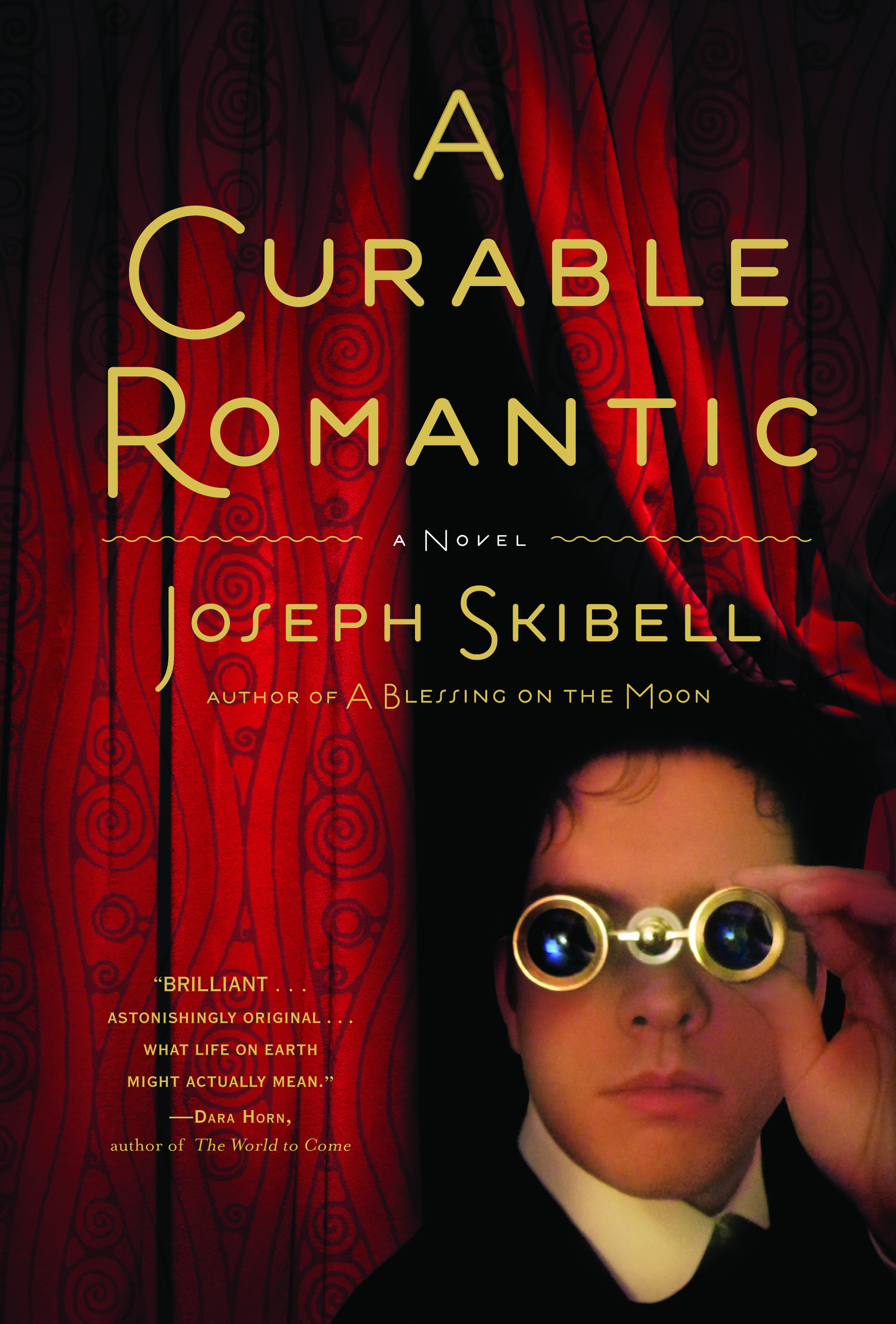
Remembering Foster, I tried to be scrupulous in the depictions of the historical figures – Freud, Dr. Zamenhof, the Piasecnza Rebbe – who, in my novel, A Curable Romantic, rub shoulders with characters who are wholly fictitious.

Accuracy, as an ethical yardstick, is easy to apply to simple facts – Foster did not buy his melodies from an unknown slave – but it’s harder to measure the subjective states novelists traffic in. To write about anyone is to offend against his or her subjective notions of self, and it’s trickier with one’s villains: in my case, Wilhelm Fleiss, Freud’s friend, who, by operating on her nose to cure her neurosis, butchered Emma Eckstein; and Louis de Beaufront and Louis Couturat who, in hoping to reform Esperanto, destroyed it altogether.

Despite the harm these men caused, each woke up in the morning, I’m certain, believing in the unimpeachable morality of his intentions.

Whose vision is the least distorted then – the subject’s or the portraitist’s?

A novelist’s commission is to tell an entertaining story. If historical truth must be jettisoned towards that end, only a bad novelist would choose to be a good historian.

Still, in a spirit of historical accuracy, allow me to confess that Boleslas Gajewski, an advocate for Solresol, an artificial language invented by Jean-Francois Sudre, did not commit the murder I depict him committing on pp. 492-493 of my novel.

Neither, as far as I know, did he write the songs of Stephen Foster.

Joseph Skibell is the author of three novels, A Blessing on the Moon, The English Disease, and A Curable Romantic. He received the Richard and Hinda Rosenthal Foundation Award from the American Academy of Arts and Letters and a National Endowment for the Arts Fellowship. His work includes stories, plays, essays and a libretto for an opera based on A Blessing on the Moon. He teaches at Emory University and is the director of the Richard Ellmann Lectures in Modern Literature.

Readers, what do you think?  Does historical fiction have to be historically accurate?  We have a feeling there’s going to be a good discussion here…

Giveaway is closed.

  • http://thetruebookaddict.blogspot.com/ Michelle @ The True Book Addict

    I’m not a total stickler for complete historical accuracy. There is something to be said for entertainment value. However, blatant inaccuracies that are completely noticeable tend to rub me the wrong way. Let me put it this way…I want my historical fiction to be somewhat accurate, but I do not want it to read like a non-fiction book. There has to be a happy medium and it takes a skilled writer to pull this off.

  • Jessica B

    This is always a hot question. For me, as long as the basics are impeccable (the characters do, say, eat, ride things that existed in that time), I’m willing to accept some nudging of history for storytelling purposes, as long as the liberties are pointed out in an author’s note. Show me that the author has done his/her research and is making a choice (rather than an error). As it’s often said, these are first and foremost novels; if we wanted the history, we’d head to the non-fiction side of the bookstore.

  • Carol Wong

    I don’t mind if there are some things that are not correct as long as the author tells me that isn’t quite right like in the footnotes or in a section in the back of the book. I would hate to be talking to a friend and tell that person something that isn’t right,

  • http://chewdigestbooks.com Gwen

    I tend to be much more forgiving than many readers when it comes to the accuracy in historical fiction. Don’t get me wrong, if the mistake is glaring, I will have a problem with it. However, I can be forgiving because I enjoy reading nonfiction and researching obscure points that I find in books. When I read something that doesn’t sound quite right, it is like a treasure hunt. Off I go, looking for facts to either prove myself right, (a happy dance usually is inserted at that point) or to learn something that I didn’t know before. (that usually leads me down the wonderful rabbit hole of learning something new, which also includes a happy dance)

    It’s all happy and all learning, growing, and expanding!

  • http://www.dmmcgowan.blogspot.com Dave McGowan

    I don’t think ‘bending’ or even changing some of the facts is a problem as long as it doesn’t hurt anything or anyone … such as Stephen Fosters legacy. In addition I think it’s a good idea to explain at some point that you (the author) have taken liberties since the reader may be depending on you for some measure of accuracy.
    As an example I changed the date of of a policeman’s murder in “Partners” and of a stage robbery in “Homesteader” so that the timing would fit in with the rest of my story line. At the end of each novel in an “Author’s Note” I explained that I had made a timing change and also gave the actual true date of the event in question.
    Dave
    http://www.dmmcgowan.blogspot.com

  • librarypat

    As one who enjoys historical fiction, I really prefer the history depicted in the story be as accurate as possible. Of course we don’t know exactly what happened or what historical figures said (in most cases). If using real people and events, be as true to the facts as you can. As long as the author sticks as close to an accurate depiction of the time and the people as possible, I’ll be happy. It is fiction after all. Just don’t make claims or accusations that are nowhere close to being true. There is no reason to slander Stephen Foster, for example, just to give your book a boost. Too many people have a tendency to believe it true if you are talking about real people or events. As much as I like research, I don’t want to have to stop in the middle of the book to fact check.

  • Katherine Baluta

    I love the immersive quality of historical fiction, that slow deep dive into another era, and I don’t want to be distracted by small inaccuracies. With that said, if I am consciously reading “Historical Fiction” I do expect it may stray from the facts somewhat; I think it’s particularly useful if the author states the factual account in brief and then poses the conjecture of the plot as a “what if” scenario, then invites me to read. This seems more honest and exciting, perhaps as the back cover blurb that convinces me to buy the book in the first place.

  • http://brokenteepee.blogspot.com Patty

    Any time you crack open a historical novel you are reading the author’s feelings channeled through the dialog and thoughts of the characters so a lot of the book is already imaginary. Which is why it is FICTION. Unless a direct quote of something left by a historical figure is used we have no real idea of what they might have said or felt in any given situation. Only the author’s imagination and knowledge at work.

    BUT I like to think that the main pieces of the history be accurate; dates, locations, etc. unless otherwise noted in an author’s comment. Especially if you are reading in a period familiar to you – an obvious error would be glaring and I think, take away from the story.

    Thanks for another unique and fantastic book giveaway.

  • http://worldofpoe.blogspot.com/ Undine

    This is actually a pet peeve of mine. Historical fiction requires a certain amount of imagination in describing conversations, situations, and motivations. However, I hate it when an author, using the “Oh, it’s just a novel,” excuse, takes real people from the past and portrays them as doing things we know for a fact they did not do.

    As an amateur Edgar Allan Poe scholar, I run into this all the time. There have been many novels that use Poe as a character, and for some reason, practically all these authors seem determined to libel him. I’ve seen him portrayed as a drug addict, a necrophiliac, a serial adulterer, a murderer…just the most ridiculous stuff imaginable. What really bothers me about this is from the reviews I’ve read of these books, most people who read them know nothing about the real Poe, and so assume he really did these things.

    Historical novelists have to realize that many people take it for granted that their work is based on some sort of reality. When they use real people in their books, I believe they have a responsibility to try and be fair to these names from the past.

  • Kitty

    I like historical fiction to be as accurate as possible. I am particulary bothered by the mention of trees/plants/veggies/flowers that cannot be in the time frame of the book either because they were an introduced species that came later than the book time period or the blooming/fruiting/flowering of a plant at the wrong time of year.

  • http://worldofpoe.blogspot.com/ Undine

    I’ve tried to comment here before, but my post apparently got “eaten” somehow…so if I wind up with duplicates, many apologies. I’m not trying to cheat on the contest, I swear.

    Anyway, I feel quite strongly that anyone who uses real people in a historical novel has a moral duty to try and be as “true” to these people’s real lives as possible. While a certain amount of invention in regard to conversations, motivations, actions, etc., is inevitable, too many writers use the “Oh, it’s just a novel” excuse to, basically, libel the dead by having them say and do things we know for a fact they did not say and do. And for some reason, they almost always have the effect of vilifying these people from the past. It can get pretty ugly.

    Charles Baudelaire, in writing about Rufus W. Griswold’s notorious obituary of Edgar Allan Poe, asked if America did not have laws to keep curs out of the cemeteries. One could ask the same about some of these novelists and playwrights.

  • Laura S.

    I want it to be as historically accurate as is possible and if much license has been taken, I would surely like that to be listed somewhere where I can see it before purchasing.
    I don’t mind some inaccuracies or even some good, plain, invented parts, but please, make it plausible. I recently started some ‘historical fiction’ (so memorable I read a few chapters, threw it away and can’t even recall the title) that upon winning a battle, the victors high-fived one another with shouts of “Yeah man!”
    As if.

  • Elizabeth Cohen

    Well, it’s all a bit more complicated in Skibell’s “A Curable Romantic.” The protagonist is narrating the story — he has a bone to pick with the historians, claiming that they have all lied — and his version of this history is filled with dybbuks and other otherworldly happenings. In Book Three, for instance, he admits that, because he’s starving in the Warsaw Ghetto, much of what he describes may be the result of his hallucinations. The historical details seem accurate, but I don’t think the reader is supposed to find the events necessarily credible.

  • Jenny

    I would say that I am quite forgiving too, but one of my favourite Regency Romance authors (My secret shame!) ALWAYS has her hero and heroine marry in their drawing room, and this can only happen in America!
    Grr.. :p

  • Jenny

    p.s @ Laura S. – that made me laugh, I’d have contuned reading it as a comedy…

  • Sally Burnell

    As a dyed-in-the-wool historic fiction fan, I do prefer historical accuracy in the novels I read about real-life people. My favorite writers are ones who do their research and give me a really good picture of what that person’s life might have been like. I’m a big fan of Stephen Foster and his songs so I’d love to read this novel, even if much poetic license has been used in the telling of the story. If Foster did, indeed, purchase his songs from an anonymous slave, so be it. It sort of makes the story more interesting to consider this possibility. And if not, if he was wholly the author of his own songs, well, that’s great, too, because I am a big fan of his music. Either way, I am eager to read this novel, even if does bend history just a bit. There is a place for “speculative historical fiction” as witnessed by books by authors like Harry Turtledove, Robert Skimin and the Newt Gingrich/William Forstchen novels, to name a few examples. Those are fun to read as well.

  • http://libraryofmyown.blogspot.com Amanda

    As a history major in college, I tend to want my historical fiction to be more accurate than not. However, I do understand authors need creative licenses so if there is fact or fiction, I like my author to do a note in the back of the book explaining. For instance, Robin Maxwell did that in The Queen’s Bastard and I’ve always admired her for that.

Previous post:

Next post: