A Legendary Locomotive

By William Rosen

Two hundred and five years ago this week, the city of Philadelphia witnessed the birth of steam locomotion in America…sort of.

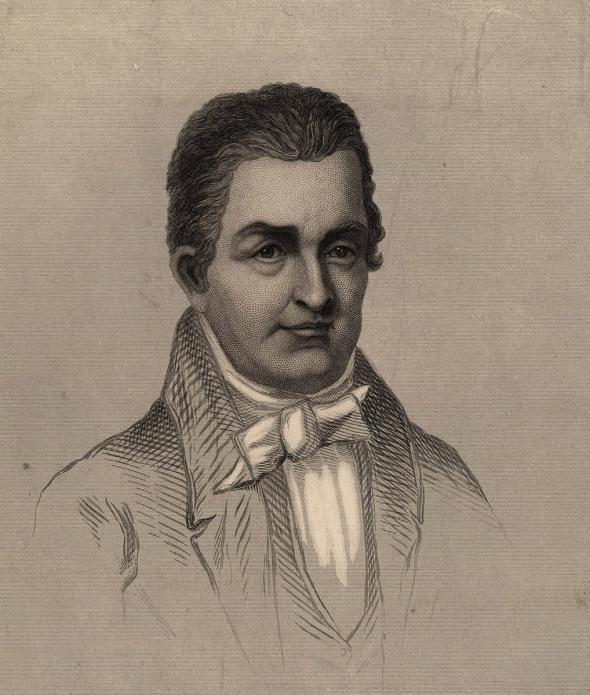
As is frequently the case, the newborn in question was beautiful only to its parent: Oliver Evans, a fifty-year old former wheelwright who had, in 1790, received the third patent ever issued by the United States of America.

His child, a steam dredge intended to clear mud out of the port of Philadelphia that he named Orukter Amphibolos (Greek for “amphibious dredger”) was built in a workshop more than a mile from the city’s harbor, so Evans gave his dredge not only wheels to travel down Market Street, but paddles to travel from the Schuylkill River to the Delaware: a locomotive, and a steamboat. Orukter’s July 1805 jaunt down Market Street and around Centre Square is firmly ensconced in the history of invention, and, for that matter, of Philadelphia, which celebrated the event’s bicentennial with a parade and reenactment.

Which doesn’t make it precisely true. The only engraving of the unlovely Orukter was produced decades after its 1805 journey. The dredge itself was junked and sold for scrap soon after. Evans’s subsequent recollections of the event were, to be charitable, erratic…as, indeed, was Evans himself, who spent a fair bit of his life loudly complaining that history had treated him shabbily.

A number of historians, including Steven Lubar of Brown University, have pointed out that his five horsepower engine might have found moving a 14 ton dredge a bit of a challenge (and the route described by Evans – downhill to the Schuylkill, with the current to the Delaware, and then with the tide to the port of Philadelphia, suggests that the engine had more than a little help).

The engine, however, is what actually mattered. Evans had spent ten years perfecting a new kind of steam engine, one in which water was boiled not by a coal fire underneath the water chamber, but inside it. The “vibrating steam engine” which Evans patented in 1804, and which featured a “boiler with the furnace in the center of the water enclosed in brick work…” as a means of increasing heat, and therefore pressure. Evans’s realization – that because higher heat equaled higher pressure, and therefore more work, heat and motion were just two ways of talking about the same thing – is at the center of every subsequent steam-powered engine, from Robert Fulton’s first steamboat to the steam turbines that still provide more than three-quarters of the world’s power.

Which is why, no matter how far the reality of Orukter Amphibolos departs from its legend, Evans is deservedly remembered as one of the greatest inventors America ever produced.

William Rosen is the author of The Most Powerful Idea in the World: A Story of Steam, Industry, and Invention. He can be reached at his website by clicking here.

IMAGE: Engraving of Oliver Evans, courtesy of the Smithsonian Institution

Congratulations to the following W & M winners of this book:

Marie, Jerry, and Audra

Related Posts:

  • Audra

    Oh, fascinating! That’s a re-enactment I would have loved to see!

  • librarypat

    I would have thought an event such as the dredge going through town would have produced articles and sketches . It is a bit suspect that decades later the first sketches were produced.
    From the size of the engine and the size of the craft it was meant to propel, It must have been a slow journey, even with downhill, current and tidal help. If it was the size stated, it must have been quite a site for the townspeople.
    The practical use of the steam engine was such a turning point around the world. It certainly opened the door for industrial, farm, and transportation development and growth.
    THE MOST POWERFUL IDEA IN THE WORLD certainly opened the door for rapid development and growth. Will be looking for it.

  • http://www.welshnepa.org Jerry Williams

    Oliver Evans’ contribution to young America’s founding was the equal of Jefferson or Washington. Without industry, ideas reach no realization. Explore Evans more deeply and you will find that his work was essential to food production, high pressure steam power for river boats, locomotives and America’s industry. His offerings on refrigeration preceded patents by more than a quarter century.

  • Rachel W.

    Thank you for the giveaway!!

  • Carol Wong

    Thank you for the giveaway.

  • http://www.txy.cz Patty

    I would have thought an event such as the dredge going through town would have produced articles and sketches . It is a bit suspect that decades later the first sketches were produced.From the size of the engine and the size of the craft it was meant to propel, It must have been a slow journey, even with downhill, current and tidal help. If it was the size stated, it must have been quite a site for the townspeople.The practical use of the steam engine was such a turning point around the world. It certainly opened the door for industrial, farm, and transportation development and growth.THE MOST POWERFUL IDEA IN THE WORLD certainly opened the door for rapid development and growth. Will be looking for it.
    +1

  • http://www.theburtonreview.com Marie

    I am always intrigued with the industrial revolution, and the people behind it. It is awesome to know that Oliver Evans is the owner of the third patent in the States.

  • http://www.wondersandmarvels.com Editor

    Thanks for the comments! the following are the winners of this book: Marie, Jerry, and Audra!

  • librarypat

    Congratulations to the winners.