Trapped…for your enjoyment of course Sir!

By Deborah Noyes

One of the three story strands in Captivity is set in the old menagerie in the Tower of London — where young Clara Gill, a zoological artist, meets the beast keeper Will Cross — on the eve of the zoo’s demise.

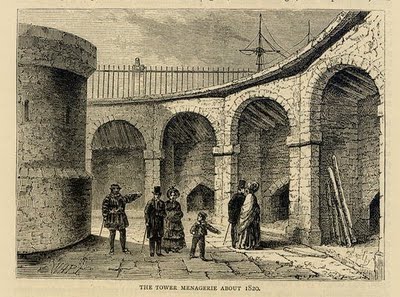
Like many royal menageries, the one in the Tower began as a private collection, a display of power and wealth. It evolved over 600 years and at various times displayed a rhinoceros, a giraffe, zebras, kangaroos, llamas, ostriches, alligators, and a hardy spaniel that one of the Tower lions adopted as a pet. During the realm of Henry III, a polar bear swam from a leash each day, fishing for its supper in the Thames.

By the eighteenth century, the menagerie was open to the public. To get in, you paid three half-pence, or you parted with a dog or a cat (i.e., lion food).

John Wesley, co-founder of the Methodist Church, once brought a flutist in to play for the lions. Do animals respond to music, he wondered; do they have souls? William Blake also visited the Tower menagerie to paint one of two resident tigers, which may have inspired his poem, “Tyger, Tyger.”

In England, animals had been displayed at carnivals and fairs since medieval times. Exhibits were often pits or boxes with metal bars, and by the nineteenth century — an age of imperial conquest when nature and the wild, like faraway nations, were there to be subdued —conditions had hardly improved.

After a beloved Indian elephant named Chunee was brutally killed during a bout of musth in London’s crowded Exeter Change menagerie, news stories, poems, plays, and engravings about the giant’s grim death (and life) finally got a newly scientific public talking about animal welfare.

By 1835, the year Clara and Will meet in the menagerie, the animals of the Tower were already being relocated to the new Zoological Society of London’s scientifically enlightened enterprise in Regent’s Park.

Deborah Noyes, author of Captivity, writes for adults and children, and is also an editor and photographer. She earned a B.A. in English from the University of Massachusetts and an MFA in Writing from Vermont College. She has taught writing and literature at Emerson College and Western New England College, and was a Visiting Writer in Lesley University’s MFA in Writing for Young People program. To Read more about the author and the book, please click here.
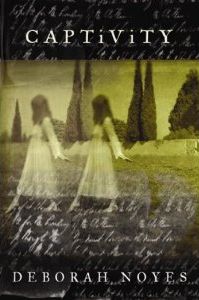
IMAGE: The Menagerie at the Tower of London, circa 1820.

Congratulations to the following W & M winners of this book:

Linda, Recca, and librarypat

Related Posts:

  • Linda Harkins

    We saw some of these pits for the manageries of the rich when we visited castles in Europe. The modern zoo that any of us can visit to see exotic animals is a much more humane habitat. I’m interested to know what the author thinks of captivity.

  • librarypat

    Zoos have come a very long way from the menageries of centuries ago. Now in many zoos the animals live in as close to a natural circumstances as possible. Hopefully they will inspire people to preserve the animal’s natural habitat so the wild population will be able to survive.
    Deborah, I visited your site. Your children’s books are lovely. The blurbs on CAPTIVITY have me curious about the direction it takes. I look forward to reading it.

  • Pingback: Ipod and its Wonderful Features | Internet Marketing is Nuts!

  • http://www.deborahnoyes.com Deb Noyes

    Thanks for these good comments, both. I was a zookeeper in Boston for a year and have mixed feelings about captivity (even wrote a book about it… at least in part about… One Kingdom: Our Lives with Animals). I realize conditions have improved dramatically in modern zoos with behavioral enrichment programs, etc. A zoo visit is as close to the wild as many human visitors ever get; if that visit makes the experience more real for them, less an abstraction, they’re more likely to feel something and champion conservation causes later. We referred to the animals on exhibit “ambassadors” — there to educate the public about pressing conservation issues. But we’re learning that for certain species (elephants, for example) captivity is too great a price. I can’t say I’ve answered this question for myself, on the whole, but it’s one I think about all the time.

    Appreciate the good words about my site. I hope you get a chance to read Captivity.

  • Rachel W.

    This looks so interesting! Thank you for the giveaway!!

  • Kimberly

    Ooo, a combination of religion, history of science, and London? What’s not to like?

  • Lindsey

    Sounds interesting. Not a topic that I know much about, but I’d love to learn.

  • reeca

    Interesting, very interesting. Thanks for the opportunity!!!

  • http://aseaofbooks.blogspot.com/ gwendolyn b.

    The novel sounds like one to get completely lost in – thanks for the chance to win a copy. As for the historical menageries — it’s an interesting point that entrance could be gained by providing “lunch” for the lions. I’ve always thought it was gruesome to feed mice to pet snakes — I just can’t imagine supplying a dog or a cat to a lion. Thank goodness that these days we can turn to Lion Chow ;-)

  • Sue

    Looks SO good. Thanks for the giveaway.

    s.mickelson at gmail dot com

  • Cheryl Smith

    This looks like a great read. I recently saw a science fiction movie in which the only animals left were those in zoos. Let us hope we wake up to the beauty of these animals in the wild before that happens. Cudos to the zoos for all the work they do to preserve these beautiful creatures and reintroduce them to the wild where possible. I look forward to reading about this era of “keeping”.

  • http://www.deborahnoyes.com Deb N

    Linda, I was a zookeeper in Boston for a year and found I had very mixed feelings about captivity (even wrote a book about it, or in part about, One Kingdom: Our Lives with Animals). Conditions have improved dramatically in modern zoos with behavioral enrichment programs, et al. For many human visitors, a zoo is as close as they’ll get to the wild, and if the experience changes them, if they go home with a sense of urgency, that can only be a good thing. Today animals on exhibit are often referred to as educational ambassadors, but I do think we’ve learned that for some species (elephants, for example), the price is too high. I haven’t answered this question for myself, but it’s important, and I know I’ll go on asking it.

    librarypat, thanks for your good words about my site.

    Thanks to all for these good comments. I hope some of you get a chance to read Captivity — and that you enjoy it.

  • http://www.wondersandmarvels.com Editor

    Thanks everyone! The winners of this book are: Linda, Recca, and librarypat!

  • Linda Harkins

    I’m excited to have won the book. How do I claim it? Please advise.

    Linda

  • http://www.wondersandmarvels.com Editor

    Hi Linda, we’ve been in touch via email and your book is on the way! Thank you!