By Stephen Fried
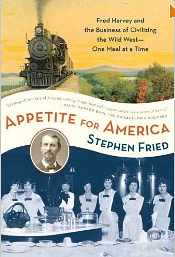
When I set out to write a book about Fred Harvey–who all but invented the American hospitality industry at his trackside restaurants and hotels between Chicago and Los Angeles along the Santa Fe–I thought I’d be writing a business biography set in the late 1800s, with some nice historical touches of the Wild West. It didn’t occur to me until about six months into the process that the story would actually have to extend two generations beyond Fred—all the way through the 1940s (when the physicists from Los Alamos used the Fred Harvey hotel, La Fonda, as their regular Santa Fe watering hole for successes and setbacks.) So instead of a historical biography, the book would need to be, for lack of a better term, a biographical history (which is why it took six years and not the two I promised my publisher.)
Fred, his son Ford, their top managers and the generations of their beloved waitresses, the “Harvey Girls” were afforded a birds-eye view of an enormous number of events in U.S. history that we often take for granted, and sometimes learn about pretty dryly. So I decided to recreate as many of the events that Fred and his employees experienced as I could, based on a new reading of original newspaper accounts (some on microfilm others, mercifully, now available on ProQuest) and then cross-referenced with the cache of never-before-seen Harvey family datebooks, correspondence and business files, as well as Santa Fe railroad archives.
From the manhunt for the escaped “Billy the Kid” in 1881 (a local celebrity in Las Vegas, New Mexico, where Fred had two restaurants and two hotels, which Billy sometimes patronized), to the Oklahoma Land Rush in 1889 (which left from the Arkansas City, Kansas Harvey House and Santa Fe depot), to the Chicago World’s Fair in 1893 (for which Fred helped cater the biggest lunch in American history for the opening ceremonies and parade), to the Rough Riders reunion in 1899 (held at the new Fred Harvey resort hotel, La Castañeda, in Las Vegas), to the development of the Grand Canyon as an international tourist attraction (Fred’s son Ford ran all the hotels at the canyon, and was a major player in the development of the national park system), to Teddy Roosevelt’s famed environmental address at the Canyon edge (which turns out to have been prompted, in part over a fight concerning the placement of the Harvey hotel there), to the first transcontinental air flights in 1929 (Fred’s grandson Freddy, a WWI pilot, was an original partner with Henry Ford, Charles Lindbergh, Glenn Curtiss and others in the company that became TWA; the first transcontinental air passenger meals were Harvey meals), to the Kansas City Massacre in 1933 (which took place in the Union Station where the Harvey company was headquartered, with bullets flying over the heads of Harvey Girls), to… well, the list really does go on.
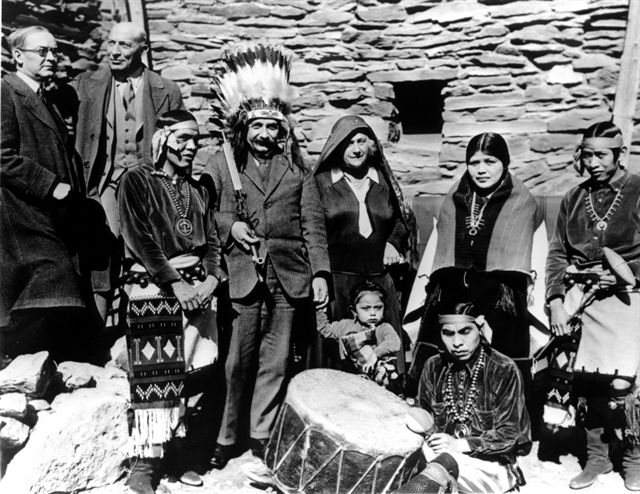
Probably my favorite historical recreation was Albert Einstein’s 1930 visit to America, which was highlighted by the day he came to the Grand Canyon, and was greeted by Hopi Indians he thought just liked him—and didn’t realize they worked for Fred Harvey. They wanted to make him an honorary chief—as they did for all visiting dignitaries—but they didn’t know who he was.
“What’s his business?” they asked their boss, Herman Schweizer, who ran the famed Harvey Indian art business.
“He invented the Theory of Relativity,” he replied.
“All right,” they said, “we’ll call him ‘Great Relative.’”
Stephen Fried is an award-winning investigative journalist and essayist, and an adjunct professor at Columbia University’s graduate school of journalism. He is the author of the highly praised books Thing of Beauty: The Tragedy of Supermodel Gia, Bitter Pills: Inside the Hazardous World of Legal Drugs, The New Rabbi, and Husbandry: Sex, Love & Dirty Laundry—Inside the Minds of Married Men. A two-time winner of the National Magazine Award–the Pulitzer Prize of magazine writing–Fried has been a prolific writer of feature stories and personal essays for various other publications. His new book, Appetite for America: How Visionary Business Man Fred Harvey Built a Railroad Hospitality Empire That Civilized the Wild West
IMAGE: Albert Einstein at the Grand Canyon with Fred Harvey employees, courtesy of El Tovar Studio, Fred Harvey Collection, Grand Canyon National Park