Who were the Guise?

By Stuart Carroll

Who were the Guise? Why write a book about them? The answer to the first question is simple. Everyone who has heard of Mary Queen of Scots knows them. Mary’s star certainly burned brightly for a brief while: she was queen of France for eighteen months, and claimed the thrones of England and Ireland, before setting sail for Scotland in 1561. But her star was not the sun around which her kinsfolk orbited. In the annals of the Guise family her existence values a few brief pages.

Today, Mary’s uncles and cousins are remembered, if at all, as bit players in the dramatic events of her life. I wanted to set the record straight and bring their remarkable story to wider public attention. But there was another reason for writing the book. In their day the Guise were held in awe throughout Europe. Admiring or appalled, none could ignore them. The story of their enmity with the great dynasties of Tudor, Habsburg, Valois and Bourbon is the story sixteenth-century Europe. The Guise shaped the course of European history: rising to prominence around mid century as one of Europe’s most powerful families before plunging France into bloody chaos, they refashioned the Catholic Church at the Council of Trent; plotted to invade England and remove Elizabeth I; and made and unmade the kings of France before ending the century as martyrs for the Catholic cause.

There was a further reason for writing the book. To understand the Guise is to understand the profound transformations that shook sixteenth-century Europe. Today’s religious fundamentalism and the conflict it entails make it imperative that we revisit the roots of Europe’s own religious violence. The word ‘massacre’ was first used in its modern context in sixteenth-century France and, as readers will discover, Europe’s Wars of Religion continue to reverberate across the centuries.

Stuart Carroll, author of Martyrs and Murderers: The Guise Family and the Making of Europe, has taught at the Universities of London and York, where he is currently Professor of History. He is twice-winner of the Nancy Roelker prize for the best essay written on early modern French History.

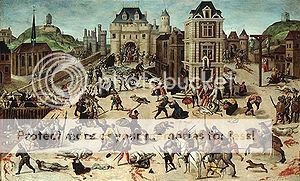
IMAGE: The Saint Bartholomew’s Day Massacre, which the Guise Family is widely believed to be partly responsible for, by Francios Dubois, c 1572-84

Related Posts:

  • http://thetruebookaddict.blogspot.com/ Michelle Miller/the true book addict

    I have been fascinated by this family since they made an appearance in one of my favorite historical films, Elizabeth. I’m going to have to check this out! Thanks for the info :)

  • http://edwardianpromenade.com Evangeline

    What’s funny is that I’ve read more than one historical romance set in the Elizabethan era which featured the Guises in a prominent role. I’ve always found them extremely fascinating–all the power they held and the schemes and double-deals that went on while Mary was on the throne. If I weren’t so caught up in the Edwardian era, I would certainly devote myself to studying this period in time.