Language is a really tricky issue in historical fiction. The point of historical novels is to transport your readers to another place and time, but chances are good that people in that place and time didn’t speak English. You have to communicate whatever language they did speak while not confusing your readers.
There are a couple of ways you can deal with the language issue in a historical novel. Some authors choose not to use any foreign words at all. The characters certainly don’t talk like modern Americans—their language tends to be more formal and stilted—but even if they’d speak Chinese or Latin in real life, the novel is entirely in English.
Personally, I dislike this approach—I think language is an essential part of a historical setting. I prefer to pick a few key words and phrases (five or six at most) and repeat them throughout the story. If there aren’t too many words, and if you clearly define them in context, your readers will understand them fine. Some authors use a larger number of foreign words and provide a glossary at the back of the novel. This technique can work, but I’m not overly fond of it because I find it annoying to flip to the back of the book every time I come across a word I don’t know.
So what do you think is the best way to cope with foreign languages in historical fiction? Should you use foreign words, and if so, how should you communicate what they mean? Or is it better to just abandon foreign vocabulary altogether and let the language come through in another way?
Melissa L. is the YA Editorial Assistant for Wonders and Marvels. You can read more about her here: Editorial Staff.
I think that the vocabulary of a foreign culture can be essential in communicating the ideas and history of that culture. There are many times when there are simply ideas that don’t have an exact English equivalent. Sure, there are translation, but it can sometimes be hard to capture all the meanings of a word or phrase. Explaining words and concepts like these are a essential part teaching about the history and culture of the area you are writing about.
For example, if you were to write a story about medieval Japan, you would probably use the word Samurai, not knight. You would probably also encounter terms like “bushido”the way of the samurai or “gaijin” an “outside person” or foreigner. Sprinkling in vocabularies like these add flavor.
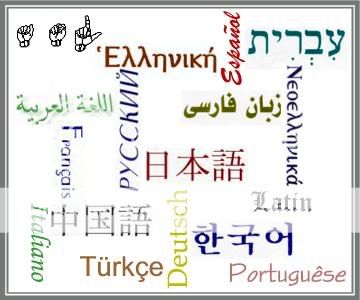
On a completely different note, the different scripts in your image have 日本語(Japanese Language) and 中国語(Chinese language) but these are both the Japanese terms. The Chinese word for the Chinese language is 中文 or 汉语
http://www.TeachingAuthors.com Carmela Martino
I’m struggling with this issue right now as I work on a historical novel set in 18th-century Milan. Of course, the characters in my novel speak Italian (or perhaps Milanese) to each other, but I am writing in English. I’ve chosen to include occasional Italian phrases to remind the reader that the novel really is set in Italy.
I ran into a similar issue when writing my first novel, which was about an Italian-American family in 1960s Chicago. In that novel, I included Italian phrases that were, for the most part, English cognates that I felt readers could readily decipher in context. However, because it was a book for children, I also included a glossary, which my editor happily included in the published book. I think dialogue is the trickiest part of writing historical and multicultural fiction. I’ve blogged a bit about why here: http://www.teachingauthors.com/2009/08/multicultural-dialogue-please-pass.html
http://www.hadleyjf.wordpress.com Hadley Ferguson
I teach middle school history and use historical fiction a lot to help my students understand the time period we are studying. I love the use of appropriate language of the time in the novels. My students also love learning and using the new and usually very different words. In African Mask by Janet Rupert, the use of the word “babalawo,” rather than diviner, totally creates a different sense of the Yoruba village.