Abigail Adams, Junk Bond Dealer

By Woody Holton

As I researched ABIGAIL ADAMS my most startling discovery was that the subject of my biography was not only a First Lady and proto feminist but a junk bond dealer. She bought up Revolutionary War bonds (many of which had been inveigled from the veterans of Saratoga and Valley Forge at a fraction of their face value) as low as 25 cents on the dollar. And she made a killing.

Even as John Adams denounced securities speculators and even used anti-Semitic language against them (they were “Jews and Judaizing Christians,” he said), he allowed his wife to turn him into one. In the end Abigail’s investment in distressed government assets (and her other financial ventures, which were also high risk and high yield) allowed the second president to die wealthy and debt free—a sharp contrast to his two successors, the Virginians Thomas Jefferson and James Madison, who died so deep in debt that their mansions (most notably Jefferson’s Monticello) had to be sold to satisfy their creditors.

Meanwhile Abigail’s success as a bond speculator emboldened her to assert unprecedented control over her household and her family’s finances. She even defied hundreds of years of statutes and judicial precedents by leaving a will, which married women were not actually allowed to do since they were not supposed to own property.

Abigail made token bequests to her two surviving sons, but the rest of her estate (worth about $100,000 in modern currency) went to women, several of whom were themselves married and thus not permitted to own property. Having spent the previous thirty years asserting ownership of a portion of her family’s fortune in defiance of the law, Abigail wanted to make it possible for these other women to make the same claim.

Woody Holton is an associate professor at the University of Richmond. A former finalist for the National Book Award, he received a Guggenheim Fellowship for Abigail Adams, which is just out from Free Press.

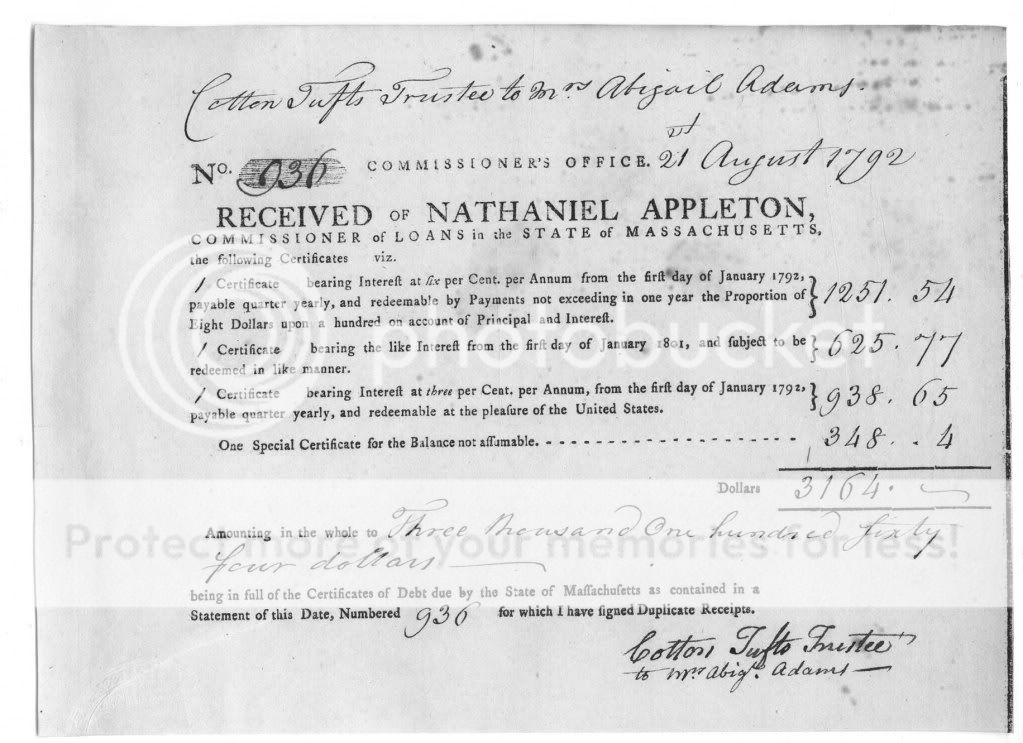
IMAGE: a Tufts Trustee receipt for Abigail Adams bonds dated August 21, 1792

Related Posts:

  • http://www.ulfelder.com Steve Ulfelder

    Mr. Holton, I just finished Paul C. Nagel’s John Quincy Adams biography and read David McCullough’s John Adams bio earlier this year. The authors’ views on Abigail Adams couldn’t be more different: while McCullough paints her affectionately as the rock who held the family together while her husband was off founding a country, I don’t think it’s too strong to say she comes across as shrewish and domineering in Nagel’s book. Do you agree, and if so, how do you reconcile the differing treatments?

  • Woody Holton

    Hi, Steve. I think your reading of Nagel and McCullough is exactly right: and that’s what makes Abigail Adams such a fun topic – different authors see her differently. McCullough is certainly right that she was often the family’s Rock of Gibraltar, but I think the depiction of her (esp. in the HBO version of McCullough’s book) is too benign. Actually she was at least as passionate as John. I think Nagel may have pushed his point a tad to far, but he is certainly correct that she could be quite controlling (of her kids, grandkids, husband, and others)–and Nagel deserves credit for being the first to make that controversial point. One thing I think Nagel (who was very generous to my own book in a Boston Globe review) should have emphasized more was that if AA was sometimes passive-aggressive, it was because women of the time were never allowed to be simply aggressive.

  • Alexandra

    Just wanted to say thank you to Mr. Holton for writing this book. I’m not too far into it yet, but I like its even-handedness and its ability to go beyond simply glorifying the Adamses’ marriage in itself. I think too many books supposedly about her still unintentionally fall into the trap of not making her the single protagonist. I really agree with your opinion of the Abigail character in the HBO series – I loved the series overall but thought a lot the characterization of a lot of the characters was a bit off, with Franklin reduced to spouting off his famous aphorisms, Jefferson being far more forceful than he seemingly was, and Hamilton reduced to a dull caricature who lacked charisma.

    I haven’t read the Nagel JQA biography in question, but I’d just like to mention that it’s unfortunate that she apparently comes across as a “shrew” in that book. I know I’m playing the “gender card” to some extent, but I think some would see her “controlling” behavior in less of a negative light if such behavior was perpetrated by a man – when Abigail was forceful in her advice, she’s shrewish, but when a father of that time was, he was simply being dutiful.

  • http://unabridged-expression.blogspot.com/ Audra

    Oh, I need to read this book! My wife and her family live by the Abigail Adams house, and I’m often regaled with stories about her. Now I can return the favor!